
Behind the film
- Year
- 1960
- Director
- Vittorio De Sica
- Writers
- Cesare Zavattini
- Runtime
- 1h 40m
- Genres
- Drama, War
- Production
- Compagnia Cinematografica Champion
- Country
- France, Italy
- Cast
- Sophia Loren, Eleonora Brown, Jean-Paul Belmondo, Raf Vallone, Carlo Ninchi, Emma Baron, Andrea Checchi, Pupella Maggio
About the film
Contains story spoilers.
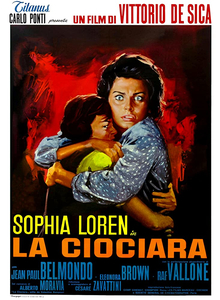
Two Women approaches war through the task of keeping a child safe, a responsibility that can become overwhelming when no surrounding institution offers reliable protection. Sophia Loren plays Cesira, a widowed mother who tries to move her daughter Rosetta away from immediate danger. Vittorio De Sica directs the adaptation of Alberto Moravia’s novel, with a credited screenplay by Cesare Zavattini. The film’s perspective is civilian rather than strategic. A change in the course of fighting matters because of what it may allow the women to do, not because it completes a military story. Their decisions are made within uncertainty, with survival depending on information, shelter and the people encountered along the way.
Cesira and Rosetta leave Rome for the countryside, where the younger woman develops an attachment to the intellectual Michele. He is later taken away by German soldiers. After Rome’s liberation, mother and daughter attempt to return, but soldiers assault them in a church. Rosetta becomes withdrawn, and Cesira struggles to understand how to reach her. The discovery that Michele has been killed eventually brings the daughter to tears, and the film ends with Cesira comforting her. That final closeness offers a moment of connection after trauma, without establishing that the violence has been repaired or that either woman can simply return to her earlier life.
Cesira’s practical energy gives the journey a distinctive centre. She has to decide where to go and whom to trust while managing the needs of someone dependent on her. Those choices cannot be made from a position of complete knowledge. The film places maternal determination inside a world that repeatedly exceeds it, making courage visible without treating courage as a guarantee. Loren’s role carries both the force required to keep moving and the fear that movement may not be enough. The title’s emphasis on the pair matters here: the story follows a relationship under pressure, not an isolated heroine whose resourcefulness can settle every danger she faces.
The countryside initially changes the appearance of the problem. Leaving a bombed city can seem like leaving the war behind, because danger has been associated with a particular place and form of attack. The rural setting exposes the incompleteness of that association. Fighting alters movement, relationships and access to safety far beyond the places visibly destroyed. A quieter environment can offer relief without becoming secure. The film uses that change of surroundings to distinguish temporary shelter from an actual end to vulnerability. Cesira’s home region is familiar, but familiarity cannot prevent forces larger than the local community from entering it.
Michele provides another kind of relationship within that temporary refuge. His importance to Rosetta gives the displacement a connection that is not simply a matter of shelter or supplies. A child can find reassurance in a person even when the adults around her cannot reassure her about the world. That attachment makes his later absence consequential beyond the mechanics of a wartime incident. The film allows the rural period to contain feeling and possibility, which means its losses cannot be described only as another stage of hardship. What disappears is something the characters had begun to depend on, giving the eventual news an intimate weight.
The assault breaks any comfortable equation between liberation and personal safety. A military development can be favourable at one scale while danger persists, or takes a new form, for civilians within it. The film makes that contradiction devastatingly direct without requiring the women’s experience to stand for every experience of the campaign. Its focus is on what has happened to them and what follows between them. The church’s association with refuge adds another failure of protection. A place that should permit vulnerability becomes a place where vulnerability is exploited, leaving Cesira’s attempt to bring her daughter home entangled with a loss no destination can undo.
Rosetta’s withdrawal also reveals the limits of Cesira’s familiar ways of responding. A mother may know how to feed, shelter or discipline a child while finding those actions inadequate to reach someone altered by trauma. The daughter’s changed behaviour cannot be understood simply as disobedience or an ordinary stage of growing up. The difficulty is painful because closeness previously supplied Cesira with a sense that she could recognise what her child needed. Now recognition itself has become uncertain. The film’s later tension lies within that damaged communication, asking how care can continue when the person being cared for no longer responds through the signs the carer expects.
The final embrace makes grief something mother and daughter can share again, while refusing the scale of a conventional triumphant conclusion. Their connection matters precisely because it does not erase what has happened. Two Women keeps the consequences of war within bodies, attachments and the difficult work of remaining present for someone else. Its movement from flight to temporary refuge and then to a devastated return shows how inadequate a simple map of safe and unsafe places can become. The film ends with the women together, but the meaning of togetherness has changed: protection can no longer mean preventing every injury, and care has to find a way to remain after protection has failed.