
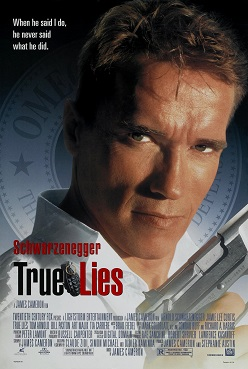
Behind the film
- Year
- 1994
- Director
- James Cameron
- Writers
- James Cameron
- Genres
- Action, Spy, Thriller, Romantic comedy
- Production
- Lightstorm Entertainment, Universal Pictures, 20th Century Studios
- Country
- United States
- Cast
- Arnold Schwarzenegger, Charlton Heston, Jamie Lee Curtis, Bill Paxton, Eliza Dushku, Tia Carrere, Tom Arnold, Art Malik
About the film
Contains story spoilers.
True Lies builds its action comedy on a lopsided arrangement of knowledge. Harry Tasker can navigate danger professionally while remaining remarkably inattentive at home, where the identity he presents to his family keeps them from understanding his absences. James Cameron makes that imbalance part of the spectacle: Arnold Schwarzenegger's imposing competence belongs to one life, and the ordinary obligations he mishandles belong to another. The joke is not simply that a supposedly dull man has an exciting secret. It is that excitement has become a resource he controls, leaving the people nearest to him with a version of their shared life they never had the information to choose.
Harry works for Omega Sector while Helen and Dana believe his business trips concern computer sales. Investigating terrorist Aziz brings him into contact with art dealer Juno, but his attention shifts when Helen meets Simon, a salesman pretending to be a spy. Harry uses his agency's resources to investigate and stages a secret mission for her. Real terrorists interrupt it, capturing the couple and exposing his deception. Aziz's group has smuggled nuclear warheads into Florida. Harry escapes, rescues Helen from a limousine at a collapsing bridge and then uses a Harrier to save their abducted daughter from a Miami skyscraper. Aziz dies in the final attack. A year later, Harry and Helen work together as agents, replacing his compartmentalised marriage with an exaggerated fantasy of shared adventure.
Jamie Lee Curtis's Helen gives the domestic side its own frustrated energy. Wanting something more vivid than routine is not the same as understanding what Harry actually does, and the gap between those desires gives their exchanges their tension. Curtis makes awkwardness active rather than merely decorative: embarrassment, curiosity and determination can pull in different directions within a moment. The film's romantic logic depends on recognising that she has a life of feeling beyond the role her husband assumes she occupies. That recognition arrives through a plot that also lets him manipulate her. The comedy therefore carries an uncomfortable question about whether being loved grants someone the right to manage the terms on which another person encounters the world.
Bill Paxton's Simon provides a smaller, shabbier variation on Harry's double life. The attraction of an exciting identity becomes visible when it is being used as a sales pitch. Paxton's performance makes confidence conspicuously constructed, while Schwarzenegger's physical authority lets Harry's own performance appear less artificial. Setting the two alongside each other complicates the opposition between genuine hero and obvious fraud. Their purposes differ, but both rely on what someone else has not been told. The comic rivalry exposes how readily jealousy turns the question away from honesty and toward possession. Harry can identify another man's deception while remaining remarkably comfortable with the arrangement he himself has maintained.
Tom Arnold's Gib gives that discomfort a conversational rhythm. His practical responses bring the professional partnership close to the familiar sound of friends discussing a relationship, even while the surrounding resources are wildly disproportionate. That contrast is central to the film's exaggeration. The machinery of national security can be redirected toward a private insecurity because the story lets Harry's feelings become the centre of every available system. The resulting absurdity does not make the intrusion harmless. It shows how action comedy can encourage identification with a protagonist's confidence while leaving room to notice that the confidence sometimes depends on other people being denied an equal position in the encounter.
Cameron's action changes the scale without losing this pattern of uneven knowledge. The film moves from concealed identities and controlled settings into situations where the family has to respond to danger directly. Its large physical spaces give movement a clear purpose: reaching someone, escaping an enclosed threat, crossing a gap or keeping pace with a vehicle. The action is a fantasy of capability, with machines extending what Harry can accomplish, but the people being rescued remain important to its shape. A spectacular solution is emotionally legible because the distance being overcome is also a distance between family members. The film repeatedly turns that relationship into a problem of bodies in space.
The villains belong to a broad and often crude action-film construction of threat. Art Malik's Aziz and Tia Carrere's Juno create an opposing network against which the hero's ingenuity can be displayed, but their theatrical presentation should not be mistaken for information about actual cultures or political movements. The film favours an exaggerated contest over a grounded account of espionage. That choice sits beside the exaggeration of domestic life: both the agency and the marriage are organised to support a fantasy of hidden competence suddenly becoming visible. Its tensions are easier to understand when the spectacle is allowed to remain spectacle, without treating Harry's authority or the enemy's caricature as a neutral picture of the world.
The central attraction is the collision between the heroic self-image and the intimate relationship that self-image has kept at a distance. Schwarzenegger and Curtis give the collision different physical registers, one built around assurance and the other around discovery. The film ultimately imagines excitement as something a couple can share, but the route there leaves questions about trust that a grand rescue cannot entirely answer. Its title captures the coexistence of capability and dishonesty: Harry's extraordinary work is real inside the story, while the life he has explained to his family is false. The comedy and action develop from what happens when those two claims can no longer be kept in separate rooms.