
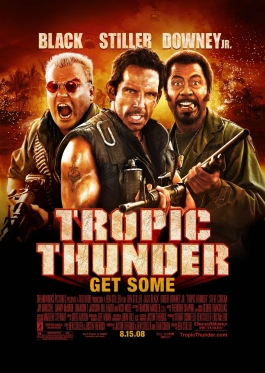
Behind the film
- Year
- 2008
- Director
- Ben Stiller
- Writers
- Justin Theroux, Etan Cohen, Ben Stiller
- Genres
- Parody, Action, Comedy
- Production
- Red Hour Productions
- Country
- United States, United Kingdom, Germany
- Cast
- Ben Stiller, Robert Downey Jr., Jack Black, Jay Baruchel, Brandon T. Jackson, Nick Nolte, Tom Cruise, Matthew McConaughey
About the film
Contains story spoilers.
A troubled war-film shoot leads director Damien Cockburn to drop his actors into the jungle, where a real land mine kills him. Tugg Speedman assumes the death is staged and keeps treating events as scenes. The group encounters the Flaming Dragon drug gang; Tugg is captured while his colleagues realise their danger. Supposed veteran Four Leaf Tayback admits that his memoir is fabricated. Studio executive Les Grossman prefers an insurance payout to rescuing his star. Kirk Lazarus, Alpa Chino, Jeff Portnoy and Kevin Sandusky use the script to organise a rescue. They escape across a bridge with the prisoners, and Tugg's agent Rick saves their helicopter by intercepting a rocket with a TiVo box. Hidden-camera footage becomes a successful film, earning Tugg an Academy Award.
The central joke depends on people treating their professional image as a reliable description of the world. An actor can be accustomed to arriving with authority because the surrounding production has been organised to support that authority. Remove the organisation and the confidence may remain long after its practical basis has disappeared. Ben Stiller's film uses that gap to turn the action hero into someone poorly equipped for action. The mistake is more revealing than simple stupidity. It arises from a life in which difficulties are normally arranged around the star, given a narrative purpose and eventually converted into proof of his importance. Real danger has no obligation to respect those arrangements, which makes the performers' habits both ridiculous and dangerous to the people nearby.
Tugg's insecurity gives the satire a more specific target than celebrity vanity alone. A familiar public identity can become a trap when the person inhabiting it needs recognition from a different audience. Wanting to be taken seriously does not necessarily produce a serious understanding of anything beyond the self. Stiller's character therefore turns professional anxiety into a way of misreading experience. He seeks a meaning that will redeem his reputation, even when a clearer reading would require him to admit how little control he has. The film can make that need pitiable without allowing pity to become an excuse. His ambition matters because it keeps directing attention inward, towards what an event might do for his career, when survival requires attention to circumstances and people outside that career.
Kirk Lazarus pushes the same problem into the ethics of performance. Robert Downey Jr. plays an actor using blackface to portray a Black soldier, with an exaggerated commitment to inhabiting that persona. The satire depends on the distance between an artist's claim to transformation and his willingness to recognise another person's perspective. That does not make the imagery neutral or remove the discomfort built into it. Brandon T. Jackson's Alpa Chino supplies an opposing presence within the ensemble, challenging the idea that artistic intensity automatically confers understanding. Their tension asks who gets to claim authority over an identity and who has to endure the claim. The useful distinction is between the depth an actor announces and the attention he actually gives to someone who can question the performance.
The film's disability caricature raises a related difficulty. Its fictional prestige acting is designed to expose a star's calculating pursuit of acclaim, but the representation used to make that argument can still be troubling. Explaining the satirical target does not require pretending that everyone will experience the joke in the same way. What connects these strands is the industry's habit of turning difference into an opportunity for someone else's recognition. A performer can describe the result as brave while remaining chiefly concerned with the reward attached to it. The comedy repeatedly tests that vocabulary of seriousness. It asks whether an elaborate claim of commitment has any meaning when the person making it treats other lives as material rather than as perspectives capable of resisting his interpretation.
The ensemble also gives competence a quieter alternative. Jay Baruchel's Kevin lacks the grandest persona, making his place in the group useful to a comedy about people who confuse status with knowledge. Jack Black's Jeff brings another kind of professional insecurity, while Nick Nolte's Four Leaf turns authoritative storytelling into a problem of trust. Their different weaknesses prevent the jungle from becoming merely one star's lesson in humility. Each participant has some habit that worked within a protected professional environment and now interferes with a collective response. The group has to discover a practical relationship with one another, however imperfectly. The familiar language of a film production becomes useful only when they stop assuming it can explain everything happening around them.
Tom Cruise's Grossman widens that argument beyond the performers. The studio world can reduce a person to an asset whose value changes according to the available transaction. Its apparent rationality is grotesque because it uses calculation to detach itself from responsibility. That makes the comedy about a system as well as a collection of egos. Hollywood's capacity to package an experience remains active even after the experience has exposed how inadequate its assumptions were. Tropic Thunder uses action spectacle to test that capacity from inside the spectacle itself. Its ending leaves an uncomfortable question beneath the success: if an industry can turn its failures into further proof of its importance, how much has it really learned about the people and realities it uses?