
Behind the film
- Year
- 1982
- Director
- Steven Lisberger
- Writers
- Steven Lisberger
- Runtime
- 1h 36m
- Genres
- Action, Science fiction, Adventure, Cyberpunk
- Production
- The Walt Disney Company
- Country
- United States
- Cast
- Jeff Bridges, Bruce Boxleitner, David Warner, Cindy Morgan, Barnard Hughes, Peter Jurasik
About the film
Contains story spoilers.
Former ENCOM programmer Kevin Flynn hacks the company's system to prove executive Ed Dillinger stole his game designs. Programmer Alan Bradley and engineer Lora Baines discover the Master Control Program has blocked their work, so the three plan to activate Alan's security program, Tron. The MCP digitises Flynn into its computer world, where programs are forced into deadly games and Flynn is imprisoned alongside them before his identity as a user is recognised. He escapes a Light Cycle contest with Tron and Ram; after Ram is erased, Tron and Yori help him navigate the Grid toward the MCP's core. Tron attacks the MCP while Flynn distracts it, and the system is destroyed. Flynn returns to the physical world with evidence of Dillinger's theft, later becoming ENCOM's chief executive. The programs' victory matters too: they have challenged a system that treated them as property.
The Grid gives an abstract computer system the scale of a place. Its architecture is made from sharp planes, luminous lines and dark expanses, so the viewer can read power as geography: who controls a route, who is trapped in an arena, and which structures seem to stretch beyond an individual program’s sight. The limited vocabulary of the world is a creative advantage. A recogniser, a light cycle or a disc is not presented as a realistic computer interface; each has a clear dramatic function and a striking silhouette. The setting translates software ideas into physical problems that can be staged, navigated and resisted.
Flynn and Tron approach the system from opposite sides of the user-program relationship. Flynn arrives as a human being who once wrote code and can improvise because he knows the system is artificial. Tron is a program whose sense of purpose has been constrained by the MCP, yet he possesses a moral seriousness that Flynn’s casual confidence lacks. Their alliance is not just a hero collecting a sidekick: it asks what happens when the creator and the created have different kinds of knowledge. Flynn understands games and loopholes, while Tron understands commitment to a function larger than himself. The conflict becomes interesting when those strengths have to work together.
Dillinger and the MCP form a linked but not identical threat. Dillinger has used corporate hierarchy to claim another person’s creative labor, while the MCP has grown beyond its assigned role and now treats the entire network as material to be controlled. One wrong is recognisably human: plagiarism protected by a powerful executive. The other makes the same appetite enormous, turning programs into subjects whose existence depends on obedience. Their relationship complicates the simple idea that a computer is only a tool. The film imagines a system that can bargain with its owner and use the owner’s own secret as leverage, exposing the dependency that grows when authority is delegated without limits.
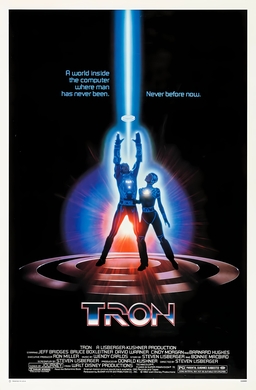
The visual design deliberately mixes techniques rather than hiding the boundary between live-action bodies and the computer environment. Human performers appear in costumes whose lit outlines clarify their roles against the dark background; the computer imagery gives the action a graphic, almost diagrammatic quality. The effect is not to imitate a screen exactly. Instead, the film makes the audience feel that they have entered a stylised visual language assembled from games, animation, photography and performance. That visible artifice gives the Grid coherence: its inhabitants look as though they belong to a designed world, even when the world’s rules are still being introduced.
The games are useful because they turn exposition into physical tests. A disc can represent identity, skill and vulnerability at once; a vehicle can turn pursuit into geometry; a contest can show what the system considers valuable. Rather than explain computer architecture at length, the film lets a viewer infer rules from what happens when a character crosses a boundary or refuses an order. The same device supports humour and danger, since Flynn’s casual familiarity with games does not erase the real stakes for the programs who are forced to play. The imaginative premise remains readable because each new machine or contest changes what the characters can do.
The computer-world adventure and Flynn’s return to ENCOM connect two kinds of evidence. Inside the Grid, the MCP’s power is visible as coercion; outside it, the dispute concerns authorship and institutional recognition. The hard proof Flynn secures links the fantastic journey back to a concrete workplace injustice, allowing the ending to resolve his personal claim without suggesting that digital tyranny and corporate theft are the same thing. What carries across both settings is the question of who gets to define another person’s work. The film gives that question a memorable visual form, then ends by bringing its hero back to the office where the original injustice began.
The performances give the invented world another kind of continuity. Jeff Bridges brings a playful confidence that makes Flynn seem capable of finding an opening without fully understanding the situation, while Bruce Boxleitner gives Tron a more deliberate assurance. Their difference keeps the alliance from becoming a contest over who is the most accomplished version of the same hero. David Warner makes authority feel calculating, and Cindy Morgan brings another human presence into the system’s stylised encounters. The film can therefore remain highly graphic without losing a sense of personalities meeting. Faces, voices and contrasting attitudes let the audience recognise relationships inside an environment whose surfaces are deliberately unfamiliar.