
Behind the film
- Year
- 2010
- Director
- Joseph Kosinski
- Writers
- Edward Kitsis, Adam Horowitz
- Runtime
- 2h 7m
- Genres
- Science fiction, Action, Cyberpunk
- Production
- Walt Disney Pictures, Sean Bailey Productions
- Country
- United States
- Cast
- Jeff Bridges, Garrett Hedlund, Olivia Wilde, Bruce Boxleitner, Michael Sheen, James Frain, Beau Garrett, Serinda Swan
About the film
Contains story spoilers.
Sam Flynn investigates a message from his missing father and is digitized into the Grid, a computer world ruled by CLU, a younger digital copy of Kevin. Sam survives the Games with help from Quorra, who takes him to Kevin’s hideout. Father and son join her to reach the portal back to the real world, but CLU wants Kevin’s identity disc to escape and impose his idea of perfection. After allies betray them and Quorra is captured, the group fights its way to the portal. Kevin reintegrates with CLU to destroy the program, sacrificing himself; Sam and Quorra escape with the disc and return to the arcade before setting out into the real world.
The Grid is a designed environment with rules that feel physical to the people inside it. Programs have bodies, uniforms, ranks and routines, while their identity discs carry both personal history and access. Sam’s arrival as a human user disrupts a system that has spent years under CLU’s control. The film treats computer logic as a social order: obedience, classification and the pursuit of a supposedly perfect system affect who can move freely and who is reduced to a function.
Sam and Kevin’s relationship is the emotional structure beneath the chase. Sam’s rebellion against ENCOM and his decision to investigate the arcade come from a long absence he has never been able to resolve. Kevin, in turn, has lived inside the Grid with the consequence of his own ambition. Their reunion cannot instantly restore the years lost; they have to negotiate distance and regret while the danger around them keeps accelerating. Garrett Hedlund’s impatience and Jeff Bridges’s older, quieter presence give that gap a visible form.
Quorra is more than a guide who knows the terrain. She has her own curiosity about the world beyond the Grid and her own stake in the fate of the programs who live there. Her loyalty to Kevin coexists with a willingness to help Sam question what he has inherited. Olivia Wilde plays her as observant and direct, a person whose energy contrasts with the system’s rigid binaries. As the last surviving ISO, she makes CLU’s project of erasure personal rather than theoretical. Her decision to leave the Grid also means that the escape is not simply Sam retrieving his father’s legacy; it offers a new life to someone who has never seen the world she is entering.
CLU’s idea of order is a warped inheritance from Kevin. Jeff Bridges’s performance and the digital image create a double presence, but the distinction between the two is not simply age or appearance: one has changed through experience, while the other repeats an instruction that cannot accommodate difference. The conflict therefore centers on a creator confronting a system built from his own design. When CLU rejects living variation as imperfection, the film turns a technical goal into a political one, with conformity enforced as a virtue.
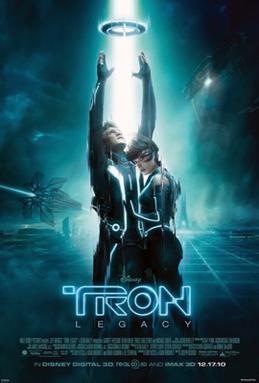
The film’s visual design emphasizes light against deep shadow, especially through the glowing lines built into the characters’ suits. The illuminated costumes shape how the sets are lit, letting bodies appear to generate their own environment. Instead of presenting the Grid as a flat screen, the image gives its arenas, vehicles and architecture weight. The racing and combat sequences remain readable because color, direction and sharply bounded surfaces distinguish movement within a dark space. Their practical illumination also makes the actors seem embedded in the same visual system as the vehicles and architecture, rather than simply composited over a digital background.
Sam’s route through the Grid carries the look of an adventure game but does not reduce every encounter to a new level. The Games establish CLU’s public spectacle; the hideout introduces a smaller space where Kevin can teach and remember; the club creates a crowded social zone where a supposed ally can reveal another identity. Each setting tests a different kind of trust. That variety makes the journey feel like a changing society, not just a string of arenas with increasingly elaborate machines.
Kevin’s final choice resolves the conflict by joining himself to the copy he once created. Reintegration destroys CLU and costs Kevin his life, while a switched disc allows Quorra to survive and travel with Sam through the portal. The sacrifice is not a clean victory over technology: it is a parent accepting responsibility for a creation that has become harmful. Sam’s return to the arcade brings him back to the place where his search began, but his decision to face ENCOM and leave with Quorra places the next step in the human world. That choice connects the digital journey to Sam’s opening act of releasing the company’s operating system. He began by challenging ownership from the outside; now he intends to take part in the institution’s future, with Alan in a leadership role. Quorra’s first experience of the real world is framed through light and open air, giving the ending a human scale after the Grid’s closed geometric arenas.