
Behind the film
- Year
- 2020
- Director
- Walt Dohrn, David P. Smith
- Writers
- Jonathan Aibel, Glenn Berger, Maya Forbes, Wallace Wolodarsky
- Runtime
- 1h 34m
- Genres
- Musical, Animated, Family, Adventure
- Production
- DreamWorks Animation
- Country
- United States
About the film
Contains story spoilers, including the ending.
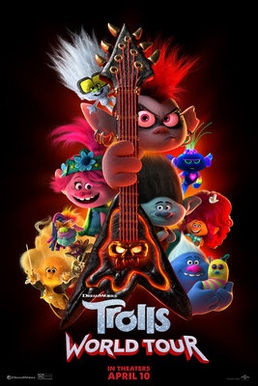
Trolls World Tour sends Poppy and Branch beyond Pop Village into communities whose music challenges Poppy's assumptions. In the 2020 animated sequel, Barb collects six magical strings so she can turn every tribe into Hard Rock Trolls. Poppy initially thinks a shared celebration will solve their differences, but her attempt to cheer up the Country Trolls ignores the music they actually value. In Vibe City, Prince D tells her that the Pop Trolls once tried to impose their own sound on everyone. That fictional history gives her optimism an uncomfortable blind spot. At Barb's concert, Poppy destroys the guitar holding the strings, briefly leaving the trolls without music or colour. Cooper's heartbeat starts a new rhythm, and the assembled voices restore both. Their solution comes from making music together while allowing the different communities to keep their own voices.
Director Walt Dohrn and co-director David P. Smith developed the sequel around music as the subject of the adventure. Dohrn wanted new worlds and characters rather than a return to the first film's most familiar jokes. The songs had to move the story forward while giving the animators something concrete to work with. Executive music producer Ludwig Göransson and Joseph Shirley supplied rough demos, which editor Nick Fletcher could combine with storyboards. Familiar tracks could also serve as temporary guides while the team worked out what a sequence needed. Justin Timberlake and his collaborators developed original songs from story ideas pitched by the filmmakers. Some animation began with the rhythm established before the complete recording was ready, then had to be refined around the finished music. Dohrn described that scheduling problem as a balancing act: a song could change while artists were already building movements to its beat. The musical numbers grew through repeated exchanges between musicians, editorial and animation.
The lands share a handmade character while using different materials to establish their identities. Production designer Kendal Cronkhite Shaindlin and art director Timothy Lamb organised a library of fabrics for each region. Hard Rock architecture drew on leather, stitching and fishnets, with torn denim suggesting window openings. Lonesome Flats began with Cronkhite Shaindlin's impression of farmland seen from an aircraft as a patchwork quilt. Its country landscape uses earthy colours, burlap and twine, which becomes substantial rope beside a tiny troll. Textile artist Natalie Miller made physical reef models using wire, foam and balsa wood covered with woven and knotted fibres. Those objects supplied references for the underwater Techno world. The surfacing team also built a scanner to study materials from different angles. Threads and loops required actual geometric detail rather than a flat fabric image placed over a smooth object. The settings were designed from their materials outward, so a new musical destination also meant a new way of constructing the landscape.
Visual effects supervisor Matt Baer described the opening underwater concert as a sequence distributed across nearly every animation department. Effects artists supplied organza bubbles, lasers and moving light patterns in the macramé environment. Crowd movements drew on the changing shapes of audio waveforms, shifting from rolling motion to sharper gestures as the music approached a beat drop. Hair could move naturally in one shot and take on more graphic shapes in another, while yarn anemones followed the rhythm. The film's water also needed a different kind of physical reference. Artists built a miniature set and used an air gun to launch organza, glitter and tinsel, filming the results close up and at high speed. The computer simulations then needed adjustable timing to capture small pieces of fabric without being trapped by their real behaviour. Lighting brought those separate movements into a common image, with the concert depending on coordinated motion throughout the environment.
Dohrn linked the six main musical communities to the six strings of Barb's guitar. That story device set a limit on how many large destinations the adventure could accommodate. A musicologist advised the production on genre relationships and the language used in the story, while smaller groups allowed reggaeton, K-pop, smooth jazz and yodelling to enter the journey. The selection is part of the film's invented world rather than a complete map of music. Dohrn also described a recurring heart motif, beginning with a heartbeat beneath the water and returning across the different locations. Chaz's smooth jazz fantasy takes a deliberately different visual direction: the artists were asked to imitate the awkward appearance of a bad cable television show. That interruption makes room for surreal comedy inside an adventure otherwise heading toward the scale of a concert finale.
The colourful imagery also draws on Dohrn's affection for Yellow Submarine and Fantasia. He associated the former with the atmosphere of the late 1960s and his own childhood in the following decade. Musical guests contributed more than recorded lines. George Clinton advised the filmmakers, and Dohrn wanted to bring something of Parliament's album artwork into the film. The team also attended concerts by Clinton and conductor Gustavo Dudamel. Dohrn said personal memories of punk clubs and other live performances fed the imaginary settings. Making the rock community the opposition was a choice the production discussed carefully: he wanted an antagonist without declaring an entire kind of music bad. Different personalities within that community helped keep Barb's campaign from becoming the only thing its members could represent.