
Behind the film
- Year
- 2017
- Director
- Michael Bay
- Writers
- Art Marcum, Matt Holloway, Ken Nolan
- Genres
- Science fiction action
- Production
- Paramount Pictures, DreamWorks
- Country
- United States
- Cast
- Mark Wahlberg, Stanley Tucci, Isabela Merced, Josh Duhamel, John Turturro, Laura Haddock, Anthony Hopkins, Santiago Cabrera
About the film
Contains story spoilers.
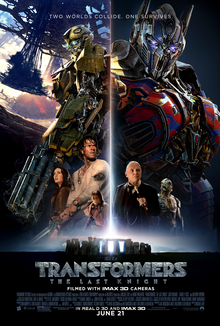
The Last Knight brings the Transformers universe into contact with a much older collection of heroes and legends. Its appeal depends on taking that improbable connection seriously inside the fiction: an ancient story can become evidence, and a legendary object can become a working part of an alien technology. The result is a quest in which knowing what an object means matters as much as being able to fight over it. Meanwhile, a familiar protector becomes a source of danger. The two movements reinforce one another, making established identities and inherited stories unstable just when the characters need something dependable to guide them through the threat. A prologue places Transformers beside King Arthur, whom Merlin helps after receiving a staff from the Knights of Iacon. In the present, Cade Yeager hides Autobots from a human task force while Optimus Prime is manipulated by Quintessa into retrieving that staff. Historian Edmund Burton recruits Cade and Oxford professor Viviane Wembly, Merlin’s descendant, to locate it. They learn that Earth is Unicron and Cybertron is using the staff to restore itself by draining the planet. The human and Autobot group assaults Cybertron, Viviane removes the staff, and the worlds survive the attempted transfer.
The film’s central pleasure is the collision of toy mythology with an invented history of Earth. Its opening makes the franchise’s ancient past literal, placing mechanical knights beside medieval legend rather than treating the robots as recent visitors. That move gives the present crisis a long, mythic prehistory, while also showing how freely the series reshapes historical icons to serve its own universe. Merlin’s staff becomes the hinge between periods: a legendary object that can be treated as weapon, power source and key. The film’s world-building is therefore a sequence of imaginative links rather than a realistic historical account.
Cade’s role connects the large mythology to a practical human scale. He is an inventor and a protector of Transformer refugees, living in a world where those beings are increasingly hunted. His junkyard becomes a fragile sanctuary filled with improvised repairs and uneasy coexistence. The setting fits his character: useful things are salvaged, and loyalty is expressed through giving shelter. Mark Wahlberg’s performance keeps Cade’s urgency direct and physical, helping the story return to one person’s decisions when the plot expands to planetary stakes.
Viviane introduces a second kind of competence. She is an Oxford professor whose academic knowledge becomes essential once the staff and Merlin’s lineage enter the plot. The film places her scholarship beside spectacle, asking a literary historian to interpret a world where myth has a technological basis. Laura Haddock’s character is also drawn into action, so expertise becomes something exercised under pressure rather than confined to explanation. Her presence expands the human ensemble beyond soldiers and inventors, although the story still uses her ancestry as the mechanism that connects her to the artifact.
Optimus’s transformation into Nemesis Prime gives the film a personal image for the danger of corrupted authority. The hero’s familiar body and voice return in a hostile form, forcing Bumblebee and the other Autobots to confront an ally they cannot simply treat as another enemy. That conflict gives the film an emotional center amid its many historical and cosmic threads. The struggle is not only about saving Earth; it is about whether a trusted figure can be recovered when an outside power has rewritten his purpose. Bumblebee’s voice and memory become part of the answer.
The franchise’s visual grammar favors simultaneous movement, metallic transformation and rapid shifts between human and machine perspectives. Battles are built around changing scale: a character on foot becomes small beside a robot, then close framing makes a mechanical gesture legible as emotion. Bay’s staging often layers explosions, vehicles and bodies in the same space, producing a sense of overwhelming activity. The film’s pace can be deliberately maximal, but the recurring figures and clear quest object—the staff—help hold the spectacle together. Without that tangible goal, the plot’s mythic vocabulary would risk becoming abstract.
The narrative gathers a crowded set of characters and threads: the TRF’s pursuit, Cade’s refugees, Burton’s secret society, Viviane’s ancestry and Optimus’s return. Their convergence gives the final assault a large ensemble scale, though the transitions sometimes prioritize forward motion over detailed explanation. The movie’s world feels expansive because every new location appears to contain another layer of hidden history. It also feels unstable by design; Earth’s ancient past, contemporary politics and alien cosmology keep rewriting one another. That instability is part of the film’s specific franchise logic.
The ending resolves the immediate threat while deliberately opening another one. Earth and Cybertron are saved from the staff’s destructive transfer, yet the worlds remain physically entangled, and Quintessa survives to approach scientists in human disguise. The last beat refuses a fully sealed conclusion: victory has changed the scale of the future problem. That choice suits a series built around continuing transformation, but it also means the emotional release is brief. The film closes on a planet that has survived a catastrophe and still has to reckon with a presence hidden inside its own history.