
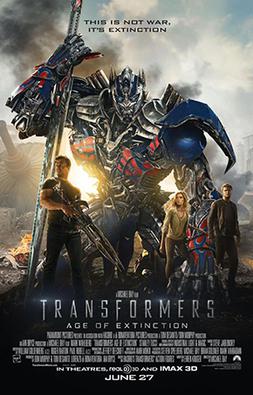
Behind the film
- Year
- 2014
- Director
- Michael Bay
- Writers
- Ehren Kruger
- Genres
- Science fiction, Action, Comedy
- Production
- Paramount Pictures, Hasbro, DreamWorks
- Country
- United States
- Cast
- Mark Wahlberg, Stanley Tucci, Kelsey Grammer, Nicola Peltz, Jack Reynor, Li Bingbing, Sophia Myles, T. J. Miller
About the film
Contains story spoilers.
Transformers: Age of Extinction imagines a world that has turned its former protectors into a problem to be managed. That change gives the familiar division between people and giant machines an uneasy new shape. Trust no longer follows automatically from being on the side that previously helped, and the right to remain alive becomes something others think they can revoke. The film’s human world responds to danger through ownership, secrecy and commercial opportunity, while its mechanical characters face the consequences of being useful without being accepted. Its enormous action rests on that tension. The story asks what happens when gratitude expires but the desire to control exceptional power continues to grow.
After the battle in Chicago, rogue CIA unit Cemetery Wind hunts Autobots while working with alien bounty hunter Lockdown. In Texas, inventor Cade Yeager discovers and repairs a damaged Optimus Prime, drawing danger towards himself and his daughter Tessa. Their escape leads to technology company KSI, which is manufacturing artificial Transformers from recovered material. Its Galvatron prototype contains Megatron’s continuing consciousness, allowing the supposed weapon to turn against its makers. Lockdown captures Optimus and Tessa, but Cade and the Autobots rescue them aboard his prison ship. The conflict shifts to Hong Kong as Galvatron takes control of KSI’s drones and seeks an alien device called the Seed. Optimus recruits the Dinobots, while Cade’s family helps free him during the final fight. Lockdown and the corrupt operative Attinger are killed; Galvatron survives. Optimus leaves Earth carrying the Seed, determined to confront the Creators responsible for sending his pursuer, while asking the Autobots to protect his human allies.
Cade offers an approachable entry into that struggle because his imagination begins with repair. A damaged object can be understood as something worth examining rather than immediately discarding, and that habit becomes an ethical possibility when the object is also a person. His position invites a different relationship with technology from the one represented by institutions seeking weapons or profit. Curiosity can lead to care, while ownership can lead to exploitation. The distinction is particularly useful in this franchise, where a machine’s exterior encourages people to think in terms of function. The story’s moral argument depends on looking beyond that function. Something that can transform, transport or fight may also have loyalties and wishes that its apparent utility cannot describe.
His family gives the adventure a smaller language for questions of protection. A parent’s desire to keep a child safe can overlap with a desire to remain in charge, making independence feel like an additional danger. Set beside the conflict over control of the Transformers, that tension gives the film a recognisable human echo. Care involves responsibility, but it becomes incomplete when it cannot recognise another person’s agency. Cade’s difficulties can therefore be read alongside the larger institutional failure: different scales of authority encounter the problem of accepting lives they cannot fully direct. The film does not make those situations identical. It places them near enough that the idea of protection carries emotional friction rather than remaining an uncomplicated promise.
KSI’s ambitions turn creation into a question about possession. Producing something does not necessarily mean understanding it, and assembling impressive capabilities cannot guarantee obedience. That is a particularly apt source of trouble for a story about transforming bodies, where identity is already less stable than appearance suggests. The corporate dream imagines power as reproducible and controllable; the narrative exposes the gap between those desires. Read in this way, the artificial Transformers belong to a familiar science-fiction anxiety about mistaking technical achievement for mastery. A successful demonstration can conceal a deeper failure of judgment. The film’s machinery becomes frightening when its makers treat its ability to perform as proof that they know what it is.
Optimus occupies the opposite side of that question. His authority has to mean more than force if his relationship with humanity is to survive betrayal. The film places his anger beside continuing obligations, making leadership an argument about what disappointment permits. A protector who feels used can withdraw, retaliate or decide that some particular relationships still matter. That gives the character a conflict beyond the practical difficulty of winning another fight. Loyalty becomes selective and personal when confidence in the wider world has weakened. The distinction keeps individual acts of trust significant amid the scale: one family’s willingness to help can stand against an institution’s decision that an entire kind of being is expendable.
The expanding mythology also changes the meaning of the spectacle. Machines are no longer only visitors involved in Earth’s disputes; their presence suggests a larger order of creation, captivity and authority. That gives the adventure room to move between domestic anxiety and almost cosmic possibility. Its pleasures depend on that breadth, with ordinary human problems repeatedly finding giant counterparts. The world can contain improvised repair, calculated exploitation and astonishing forms of life at once. Age of Extinction is best understood through the question connecting those elements: when extraordinary beings appear, do people recognise partners or materials? The answer shapes the alliances and betrayals around every battle, leaving survival tied to the ability to see a person where somebody else sees an asset.