
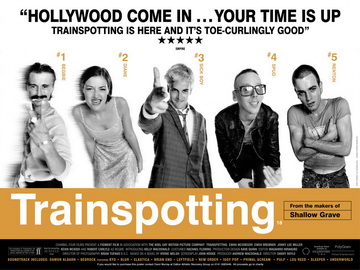
Behind the film
- Year
- 1996
- Director
- Danny Boyle
- Writers
- John Hodge
- Genres
- Buddy, Crime, Drama, Independent
- Production
- Film4 Productions, Figment Films
- Country
- United Kingdom
- Cast
- Ewan McGregor, Ewen Bremner, Jonny Lee Miller, Robert Carlyle, Kevin McKidd, Kelly Macdonald, Peter Mullan
About the film
Contains story spoilers.
Danny Boyle’s Trainspotting follows Mark Renton through an Edinburgh where his ambitions are repeatedly reduced to the next high, the next escape, or the next excuse. The opening races down Princes Street as Renton and his friend Spud flee store detectives; its brisk motion makes their life look thrilling before the film shows the cost underneath. Renton’s voice frames his choices with comic certainty, but his addiction is not an abstract pose. He lives with his parents, returns to heroin with his friends, and must repeatedly decide whether he actually wants to stop. The film's Scots-inflected dialogue and local streets keep the story grounded in a particular city rather than presenting addiction as a placeless fable.
Renton’s circle contains distinct forms of self-destruction. Simon, or Sick Boy, is a compulsive womaniser and a devotee of James Bond; Spud is gentle and easily led; Tommy initially avoids heroin and takes pride in a healthier, more active life. Begbie does not use the drug, but his heavy drinking and sudden violence make him no safer company. Their friendship offers affection and routine, yet it also keeps them close to the same dealers, arguments, and narrow streets. Renton can mock their habits while remaining caught in the group’s shared cycle. Tommy's early refusal gives him a different position in the group, but his eventual collapse demonstrates how quickly that boundary can disappear. Renton’s encounter with Diane adds another complication: discovering that she is underage undermines his assumption that he has understood the situation. Her continued presence and advice make her more than an episode he can simply leave behind.
Tommy’s relationship with Lizzy breaks down after Renton steals their private sex tape, giving one friend’s thoughtless act consequences that reach well beyond the joke he intended. Tommy turns to heroin and deteriorates, while the death of Allison and Sick Boy’s baby Dawn makes the group’s neglect impossible to dismiss. They are shocked without finding a lasting way to stop. The film lets scenes of affection and comic banter remain beside that failure, exposing how a close circle can acknowledge a disaster and still continue the routine that produced it. Renton’s narration can make him seem more perceptive than the others, but recognising the pattern does not keep him from participating in it.
After Renton and Spud are caught shoplifting, Spud goes to prison while Renton enters a rehabilitation programme. He relapses, overdoses and is taken to hospital, then undergoes withdrawal locked in his childhood bedroom by his parents. The hallucinated baby on the ceiling brings Dawn’s death into an ordeal where memory and physical distress cannot be separated neatly. Returning to that room makes his dependence visible in another sense: the adult who presents himself as detached from conventional life needs his family to keep him alive. Tommy’s worsening illness adds a fear that cannot be contained within Renton’s own attempt to recover. The film’s distorted spaces let guilt, panic and bodily discomfort occupy the same frame.
On Diane’s advice, Renton moves to London and finds work as a property letting agent. Wages, sobriety and distance give him a routine that seems capable of replacing the old one. Begbie and Sick Boy arrive with their own problems, bringing intimidation and disruption into the accommodation he finds for them. Their behaviour costs him his job, and the return to Edinburgh for Tommy’s funeral puts the damage of the earlier life before him again. A proposed heroin deal then offers a sudden windfall, but it requires money from Renton and draws him back into the group’s loyalties. The journey to London changes from an attempt to build a separate life into another venture conducted with the people he meant to escape.
The deal succeeds, and the friends celebrate in a pub. Renton suggests to Sick Boy and Spud that they take the money and leave Begbie out; Spud refuses to betray the others, while Sick Boy is receptive. The next morning Renton quietly takes the bag and leaves, noticing that Spud sees him but does not alert the group. Begbie discovers the theft and wrecks the hotel room in a rage, bringing the police down on himself. Renton has chosen an escape that is also a betrayal, and he knows his old friend has been left exposed. The group's decision to celebrate before dividing the money exposes how easily a shared success becomes another test of trust and self-preservation.
The ending does not claim that a stolen fortune instantly solves Renton’s life. He walks away promising himself a more conventional future, carrying both the money and the possibility of becoming someone outside the group. Spud finds £4,000 left for him by Renton, giving the betrayal an exception that preserves something of their friendship without telling us what his next life will be. Boyle’s jump cuts, wide-angle distortions, and music-driven momentum make the city feel at once lively and claustrophobic; the bright energy heightens rather than softens the squalor. Humour stays close to danger, so a gag can turn into a reminder of what the characters risk. Spud's silent decision not to warn Begbie leaves their friendship more complicated than Renton's simple promise to abandon his former life.