
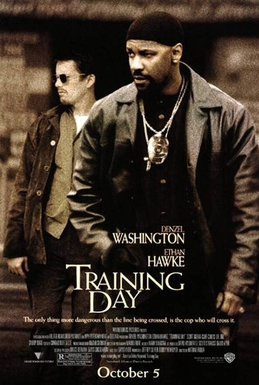
Behind the film
- Year
- 2001
- Director
- Antoine Fuqua
- Writers
- David Ayer
- Genres
- Crime, Hood, Buddy cop, Action
- Production
- Warner Bros. Entertainment, Village Roadshow Pictures, Outlaw Productions
- Country
- United States
- Cast
- Denzel Washington, Ethan Hawke, Scott Glenn, Tom Berenger, Harris Yulin, Cliff Curtis, Dr. Dre, Snoop Dogg
About the film
Contains story spoilers.
Jake Hoyt joins decorated detective Alonzo Harris for a one-day narcotics evaluation in Los Angeles. Alonzo coerces him into smoking PCP-laced marijuana, creating leverage over him. Jake independently saves a girl from assault and keeps her dropped wallet. Alonzo needs money to settle a deadly Russian mob dispute. He murders dealer Roger, steals cash with corrupt officers and tries to implicate Jake. Refusing to cooperate, Jake is abandoned with gangsters paid to kill him. The wallet identifies the rescued girl as their cousin, and they spare him. Jake confronts Alonzo, whose neighbours refuse his appeals for help, and takes the stolen money as evidence. Russian gunmen kill Alonzo as he flees. Jake reaches home while the news presents a misleading account of the detective's death.
Antoine Fuqua's film compresses its central relationship into a day, making the invitation to join a prestigious unit feel increasingly like confinement. Jake has ambitions before he meets Alonzo, and Ethan Hawke keeps those ambitions visible even as his character becomes frightened. He wants to prove himself, so refusing a demand can seem like refusing his own future. That is the trap underlying the evaluation. A supervisor's approval offers a practical reward and a judgment of identity: it might confirm that Jake is capable of becoming the officer he imagines. The film makes that desire understandable without allowing it to excuse every concession. His discomfort matters because recognising that something is wrong and acting on that recognition are separate challenges.
Denzel Washington's Alonzo is persuasive partly because he seems to possess a complete map of the world around him. He speaks as someone for whom hesitation is a luxury, offering experience as the answer to any objection. His charisma does not operate only through friendliness. He can mock, impress, intimidate and then become companionable again, keeping Jake unsure which version of the relationship he is in. That changeability makes resistance difficult: the person applying pressure also appears to be the person who can explain the pressure and make it go away. Washington gives authority an active, conversational form. Alonzo continually works on the meaning of what is happening, so a troubling act can be repackaged as a lesson before Jake has finished responding to it.
David Ayer's screenplay makes instruction into a contest over moral language. An experienced officer can reasonably know things a newcomer does not, which gives Alonzo's arguments an initially plausible shape. The problem begins when practical knowledge is used to make every boundary look childish. Competence and permission become entangled: if Jake questions a method, his judgment of the whole job can be dismissed. The film's tension depends on separating those claims. Someone can read a dangerous situation accurately while making an indefensible choice inside it. Knowing how to survive does not automatically establish how one ought to behave, and the distinction becomes harder to preserve when survival and career advancement seem to depend on the person demanding obedience.
Los Angeles appears through relationships as much as through streets. Alonzo's ability to move through different spaces suggests an intricate web of recognition, obligation and fear. People respond to the man and to the institution represented by his badge, and those responses do not always mean the same thing. The city therefore refuses to function simply as a hostile background against which two officers demonstrate their skills. Its residents have their own judgments about what power has done to them. This gives the later conflict a scale beyond the private contest between mentor and trainee. Authority may dominate a particular encounter without creating loyalty, and repeated intimidation can accumulate consequences the intimidating person fails to understand because he mistakes compliance for respect.
The car gives the film a particularly effective working space. Jake can observe and question, but Alonzo controls the direction of travel and the pace at which new demands arrive. Physical proximity does not create trust; it can make someone else's confidence harder to escape. Their conversations carry much of the story's pressure because a casual tone can conceal a serious test. Fuqua allows movement through the city to become movement deeper into a relationship whose terms are being rewritten. A new location promises another lesson, yet the accumulated experience gives Jake less reason to accept the teacher's version of himself. The apparent apprenticeship steadily becomes an effort to recognise and reject the conditions under which approval is being offered.
The contrast between formal standing and actual conduct also gives the supporting characters a specific function. Alonzo's apparent success is not proof that the surrounding systems can reliably identify virtue, and his connections make the abuse feel larger than an individual lapse. Jake cannot simply appeal to the prestige of the job as though that prestige will solve the problem. At the same time, the film does not treat every person outside official authority as interchangeable. Actions and loyalties cut across institutional labels. That unsettles the simple division Alonzo wants to maintain between those entitled to impose a story and those expected to live beneath it. The pressure on Jake is to judge what people do, even when their position encourages him to accept what they claim.
The conclusion retains that conflict over interpretation. Surviving the day does not mean Jake has somehow restored every institution or made the city transparent. His refusal matters on the scale of a particular choice, while the story continues to show how power can shape what others hear about an event. Training Day's deeper concern is the cost of surrendering one's judgment to someone admired for experience. It understands the attraction of certainty and the exhaustion of resisting it, especially when uncertainty threatens a desired future. Jake's ordeal gives professional ambition a difficult condition: becoming capable must not require becoming incapable of recognising harm. The day's lesson emerges from the failure of the teacher's account of himself, and from the trainee's struggle to act without his permission.