
Behind the film
- Year
- 2000
- Director
- Steven Soderbergh
- Writers
- Stephen Gaghan
- Runtime
- 2h 27m
- Genres
- Crime, Drama, Political thriller
- Production
- Focus Features, Bedford Falls Productions
- Country
- United States, Germany, Mexico
- Cast
- Michael Douglas, Benicio del Toro, Catherine Zeta-Jones, Don Cheadle, Luis Guzmán, Erika Christensen, Jacob Vargas, Dennis Quaid
About the film
Contains story spoilers.
Traffic is organised around the limits of a single viewpoint. Its characters can understand the situation immediately around them and still fail to see how that situation belongs to something larger. The interwoven stories give the audience connections no individual character fully possesses, making certainty look increasingly difficult to sustain. A successful operation can serve a concealed interest, a public programme can misunderstand the household of the person announcing it, and apparent distance from crime can disappear when a comfortable life is threatened. The film's structure turns those changes into its central argument: describing a system from one position can leave the consequences occurring elsewhere outside the account.
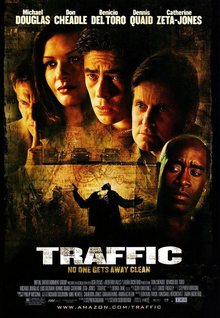
Steven Soderbergh directs the 2000 drama, with a screenplay by Stephen Gaghan adapted from the British series Traffik. Benicio del Toro plays Javier Rodríguez, Michael Douglas plays Robert Wakefield and Catherine Zeta-Jones plays Helena Ayala. Don Cheadle and Luis Guzmán play agents Montel Gordon and Ray Castro, while Erika Christensen plays Caroline Wakefield. The film combines English and Spanish dialogue and separates its strands visually as well as geographically. That arrangement helps viewers move among perspectives without pretending the different circumstances are interchangeable, giving the ensemble room to expose relationships between events rather than requiring everyone to meet in a single concluding scene.
Javier discovers that an official anti-drug campaign serves a rival cartel and cooperates with US agents to expose corruption, securing lighting for local children. Wakefield's national appointment collides with his daughter's addiction, leading him to abandon a combative public account and listen within his family. Helena responds to her husband's prosecution by arranging a witness's death; the case collapses, though Gordon continues surveillance. These endings provide local changes without declaring the trade defeated. The stories finish at different levels of consequence, with recovery, public benefit and continued criminal power existing beside one another rather than resolving into a shared victory.
Javier's strand makes official effectiveness an uncertain measure. An operation can remove visible criminals while benefiting people whose involvement remains concealed, allowing institutional success to become part of the very arrangement it claims to oppose. That changes what integrity requires from a person inside the system. Following an order is not enough if the order's practical meaning differs from its announced purpose. The film gives this problem a local scale through Javier's concern for his community, suggesting that a concrete improvement can have value without pretending it answers every larger question. The modestness of the result becomes part of its significance rather than evidence that nothing happened.
Wakefield's family confronts the distance between public language and private responsibility. A policy can describe a group as an enemy while somebody within the policymaker's own home belongs to the people that description excludes from sympathy. The resulting contradiction is emotional as well as intellectual. It becomes harder to speak with certainty when the abstract problem has a familiar face, needs care and cannot be resolved by forceful language alone. The film does not turn one family's experience into a complete treatment programme or current policy recommendation. It uses the encounter to expose how confidence can depend on keeping the people affected at a reassuring distance.
Helena's story shows how a protected position can change when its supporting arrangements become visible. Learning where comfort came from does not automatically produce rejection of it; threatened security can instead create a willingness to participate more directly. That gives her strand a movement different from the disillusionment occurring elsewhere. Knowledge is not guaranteed to make a person act ethically. It can supply the means to preserve something they decide matters more than the harm preservation requires. The film's comparison becomes sharper because the same wider trade creates different incentives in different lives, making awareness a beginning of responsibility rather than proof that responsibility has been accepted.
The agents' work supplies a practical cost to events that can otherwise be narrated as shifts in institutional advantage. Protection requires people to remain present while the interests around a case change, and danger does not disappear because the legal process has a clear objective. The film's ensemble keeps those immediate losses inside the larger account. A system is made of decisions that land on particular bodies and relationships, not merely of organisations competing for territory or authority. Moving among perspectives makes that point without asking the characters to agree on it. Their incomplete knowledge becomes part of the audience's understanding of why a shared explanation is so difficult to produce.
The conclusion resists the satisfaction of one decisive blow. A family can begin listening, a neighbourhood can gain something useful and a criminal enterprise can survive within the same ending. Traffic gives those outcomes a common frame while preserving their differences. Its fictional drama is most useful as an examination of perspective, not a substitute for current evidence about drugs or border policy. The interlocking world asks viewers to notice what an account leaves out when it names success. By moving between public claims and private consequences, the film makes the missing parts of each viewpoint central to understanding the problem it was trying to explain.