
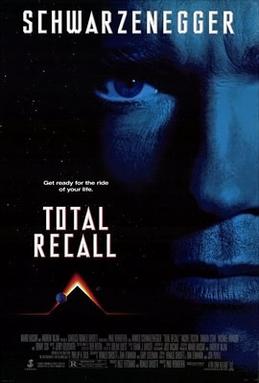
Behind the film
- Year
- 1990
- Director
- Paul Verhoeven
- Writers
- Dan O'Bannon, Gary Goldman, Gary Goldman
- Runtime
- 1h 53m
- Genres
- Action, Dystopian, Adventure, Science fiction
- Production
- Carolco Pictures, StudioCanal
- Country
- United States, Mexico
- Cast
- Arnold Schwarzenegger, Ronny Cox, Sharon Stone, Rachel Ticotin, Michael Ironside, Dean Norris, Marshall Bell, Debbie Lee Carrington
About the film
Contains story spoilers.
Total Recall introduces Douglas Quaid, a construction worker on Earth who dreams repeatedly of Mars. His wife Lori, played by Sharon Stone, dismisses the idea of a real trip, so he visits Rekall, a company that sells implanted memories of vacations and adventures. Quaid selects a secret-agent scenario on Mars, hoping to experience a life he cannot afford to live. During the procedure, technicians discover that the memories they planned to implant appear to overlap with memories already inside him. Before they can finish, Quaid wakes frightened and soon finds himself pursued by people who claim he is dangerous. The question begins with a gap between memory and evidence: is he an ordinary man whose mind has been altered, or a trained agent whose ordinary life was constructed?
The search for answers takes Quaid to Mars, a world where air and access are controlled. The colony depends on an atmosphere system overseen by Vilos Cohaagen, a powerful administrator played by Ronny Cox. Quaid encounters Melina, played by Rachel Ticotin, who recognizes the person he may have been and helps him move through a network of rebels and residents. Richter, played by Michael Ironside, is sent to capture him. The science-fiction setting is grounded in concrete dependencies: people need pressure, air and safe passage, and those needs give political power a physical form. Mars is both an adventure destination and a place where control over survival is made visible. Quaid's personal identity crisis unfolds inside a wider struggle over the colony's future.
Verhoeven and the effects team give the story a tactile surface. The production relies heavily on practical effects and was filmed at Churubusco Studios in Mexico City. The Mars colony is expressed through sets, costumes, make-up and crowds, while the action relies on visible machinery and changing environments. These details help the viewer feel the difference between an ordinary Earth routine and the colony's harsher conditions. They also suit Quaid's uncertainty: the world appears physical and consistent, but that does not prove his experience is true. The setting can be trusted as a place even when the protagonist's account of himself cannot. The practical look keeps the action bodily and allows the colony to feel populated rather than like an empty effects backdrop.
The film carefully keeps two explanations available. Quaid may be living out the secret-agent scenario Rekall promised, with the chase and Mars adventure unfolding as an implanted fantasy. Or the memories he has uncovered may belong to an actual past, and the company's intervention merely opened a door he did not know was there. Each new ally or betrayal can support either reading. Verhoeven makes the ambiguity part of the entertainment rather than a puzzle solved by a final explanatory speech. The viewer follows Quaid's present actions because they matter within both possibilities: he must escape capture, learn what Cohaagen wants and decide which people deserve his trust. This uncertainty also changes the romance and action, since each apparent confirmation may be part of the fantasy he paid to experience.
Action repeatedly turns identity into performance. Quaid has to present himself as someone with a legitimate reason to be in a place, while other characters conceal affiliations or use public roles as disguises. On Mars, the crowd and its infrastructure give the chase a social dimension; Quaid is not alone in a sterile set but moving through a populated environment where residents face the consequences of political decisions. The film's violence and broad comic touches keep it closer to an exuberant action thriller than a restrained philosophical fable. Its ideas remain attached to memorable situations: a purchased memory, an apparently false marriage, an enemy who insists on defining Quaid and a planet whose air supply is a lever of control. That concrete approach gives the high-concept premise an accessible route through the plot.
By the end, Quaid's choice has consequences beyond his own self-image. Cohaagen's control of the atmosphere system threatens the people living on Mars, and changing that arrangement becomes the immediate objective. The climax pushes the film toward a vivid physical resolution even as it preserves uncertainty about whether the whole adventure could be a dream. That uncertainty is not a missing detail to patch over; it changes how the ending feels. Adapted from a Philip K. Dick short story, the film keeps its reality question active while giving the adventure a physical shape through practical effects. Total Recall lets the action resolve the colony's crisis without claiming that memory has become a perfectly reliable guide. Its final image can be read as arrival or as the closing beat of a fantasy, and the film leaves that choice with the audience.
The colony's hierarchy is made clear through its dependence on systems that people cannot individually replace. A shortage of breathable air is not an abstract policy dispute: it determines whether residents can remain alive in their homes. That gives Cohaagen's control of the atmosphere equipment an immediate political weight, and gives Quaid's decisions consequences for strangers beyond his own circle. Crowds, make-up and the varied Mars environments make the settlement feel populated, with different interests and pressures visible around Quaid's personal journey. The people moving through those sets are not simply background for a hero's identity puzzle. Their presence makes the colony a community with a shared need, so the climax asks whether Quaid can act on behalf of people he has only recently met.