
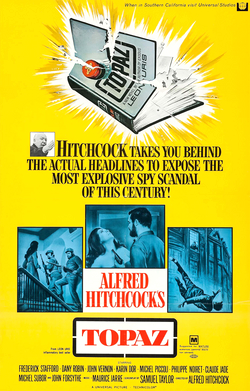
Behind the film
- Year
- 1969
- Director
- Alfred Hitchcock
- Writers
- Samuel A. Taylor
- Genres
- Political thriller, Thriller
- Production
- Universal Pictures
- Country
- United States
- Cast
- Frederick Stafford, John Forsythe, Dany Robin, John Vernon, Karin Dor, Michel Piccoli, Philippe Noiret, Claude Jade
About the film
Contains story spoilers.
Topaz makes espionage a process of moving knowledge across places where it is dangerous to possess it. Alfred Hitchcock directs Frederick Stafford as André Devereaux, a French agent drawn into a Cold War investigation that moves from international evidence gathering towards betrayal close to home. Samuel A. Taylor adapts Leon Uris’s novel. The film’s world is full of public meetings, official positions and private attachments, with each capable of concealing another allegiance. Knowing the right person can open a door, but it can also make the meaning of what lies behind the door harder to assess. Familiarity is useful until it becomes a reason to overlook danger.
A Soviet defector provides information about missiles in Cuba. Working with CIA agent Nordstrom, Devereaux obtains photographic evidence in New York and travels to Cuba, where his lover Juanita helps gather further proof. Her involvement leads to her death at the hands of Rico Parra. Back in Paris, Devereaux investigates the Soviet spy network called Topaz and discovers that its leader is his friend Jacques Granville, also his wife’s lover. In the American theatrical ending, the exposed Granville kills himself. The story’s investigation therefore returns to the protagonist’s own circle, revealing that private trust and professional security have been compromised together.
The photographic evidence gives the story a particular kind of suspense. Someone can know that a danger exists while lacking material that another institution will accept as proof. A camera must be used, a record must survive and the record must reach the people able to act. That chain creates vulnerabilities at every point. The film makes the small object carrying information as consequential as the large weapon the information concerns. Power depends partly on what can be established, and establishing it depends on people undertaking physical risks. The distance between a suspicion and a usable fact is filled by work that can remain invisible after the fact has arrived.
Devereaux’s travel also puts domestic life beside an operation that does not respect domestic boundaries. A family journey can become cover, and a relationship can become a means of access. The film’s international movement is therefore more than a succession of settings. It exposes how an agent’s different identities travel together: husband, father, lover and professional cannot be kept perfectly separate by crossing a border. The people connected to one identity become vulnerable to decisions made through another. His work needs secrecy, but secrecy also affects those who must live with the consequences of his absences and incomplete explanations.
Juanita’s participation makes that imbalance especially sharp. Assistance in an intelligence operation can be described as valuable cooperation from the position of the person receiving it, while the person supplying it remains exposed within the place being investigated. Devereaux can leave with evidence; local involvement has dangers that do not disappear when the operation succeeds. The film places personal attachment inside that unequal distribution of risk. It makes the successful transfer of information difficult to regard as an uncomplicated victory. The proof may arrive at its destination while the human connection that helped produce it is destroyed. Espionage’s practical success and its emotional cost can occur at the same moment.
The later discovery in Paris brings the question of divided loyalties back into familiar surroundings. An investigation is easier to imagine as a search for strangers than as a process that may invalidate existing relationships. A friend’s position can make suspicion seem disloyal, and a shared past can offer reassurance that current evidence does not justify. The spy network exploits precisely that gap. Personal knowledge does not automatically provide knowledge of every purpose a person serves. The film’s movement from Cuba to the French circle gives betrayal a different scale: the threat is no longer contained in somewhere the protagonist visited, but within connections he carried with him throughout the journey.
Hitchcock’s emphasis on observation suits a story in which significance often has to be inferred before it can be stated. A person’s movement, a hidden item or an unexpected connection can change the meaning of an apparently ordinary exchange. The viewer’s attention is directed towards the relation between what is visible and what remains undisclosed. That relation does not require continuous physical confrontation to become tense. The possibility that an interaction is being watched, misunderstood or used for a concealed purpose can carry the pressure. Topaz treats information as something people perform around, with manners and appearances able to delay the moment when an underlying conflict becomes explicit.
The film exists in versions with different final outcomes, so the suicide ending belongs to a specific release rather than providing a conclusion shared by every cut. Within that version, exposure offers no clean repair of the protagonist’s wider life. The network can be identified while the losses and damaged attachments remain. Topaz is interested in that discrepancy between solving an intelligence problem and escaping what its solution reveals. Its Cold War plot creates an international framework, but its lasting discomfort comes from the way hidden allegiance passes through intimacy. Learning who has betrayed whom can settle an investigation without restoring the trust that made the betrayal possible.