
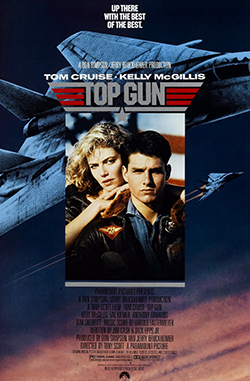
Behind the film
- Year
- 1986
- Director
- Tony Scott
- Writers
- Jim Cash, Jack Epps, Jr.
- Genres
- Action, Drama, Romance, Melodrama
- Production
- Paramount Pictures
- Country
- United States
- Cast
- Tom Cruise, Kelly McGillis, Val Kilmer, Anthony Edwards, Tom Skerritt, Michael Ironside, Meg Ryan, Rick Rossovich
About the film
Contains story spoilers.
Pete Mitchell’s callsign, Maverick, is a description as much as a name. Tom Cruise’s pilot enters Top Gun with the confidence that makes him impressive in the air and difficult to manage within a military organisation. His partnership with radar intercept officer Goose gives that confidence a companion who can share the jokes, read the risks and remind him that he does not fly alone. Tony Scott’s 1986 film takes their admission to an elite Navy training programme as the beginning of a story about competition and dependence. The pilots are asked to become individually exceptional while learning a discipline in which another person’s safety may depend on their choices.
The school at Miramar provides a concentrated social world. Callsigns, rankings and public assessments give its students clear ways to measure themselves against one another. Val Kilmer’s Iceman becomes Maverick’s chief rival because his controlled manner challenges the newcomer’s preference for improvisation. Their disagreements have practical stakes: a daring manoeuvre can demonstrate talent while making life more dangerous for a wingman. The instructors Viper and Jester are not simply obstacles to enjoyment. They judge decisions, identify errors and insist that surviving one risky choice does not establish that it was sound. Training converts personality into something observable, with pride and impatience leaving traces in the simulated engagements.
Maverick’s attraction to Charlie complicates his life on the ground. Played by Kelly McGillis, she is a civilian instructor with technical knowledge that places her inside the professional world he initially tries to charm his way through. Discovering her role changes the balance between them. He wants admiration, but she can assess his conduct as well as respond to his confidence. Their relationship moves between those positions rather than remaining a simple reward for athletic achievement. Scott’s film gives the romance a visual register distinct from the classroom, using evening light, intimate framing and the soundtrack to make the spaces outside training feel like another arena in which Maverick has something to learn.
Goose and his family provide a different form of intimacy. Anthony Edwards makes the friendship relaxed enough to suggest shared experience before the story begins, while Carole’s arrival gives Maverick a glimpse of the domestic life surrounding his colleague. Goose is therefore more than a voice beside the pilot or a source of comic relief. His presence connects flying to relationships that continue when the aircraft lands. The piano and bar scenes belong to that continuity: these are people enjoying time together, not merely competitors waiting for another exercise. The warmth makes the subsequent break in their routine especially consequential, because the audience has seen the ordinary life that an accident can destroy.
That accident occurs during a training engagement when Maverick’s aircraft enters disturbed air and goes into a flat spin. The crew ejects, but Goose strikes the canopy and dies. An inquiry clears Maverick of wrongdoing, yet an official finding cannot remove his grief or the memories associated with flying. The film turns from a contest over being the best to a struggle over whether he can continue at all. Viper also changes Maverick’s understanding of his father, whose military history has shadowed his own ambitions. The advice does not erase the loss. It offers a way to separate inherited anxiety, personal guilt and the responsibilities he still has toward living colleagues.
Graduation does not supply the final proof of recovery. A real crisis places the pilots back aboard an aircraft carrier, where the distinctions between a training defeat and a fatal mistake become immediate. Maverick’s hesitation shows that courage is not restored simply by returning to the cockpit. When he re-engages, he has to function with other pilots rather than pursue an individual display. The resolution gives him and Iceman mutual respect that their earlier rivalry could not produce. Maverick’s decision to return as an instructor completes a shift in purpose: the skill he wanted recognised can now help teach others. His reunion with Charlie follows that professional choice rather than replacing it.
Scott makes the machinery and environments central to the film’s appeal. The carrier deck is crowded with movement, noise and coordinated labour, while the flight sequences alternate broad views of aircraft with tight glimpses of the people inside them. Sunlight, silhouettes and the score give take-offs and returns an almost ceremonial energy. The music also helps connect combat training, sport, nightlife and romance into one recognisable world. That world is stylised, shaped around speed and young confidence, rather than an exhaustive account of naval service. Its emotional logic depends on the contrast between the glamour of flying and the vulnerability of the people enclosed within the machines.
Written by Jim Cash and Jack Epps Jr., the film gives Maverick a problem that cannot be solved by becoming slower or less talented. He has to understand what his talent is for and whose trust it requires. Cruise’s restless enthusiasm, Kilmer’s composure and Edwards’s easy companionship provide different models of confidence, allowing their interactions to carry the theme without turning every exchange into a lesson. Goose’s absence remains part of the ending even as the action offers triumph. Top Gun’s central transformation is therefore a change in the pilot’s relationship to other people: ambition survives, but the man who wanted to stand above his peers learns why he needs to fly beside them.