
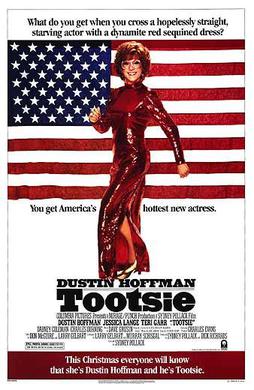
Behind the film
- Year
- 1982
- Director
- Sydney Pollack
- Writers
- Larry Gelbart, Murray Schisgal
- Runtime
- 1h 56m
- Genres
- Romantic comedy, Comedy drama, Lgbtq-related, Satirical
- Production
- Mirage Enterprises, Columbia Pictures
- Country
- United States
- Cast
- Dustin Hoffman, Jessica Lange, Teri Garr, Charles Durning, Bill Murray, Dabney Coleman, Sydney Pollack, George Gaynes
About the film
Contains story spoilers.
Michael Dorsey is a skilled actor and acting teacher whose reputation for perfectionism and arguments has made producers wary of hiring him. He waits tables and coaches students, including his friend Sandy Lester, who auditions for a role on the soap opera Southwest General and is rejected. When Michael’s agent tells him that his difficult reputation has shut him out, he decides to audition himself in disguise as Dorothy Michaels, a middle-aged actress. The scheme begins as a way to earn money for a play his roommate Jeff wants to produce, but it immediately places Michael inside a professional life he has not considered from a woman’s position.
The producers initially dismiss Dorothy as too forceful for the role of hospital administrator Emily Kimberly. Michael pushes back against their expectation of a mild, compliant woman, and they hire her after she challenges the script’s assumptions. On the show, Dorothy’s character becomes unexpectedly assertive, and audiences respond to her. The workplace comedy comes from Michael’s effort to maintain the disguise across auditions, rehearsals and public appearances, but the larger change is how other people treat Dorothy: colleagues listen to her, flirt with her, or try to manage her in ways Michael has not experienced as himself.
Michael’s private life becomes harder to separate from Dorothy’s. He is attracted to co-star Julie Nichols, a single mother involved with the soap’s sexist director, Ron Carlisle. As Dorothy, Michael encourages Julie to stand up to Ron; as himself, he later tries a line Julie liked when Dorothy said it and is rejected. He is also caught by Sandy while trying on clothes for Dorothy’s wardrobe and lies to her, claiming he wants a sexual relationship; they sleep together, but his dishonesty leaves Sandy emotionally invested in something he does not truly offer. His identity is no longer a harmless performance because people are making decisions based on it.
Dorothy attracts other admirers too. John Van Horn, an older actor on the show, makes advances, and Julie’s widowed father Les proposes marriage. Michael must deflect these approaches without revealing who he is, while Jeff and Sandy become increasingly entangled in the consequences. The role has brought the employment Michael wanted, but it also requires him to absorb situations he once observed only from the outside. His increasing empathy does not erase the deception: he is still enjoying opportunities gained under a false identity while the women around him bear the uncertainty and risk of trusting Dorothy.
When the producers extend Dorothy’s contract for a year, Michael realizes the arrangement cannot continue. A technical problem forces the cast to perform live, and he reveals on air that Emily is actually Edward, a twin brother who impersonated her to avenge her. The improvised exit ends Dorothy’s role but exposes Michael in front of his colleagues and the audience. Julie is furious when she discovers the truth and punches him after the broadcast. The revelation resolves the professional charade without instantly repairing the personal harm it caused.
Weeks later, Michael is producing Jeff’s play and returns Les’s engagement ring. He and Les manage a more honest conversation, and Michael later waits for Julie outside the studio. She is still hurt but admits she misses Dorothy; Michael acknowledges that the persona brought out qualities he had neglected. They walk away talking rather than receiving a tidy romantic resolution. Sydney Pollack’s film balances television-set farce with grounded scenes of rehearsal, friendship and romantic misjudgment. Its cross-dressing premise is built around a man’s deception, while the story’s better moments come from showing how he begins to notice the unequal rules women face at work and in relationships.
Dustin Hoffman’s performance relies on small shifts of posture, voice and movement as Michael constructs Dorothy and then tries to keep the two identities from colliding. The soap-opera set provides a comic mirror: a fictional workplace melodrama with its own artificial conventions, staffed by actors who are more complicated than their roles. The film’s resolution does not suggest that Michael’s disguise was harmless; Julie and Sandy have concrete reasons to distrust him. It instead lets Michael’s new understanding begin with accountability, as he returns to ordinary life with a clearer sense of the people he had treated as characters in a scheme.
Larry Gelbart and Murray Schisgal’s screenplay makes acting itself part of the problem. Michael can demand seriousness from other performers while inventing explanations to protect his own convenience. Jessica Lange’s Julie and Teri Garr’s Sandy are therefore more than obstacles to keeping Dorothy hidden: both have professional frustrations and emotional expectations that exist outside his plan. Charles Durning’s Les approaches Dorothy sincerely, making an unwanted proposal difficult for reasons that cannot be solved by another comic evasion. Pollack also appears as Michael’s agent, providing an exasperated professional witness to a scheme that began as an answer to unemployment. The contrast between a convincing performance and an honest relationship runs through their encounters, until Michael finally has to speak with people using his own name.