
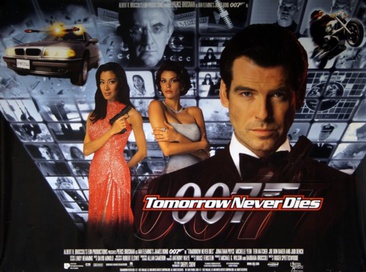
Behind the film
- Year
- 1997
- Director
- Roger Spottiswoode
- Writers
- Bruce Feirstein
- Runtime
- 1h 59m
- Genres
- Action, Thriller, Spy
- Production
- Eon Productions
- Country
- United Kingdom, United States
- Cast
- Pierce Brosnan, Teri Hatcher, Jonathan Pryce, Judi Dench, Desmond Llewelyn, Michelle Yeoh, Ricky Jay, Vincent Schiavelli
About the film
Contains story spoilers.
Tomorrow Never Dies begins with James Bond observing an arms market where dangerous technology is being traded. When an attack is ordered before everything at the site has been properly understood, he must improvise an escape that also prevents a larger catastrophe. The sequence introduces a recurring problem in the film: information moves rapidly between people who are ready to act but do not necessarily have the whole picture. That problem soon becomes international. A British warship is drawn into a false position, attacked by an unseen vessel and made to appear the victim of Chinese aggression. The surviving sailors are killed to reinforce the deception.
The crisis seems ready-made for headlines, and media owner Elliot Carver supplies them with suspicious speed. His news organization knows details before British intelligence can explain what happened, prompting M to send Bond into Carver’s circle. Jonathan Pryce plays him as a man who enjoys both the stage and the machinery behind it. He is preparing to launch a global satellite network, so the disaster has immediate commercial value as well as political consequences. The film makes his power more concrete than a general accusation that newspapers influence events: his organization helps create the incident, produces its preferred interpretation and distributes that interpretation as a product.
Bond travels to Hamburg, where Carver’s wife Paris is someone he knew before her marriage. Their encounter brings an old personal connection into a mission that initially looks like an investigation of corporate wrongdoing. Teri Hatcher’s Paris is caught between a controlling husband and a man whose profession has already made intimacy unreliable. She gives Bond information that helps him reach the company’s newspaper operation, but assisting him exposes her to Carver’s retaliation. Her death turns the cost of the inquiry into something immediate. Bond also faces the assassin responsible, forcing him to escape a trap in which a hotel room has become part of the effort to silence him.
A stolen satellite-navigation device helps establish how the warship was led into danger. Bond’s investigation then moves from the polished surroundings of Carver’s business to the wreck itself, where physical evidence contradicts the account circulating above the water. A missile has been removed from the ship. Chinese agent Wai Lin is investigating the same operation, though neither agent initially knows how much the other understands or whom they can safely trust. Their discovery points toward a conspiracy larger than simply sinking one vessel. The attackers have acquired a weapon that can make their next provocation appear to come from a government rather than from Carver’s private organization.
Bond and Wai Lin are captured and taken to Carver’s headquarters in Saigon, where their escape turns uneasy cooperation into a working partnership. Chained together during a motorcycle chase, they have to coordinate movement as well as decisions, with their competing instincts becoming a source of both danger and humor. Michelle Yeoh’s Wai Lin has her own contacts, equipment and combat skills, allowing her to act as more than someone waiting for Bond’s solutions. The film gives each agent moments of initiative while making communication between them necessary. Their shared objective does not erase their different professional loyalties; it provides a reason to work across them before those governments are pushed into conflict.
Carver intends to use the stolen missile against Beijing and support a corrupt Chinese general’s rise to power. In exchange, he expects exclusive broadcasting access to an enormous market. The scheme connects political violence to a business agreement, giving his apparent enthusiasm for war a specific financial destination. Bond and Wai Lin reach the stealth vessel operating at the center of the plan, while the British navy approaches a confrontation based on the fabricated evidence. Their task is to expose the hidden ship and prevent the missile launch. The climax compresses the international conspiracy into a confined space where machinery, prisoners and the launch preparations can all be reached, but not safely controlled at once.
The stealth ship becomes detectable during the fight, breaking the concealment on which Carver’s operation depends. Wai Lin works to disable its systems while Bond confronts the men directing the attack. Carver is killed, but the danger continues through his enforcer Stamper and the prepared missile. Bond has to stop the launch and rescue Wai Lin after she is chained beneath the water. The ship’s destruction ends the immediate threat and leaves the two agents among the wreckage, alive after a partnership neither had planned at the beginning. The resolution prevents the staged conflict from reaching its intended destination, though the film has already shown how quickly governments can be maneuvered toward it.
Roger Spottiswoode directs from Bruce Feirstein’s screenplay, giving Pierce Brosnan’s Bond an adventure organized around communications technology and controlled appearances. Remote-operated equipment creates playful reversals in the action, while David Arnold’s score joins the familiar Bond musical vocabulary to the film’s urgent pace. Carver’s speeches and broadcasts keep returning to his wish to control the story, whereas the investigators depend on awkward encounters, recovered objects and direct cooperation. The contrast is clearest in Wai Lin and Bond’s relationship: neither can manufacture trust with a slogan or a screen image. They develop it while escaping, investigating and protecting one another, offering a practical answer to the villain’s belief that control of information should mean control of the world.