
Behind the film
- Year
- 1962
- Director
- Robert Mulligan
- Writers
- Horton Foote
- Genres
- Drama, Trial, Crime
- Production
- Universal Pictures
- Country
- United States
- Cast
- Gregory Peck, Mary Badham, Phillip Alford, John Megna, Brock Peters, Robert Duvall, Frank Overton, Estelle Evans
About the film
Contains story spoilers.
Robert Mulligan’s To Kill a Mockingbird follows Scout and Jem Finch through childhood summers and an autumn in Maycomb, Alabama, as their childhood world begins to intersect with the adult responsibilities of their father, Atticus. Their games with visiting friend Dill revolve around the mysterious neighbor Boo Radley, whose house becomes the center of stories the children invent. Atticus is a widowed lawyer who represents poor people in town, and when he defends Tom Robinson, the children must confront a system of racial prejudice that their games cannot explain away.
On the night before Tom’s trial, Atticus waits outside the jail to protect him from a lynch mob. Scout recognizes the father of one of her schoolmates among the men and begins talking to him as if they were neighbors; the ordinary familiarity breaks the confrontation and the crowd disperses. At the trial, Scout and Jem watch from the segregated balcony. Atticus exposes the weakness of the accusation against Tom, whose left arm is unusable, but the all-white jury convicts him. Tom is later shot dead while supposedly trying to escape.
The children’s curiosity about Boo continues in parallel with the case. They devise ways to draw him out and find small gifts left in a tree by the Radley home, though they do not understand who is leaving them. After Bob Ewell attacks them on their walk home, an unseen rescuer carries the injured Jem back to the Finch house. The sheriff identifies Boo as their protector and decides that prosecuting him would serve no public purpose. Scout walks Boo home and pauses on his porch, imagining the neighborhood from his point of view.
The film’s childhood perspective does not make the racial injustice of Tom’s case a child’s misunderstanding. The children can see that Atticus has answered the accusation, yet the verdict demonstrates that clear evidence does not guarantee fair treatment. Their limited understanding instead shapes how the town’s contradictions arrive: as a jail guarded at night, a crowded courtroom, whispered judgments at school, and adults who choose when to act. The film gives Scout a developing sense of moral attention without pretending that she can repair what the legal system has done.
The courtroom is the story’s formal center, but Mulligan uses the house and street as equally important spaces. The Finch home provides a place for conversation and recovery, while the Radley property remains an unseen boundary the children approach with both fear and curiosity. Maycomb’s porches and sidewalks create a shared neighborhood where everyone can watch and talk about everyone else. The children’s movement through these spaces makes their learning physical: they walk past houses, climb courthouse stairs, and finally stand where Boo has watched them.
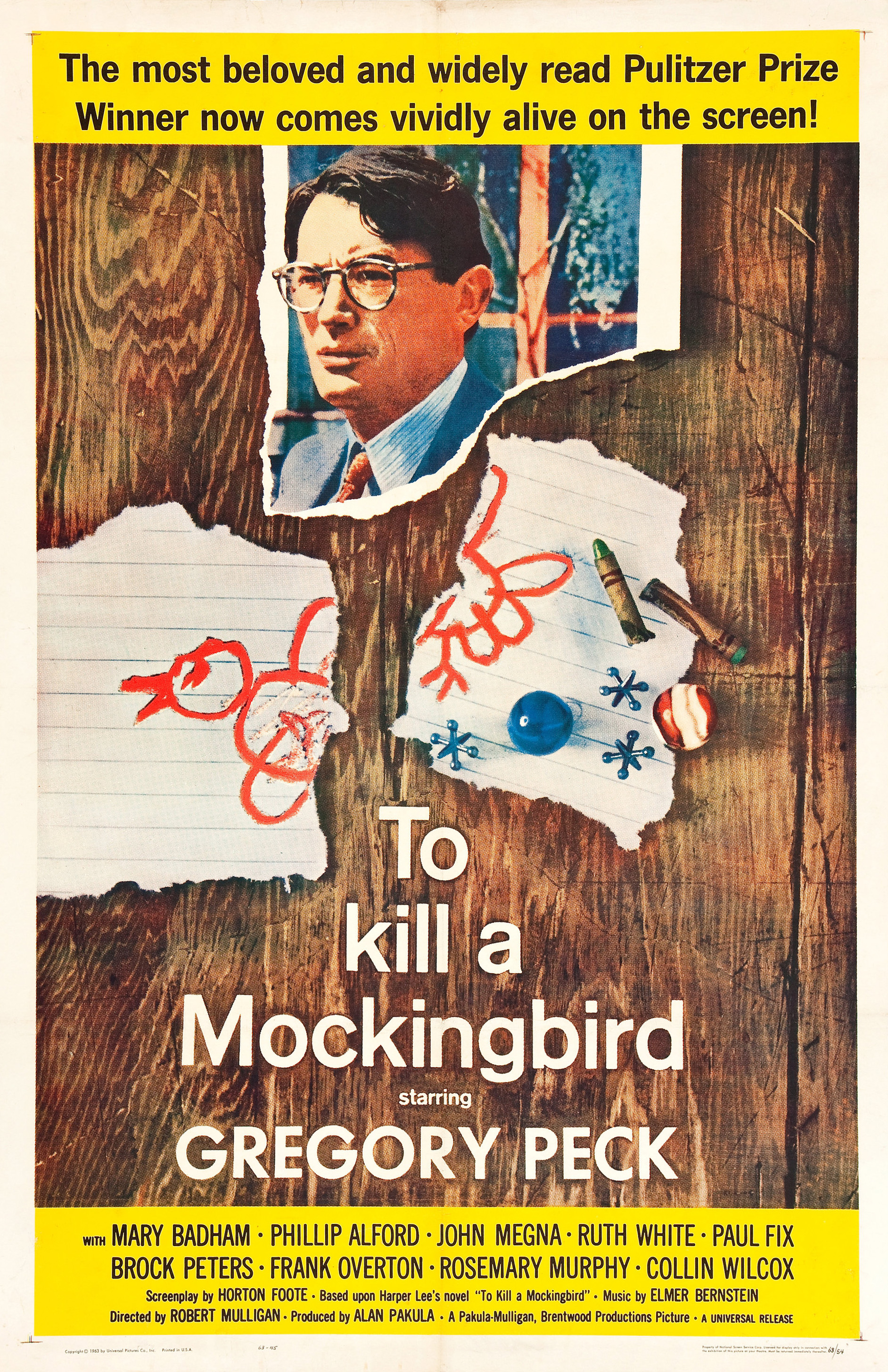
Russell Harlan’s black-and-white cinematography separates patches of bright daylight from the dark windows, interiors and woods where the children imagine danger. The contrast does not simply assign innocence to light and guilt to shadow; the courthouse itself is brightly visible while its verdict remains unjust. The film’s opening title sequence meditates on objects in a child’s box, establishing material things as fragments of memory. That attention to small objects anticipates the gifts at the Radley tree and the way the children slowly revise their idea of who Boo is. The children’s movements between these settings also give the film an accessible sense of scale: the courtroom is intimidating because it contains adults and rules, but the porch is an intimate place where one person can be encountered without the rumors surrounding him. That transition makes Scout’s final perspective-taking concrete. She has not learned that every adult is safe or fair; she has learned that the stories adults tell about a neighbor may hide the person who was there all along.
Gregory Peck plays Atticus with a calm that feels like a practiced discipline rather than a claim to control everything. His patience with Scout and Jem is part of his legal work, but the film shows how his composure can be misread as passivity by people who want justice to be forceful and immediate. Mary Badham’s Scout is curious and direct, while Phillip Alford’s Jem makes the loss of childhood certainty visible in his response to the verdict. Their performances keep the story’s moral questions attached to particular relationships rather than abstract lessons.
The closing walk with Boo gives Scout a brief chance to see the street from the neighbor’s position, but it does not undo Tom’s fate or the community’s judgment. The film sets these endings beside one another: one adult is quietly protected from a public spectacle, while another has been denied justice by the town’s formal institutions. That contrast makes the porch scene more than a comforting resolution to a mystery. Scout’s new understanding of Boo is real and personal, yet the larger town remains divided by its rules.