
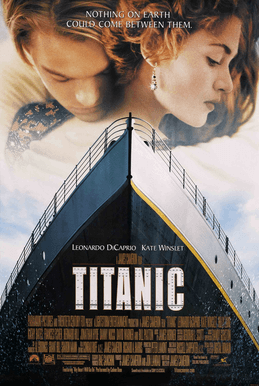
Behind the film
- Year
- 1997
- Director
- James Cameron
- Writers
- James Cameron
- Runtime
- 3h 15m
- Genres
- Disaster, Drama, Romance, Flashback
- Production
- 20th Century Studios, Paramount Pictures, Lightstorm Entertainment
- Country
- United States
- Cast
- Leonardo DiCaprio, Kate Winslet, Billy Zane, Kathy Bates, Frances Fisher, Gloria Stuart
About the film
Contains story spoilers.
James Cameron’s Titanic frames its romance inside a search for the lost ship. In 1996, a research team aboard the Keldysh explores the wreck and recovers a safe they hope contains a valuable diamond. Instead, they find a drawing of a young woman wearing the necklace. Rose Dawson Calvert, now elderly, contacts the expedition after seeing the image and comes aboard to tell the story. The frame gives the film two points of view: a modern operation mapping the wreck and Rose’s first-person recollection of the voyage. What follows is a dramatized love story set amid the historical disaster, not a claim that Jack and Rose were real passengers.
In 1912, seventeen-year-old Rose boards the ship with her mother Ruth and her fiancé Cal Hockley. Ruth treats the engagement as a financial necessity after the family’s money has run out, while Rose experiences it as a narrowing of her life. Jack Dawson, a penniless artist who won his ticket in a card game, is traveling in third class with his friend Fabrizio. He notices Rose at the rail when she considers jumping, and pulls her back. Their encounter brings him into the first-class world for an evening, where he sees the rules governing Rose’s daily life. Ruth and Cal expect her to behave as an obedient future wife; Jack responds to her as someone who can choose for herself.
Rose and Jack meet again and spend time away from the formal dinners and private rooms that organize the upper deck. Jack introduces her to his friends and the lively third-class gathering, where they dance. Cal’s bodyguard, Lovejoy, watches their growing closeness. Rose later asks Jack to draw her wearing the blue diamond necklace Cal gave her, and the drawing becomes the object the modern salvage team searches for. They hide in a car in the cargo hold, but the ship’s collision with an iceberg changes the story’s direction. The iceberg tears openings along the starboard side below the waterline. The watertight compartments can slow the flooding but are not sealed at the top, so water spilling from one compartment to the next makes the ship’s bow sink progressively lower.
As the Titanic begins to sink, Rose chooses to leave Cal and search for Jack, who has been handcuffed in a lower room after Lovejoy plants the necklace in his coat. She finds an axe and frees him. They try to reach the upper decks as water rises through the ship. Ruth and Cal seek places in the lifeboats, and Cal attempts to board by claiming a child is his. Rose and Jack are separated in the crowd and the flooding corridors, then reach the open deck as the stern rises. Rose climbs aboard a floating piece of debris, but it supports only one person. Jack remains in the water beside her; by the time she is found, he has died from the cold.
Rose is rescued by the Carpathia and gives her name as Rose Dawson, distancing herself from the identity Cal had arranged for her. In the present-day frame, she reveals that she kept the necklace and drops it into the sea above the wreck. The film then shifts to the ship’s grand staircase, where the dead passengers and crew gather as a younger Rose approaches Jack. The image may be read as a dream or an afterlife reunion; the film leaves that meaning open rather than explaining it as literal fact. Her story closes the distance between a famous wreck and the individual choices she remembers making aboard it.
The film’s scale comes from connecting small decisions to a catastrophe that no character can stop. Rose’s choice to go back for Jack, the officers’ attempts to organize evacuation, and the crew’s limited supply of lifeboats all unfold within the same physical structure. Cameron moves between intimate spaces—Rose’s cabin, the engine room, the car—and wide views of the ship, emphasizing how people occupy different social worlds while sharing one vessel. The real sinking and the fictional romance remain distinct: the film draws on a documented maritime disaster and historical figures, while its central couple and their specific relationship are inventions created to guide viewers through the event.
The ship’s class divisions remain visible even as the disaster makes the passengers share a single emergency. Rose begins in the first-class rooms with formal meals and family expectations; Jack’s route through the ship introduces her to a more crowded social world. During the evacuation, access to lifeboats and information is shaped by where people are and whom they know. The film does not claim that every historical detail unfolds exactly as shown, but uses the ship’s hierarchy to make the romance’s choices concrete. Rose is not only deciding between two men; she is resisting a future chosen by Ruth and Cal. Jack offers companionship and a different way to imagine adulthood, but he cannot protect her from the sinking or promise a life together. Her eventual survival therefore carries both gratitude and loss.