
Behind the film
- Year
- 1994
- Director
- Krzysztof Kieślowski
- Writers
- Krzysztof Kieślowski, Krzysztof Piesiewicz, Agnieszka Holland, Edward Klosinski, Edward Żebrowski, Marcin Latałło
- Genres
- Drama, Romance, Art
- Production
- France 3, Canal+
- Country
- France, Poland, Switzerland
- Cast
- Zbigniew Zamachowski, Julie Delpy, Janusz Gajos, Jerzy Stuhr, Aleksander Bardini, Juliette Binoche, Cezary Harasimowicz, Grzegorz Warchoł
About the film
Contains story spoilers.
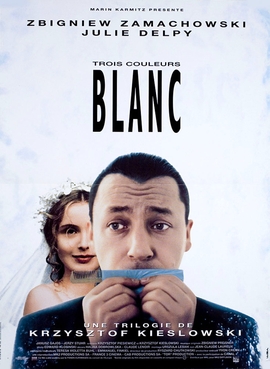
Three Colours: White begins with Karol Karol losing his marriage in a Paris courtroom. Dominique divorces him because they cannot consummate it. Deprived of money and his passport, then framed by her for arson, he begs in the Métro. Fellow Pole Mikołaj smuggles him home in a suitcase, which thieves steal and empty at a dump. Karol returns to his brother's salon and becomes a bodyguard. Overhearing a land deal, he buys ahead of his employers, protecting himself by making the church his heir if they kill him. The tune he plays on a comb in Paris belongs to another kind of loss. Speaking to Tony Rayns, Kieślowski identified it as a familiar prewar Polish drinking song about lovers parting forever. Its sentiment gives the penniless traveller a way to express what has happened to him.
Karol's name acknowledges Charlie Chaplin. Kieślowski described him as a little man combining innocence with shrewdness, qualities that let the same character suffer humiliation and devise his escape from it. His smile at an elderly person struggling to deposit a bottle is less generous: the director explained that Karol has spotted someone worse off than himself. He can take comfort in another person's disadvantage. The comedy allows that small, unflattering response to sit beside his misery. Zbigniew Zamachowski approached Karol as an ordinary man to whom extraordinary things happen. In recollections collected by the Cinémathèque française, he described adding characteristic gestures almost without Kieślowski noticing: repeatedly combing his hair and keeping a coin clenched against his palm. Such small actions gave him something particular to carry through Karol's changing circumstances.
Financial recovery does not settle the question of equality. Kieślowski told Rayns that Karol wants to be better than other people. The French revolutionary motto supplied a starting point for the trilogy, rather than a doctrine the characters would demonstrate. Asked about White's picture of post-Communist Poland, he called its money obsession a background element, while acknowledging his own bitterness about it. He did not object to enterprise itself; he objected to people caring for nothing else. Karol's success takes place in that atmosphere, where purchasing power can change his position far faster than it can cure his attachment to Dominique. Stuart Klawans's Criterion essay hears that commercial revival in Zbigniew Preisner's tango. Its lilting rhythm accompanies the growing bustle of Karol's performance. For Klawans, the film makes the energy of getting rich attractive even while the dealings around it are corrupt.
The encounter with Mikołaj takes a different route towards recovery. Writing for Culture.pl, David Tejer considers the scene in which Karol discovers that his prospective employer is himself the man who wants to die. Karol fires a blank and offers him a real bullet next; Mikołaj chooses life. Tejer reads the ice-sliding that follows as a rebirth, with white becoming a clean slate. The movement from apparent death to childish delight gives their friendship a release that money alone cannot provide. Mikołaj becomes his business partner as Karol builds a fortune.
The visual approach avoids making every image announce itself. Cinematographer Edward Kłosiński recalled knowing how sequences would be told before their locations were settled, then finding their style during filming. He wanted natural-looking lighting and few conspicuous effects, so viewers would not constantly imagine the people behind the camera. He still chose and emphasised details; restraint did not mean recording whatever happened to be there. Kieślowski likewise described white as an absence of colour, handled differently from the dramatic associations of Blue and Red. Co-writer Krzysztof Piesiewicz recalled that the absurdity of contemporary Polish life demanded humour, with Chaplin, Brueghel and Fellini among their references. The transition between films also had a practical cause. Kieślowski recalled beginning White on Blue's final shooting day to use a hard-won Paris courtroom permit. About thirty per cent was filmed in Paris before the production moved to Poland.
Klawans traces Karol's transformation through repetitions: paired guns, passports and caskets, comb performances, subway meetings and apparent returns from death. Mikołaj changes from protector to protégé, while Karol acquires a more commanding manner and an overcoat reminiscent of his friend's. His experiments with his hairstyle make reinvention a literal task for a hairdresser. Klawans also reads the ending as a reversal between countries and spouses. Dominique, heard by the French court at the beginning, becomes silent in a foreign homeland. In his reading, the couple's unequal relationship also suggests a possible relationship between Poland and France.
Wealthy Karol fakes his death, leaving Dominique his fortune. After watching her mourn, he sleeps with her successfully. Arrested for his supposed murder, she later signs through her prison window that she wants to remarry him. Watching through binoculars, he cries. Julie Delpy recalled being summoned back after filming for a new ending. As she explained in TCM's account, Kieślowski wanted Dominique to have more warmth and a chance to express herself. The additional scene was meant to leave a glimpse of hope. Kieślowski himself called White's ending happy because the two still love each other. To him, their freedom in separate countries would not compensate for the loss of that love. His answer leaves the prison bars in place while insisting that the feeling crossing them matters.