
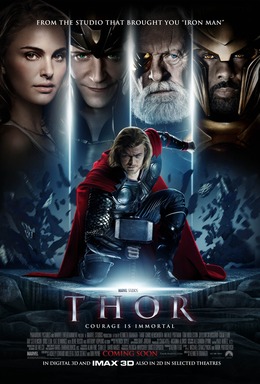
Behind the film
- Year
- 2011
- Director
- Kenneth Branagh
- Writers
- Ashley Edward Miller, Zack Stentz, Don Payne
- Genres
- Action, Fantasy, Adventure, Superhero
- Production
- Marvel Studios
- Country
- United States
- Cast
- Chris Hemsworth, Natalie Portman, Tom Hiddleston, Stellan Skarsgård, Kat Dennings, Anthony Hopkins, Idris Elba, Clark Gregg
About the film
Contains story spoilers.
Kenneth Branagh’s Thor opens on a clash between royal ambition and responsibility. In the distant past, Odin leads Asgard’s forces against the Frost Giants of Jotunheim, taking their Casket of Ancient Winters and ending the invasion of Earth. In the present, Thor expects to inherit the throne, but a Frost Giant incursion into Asgard interrupts his ceremony. Suspecting a deception, Thor ignores Odin’s command and travels to Jotunheim with Loki, Sif and the Warriors Three. His anger turns a tense border encounter into a battle, damaging the fragile peace his father had maintained.
Odin intervenes before Thor and his companions are killed, then punishes his son for confusing strength with judgment. He strips Thor of his powers, banishes him to Earth and sends Mjolnir after him with an enchantment: only someone worthy can lift it. Thor lands in New Mexico, where astrophysicist Jane Foster, her assistant Darcy Lewis and mentor Erik Selvig are conducting research. Jane’s van collides with him as he appears in the desert. The collision between Asgardian certainty and a small scientific team gives the Earth scenes a more informal, comic rhythm than the courtly ceremonies above. Jane’s equipment has registered the passage that brought Thor to Earth, but S.H.I.E.L.D. encloses the immovable hammer in a secured site and confiscates her research materials. The agency’s secrecy makes it difficult for her to continue the work or explain what the readings mean. Thor, by contrast, treats the hammer as a possession he should be able to reclaim by force. Their different responses to the same barrier help distinguish scientific curiosity from royal entitlement, while Darcy’s jokes keep the Earth scenes from becoming only a technical briefing.
Thor breaks into the secured site and strains to lift Mjolnir, but cannot move it. That defeat makes the exile concrete: he is no longer a prince whose title can command obedience. Loki visits the captive Thor and falsely tells him that Odin has died, making his banishment seem irreversible. Selvig gets him released, and Thor begins to accept ordinary kindness from Jane’s group. Back in Asgard, Loki discovers that he is Laufey’s biological son, adopted by Odin after the earlier war. The discovery turns his hurt into a political calculation: while Odin falls into the restorative Odinsleep, Loki takes the throne and offers Laufey a route to kill his father.
Sif and the Warriors Three distrust Loki’s rule and persuade Heimdall to let them reach Earth. Loki sends the Destroyer after them, both to stop the rescue and to kill Thor. When the armored machine attacks the town, Thor steps forward to protect the people who helped him, even though he has no weapon or power. The Destroyer strikes him down, and Thor’s willingness to die for others proves the quality Odin had demanded. Mjolnir flies back to him, restoring his strength. He defeats the machine, says goodbye to Jane and returns to Asgard with his friends.
Loki betrays Laufey, killing him before he can murder the sleeping Odin and presenting himself as his adoptive father’s protector. His plan has widened beyond the throne: he intends to use the Bifrost to destroy Jotunheim and prove himself more loyal to Asgard than its king. Thor fights his brother on the bridge, then breaks the Bifrost to stop the attack. Odin wakes and catches both sons as the structure collapses. When Odin rejects Loki’s plea for approval, Loki lets himself fall into the abyss. Thor makes peace with his father and admits he is not ready to rule. Jane’s team continues looking for a way to contact Asgard, while the final tag shows Loki secretly influencing Selvig as Nick Fury reveals a mysterious cube.
The film’s two worlds are designed to feel different without separating their emotional stakes. Asgard’s gold halls, ceremonial clothing and immense bridges turn family conflict into public spectacle, while Jane’s desert research sites and borrowed equipment keep Earth’s discoveries tactile and provisional. Branagh’s background in stage drama is visible in the formal confrontations: characters often state what they want from one another before action breaks their arrangement. Patrick Doyle’s score supplies a grand register, but the story’s decisive change is quieter—Thor stops treating the people around him as instruments of his pride. The final confrontation also confirms that Odin’s idea of worthiness is about restraint, not merely victory. Thor could have tried to defeat Loki without destroying the bridge, but the choice to stop the weapon costs him access to Jane and Earth. His grief at that separation keeps the decision from feeling like an effortless return to heroic status.
Thor is an origin story built around a fall from inherited authority. Its fantasy machinery gives the central choice a visible form: a hammer will answer only to someone who has learned to protect rather than dominate. Loki’s turn complicates the family drama because his grievance is real even as his choices become destructive. The film ends with Thor alive and changed, but separated from Jane by the broken bridge between worlds. His return to the throne is postponed, leaving the question of what kind of ruler he might become open beyond the immediate crisis.