
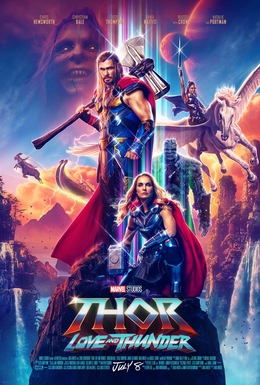
Behind the film
- Year
- 2022
- Director
- Taika Waititi
- Writers
- Taika Waititi, Jennifer Kaytin Robinson
- Runtime
- 1h 59m
- Genres
- Action, Adventure, Superhero, Science fiction
- Country
- United States
- Cast
- Chris Hemsworth, Natalie Portman, Tessa Thompson, Christian Bale, Taika Waititi, Russell Crowe, Jaimie Alexander, Chris Pratt
About the film
Contains story spoilers.
Thor: Love and Thunder begins with two very different relationships to divinity. Thor is a god trying to work out what gives his life direction; Gorr is a father whose devotion has brought no help when he needs it most. Their eventual conflict turns on what power is for and whom its holders are willing to notice. The film belongs to the Marvel screen universe, where gods can be warriors, rulers, celebrities and flawed partners. New Asgard also gives that universe a practical local dimension: displaced people have built a community rather than simply returning to the grandeur of a vanished kingdom. The rescue story moves between that community and cosmic places where ordinary suffering seems very far away.
Gorr loses his daughter, is mocked by his god, and takes up the Necrosword to kill gods. Thor returns from travelling with the Guardians to find Jane Foster wielding the repaired Mjolnir. Jane has cancer, and her transformation into Mighty Thor does not cure it. Gorr kidnaps New Asgard's children, using them to lure Thor and obtain Stormbreaker, whose Bifrost can open the way to Eternity and one wish. The heroes' appeal to Zeus fails. At Eternity's altar, Jane returns to help destroy the Necrosword despite the cost to her health. Thor urges Gorr to choose his daughter over revenge. Gorr restores her, Jane dies, and the dying Gorr entrusts the child to Thor.
Jane's presence changes the meaning of the familiar hammer. For Thor, Mjolnir carries his history and a version of himself he no longer possesses in quite the same way. For Jane, it offers access to action at a time when her body is increasingly beyond her control. Seeing an ex-partner hold that symbol therefore produces more than a visual surprise. Their former relationship has acquired a new imbalance: she can stand beside him with similar powers, but cannot depend on the same endurance. The fantasy asks us to keep both versions of Jane in view. Her heroic appearance is real within the story, yet it does not make her vulnerability unreal or reduce her choices to a temporary transformation gag.
Gorr's weapon gives him a comparable mixture of ability and cost, although he directs it towards destruction. Christian Bale's character comes from bereavement and humiliation, not from a simple wish to rule. His grievance also finds support in what the heroes encounter. The gathering of gods is concerned with its own protection, and the spectacle of divine status does not translate into assistance for the missing children. That context gives his anger a target we can understand while leaving the violence of his response unmistakable. He treats an entire class of beings as disposable because one of them revealed how little he valued a devotee. The widening of a personal loss into an indiscriminate mission is the danger the final encounter must address.
Valkyrie and Korg help set the adventure's social tone. Valkyrie has the obligations of leadership alongside the skills of a warrior; Korg's presence keeps heroic narration close to chatty storytelling. Around them, the film repeatedly brings large mythic claims down to the level of awkward companionship. Thor can possess enormous strength and still be unsure how to speak to Jane. That mismatch gives Chris Hemsworth's hero a different kind of exposure from losing a battle. A relationship cannot be restored through force, and grief cannot be defeated by discovering a more powerful weapon. The adventure's tools are impressive, but the emotional problem requires him to become available to somebody else's needs rather than continually protecting himself from another loss.
The Shadow Realm makes the conflict visible through a marked change in the film's colour and atmosphere. Away from the brighter, more exuberant environments, the heroes enter a space dominated by darkness and drained colour. Gorr's shadow creatures belong to that deprivation: his power turns absence into something capable of attacking. The contrast helps separate his outlook from the noisy divine world he despises. It also puts Jane's condition beside Thor's physical confidence without turning the whole film into a realistic account of illness. This remains fantasy, with magical transformations and cosmic rules. Those rules create a dramatic cost for her decision to keep fighting; they should not be mistaken for an explanation of real cancer or its treatment.
Taika Waititi directs, with a screenplay by Waititi and Jennifer Kaytin Robinson. The final turn shifts the scale of the solution. Gorr reaches a place where his wish could destroy the gods, but the story resolves around restoring one child and finding someone willing to care for her. Thor's new responsibility gives his search for purpose a daily shape, including the less spectacular work of being a guardian. Jane's arrival in Valhalla after the main story places her sacrifice within the film's mythology, while Zeus's desire for retaliation leaves divine vanity intact. The ending does not claim that all the powerful have learned compassion. It gives Thor a particular person to love and protect, and turns that relationship into the next reason for him to act.