
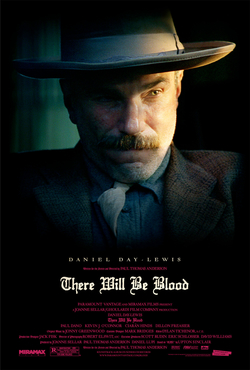
Behind the film
- Year
- 2007
- Director
- Paul Thomas Anderson
- Writers
- Paul Thomas Anderson
- Genres
- Drama, Epic, Period drama, Western
- Production
- Paramount Vantage
- Country
- United States
- Cast
- Daniel Day-Lewis, Paul Dano, Dillon Freasier, Ciarán Hinds, Kevin J. O’Connor, David Warshofsky, Russell Harvard, Hans Howes
About the film
Contains story spoilers.
There Will Be Blood begins with Daniel Plainview alone in a mine, prospecting for silver. After an accident leaves him injured, he still gets his claim registered; years later he is drilling for oil and raising the orphaned son of a dead worker as H.W. Daniel presents the boy to landowners as proof of a family business, but the arrangement also becomes a genuine bond. The film’s nearly wordless opening establishes his physical persistence before showing how he turns that endurance into a commercial method: he travels to isolated communities, studies what they need and sells them a future built around his wells.
Paul Sunday approaches Daniel with news of oil on his family’s land in Little Boston. Daniel arrives posing as a quail hunter and meets Paul’s twin brother Eli, a preacher who recognizes the value of the property. They bargain over the Sunday land and the drilling rights, with Eli seeking money for his church. Daniel acquires the surrounding leases but cannot secure William Bandy’s ranch. His operation brings workers and construction to the town, while the spiritual authority Eli claims for himself competes with Daniel’s promises of wages, roads and prosperity.
Before the well begins drilling, Daniel breaks his agreement to let Eli bless it. An accident kills a worker, and a gas blowout destroys the rig and deafens H.W. Daniel celebrates the oil discovery even while H.W. cannot hear him. Later, after the boy sets fire to their lodging during Henry’s visit, Daniel sends him to a school for deaf children. When Eli publicly presses him for the church money, Daniel humiliates him, and Eli turns on his father for trusting the oilman. The disaster reveals the precariousness beneath Daniel’s certainty: his enterprise can injure the people he claims to provide for, and he responds to vulnerability by trying to remove it from view.
A stranger arrives claiming to be Daniel’s half-brother Henry. Daniel welcomes him and brings him into his business, but small inconsistencies make him suspicious. The supposed Henry eventually admits he was a friend of the real man, who died of tuberculosis, and had hoped to find work by impersonating him. Daniel kills him and later reads the real Henry’s journal, which shows the dead brother had been traveling to meet him. The scene gives Daniel a glimpse of grief that he cannot turn into reconciliation; he drinks alone with a stranger’s memories in his hands.
The next day, Bandy offers the pipeline easement Daniel needs, but demands public repentance in Eli’s church. Eli forces Daniel through a humiliating baptism and makes him confess that he abandoned his son. The pipeline moves forward, and H.W. later returns, but the religious spectacle does not reconcile the two men. The film treats the church and oil business as rival forms of power that also borrow from one another: each requires public performance, loyalty and the ability to make a crowd believe. Daniel can endure humiliation when it brings him land, yet remains unable to accept the vulnerability involved in family life.
By 1927 Daniel is immensely wealthy and lives alone in a mansion. H.W., now an adult and married to Mary Sunday, asks to dissolve their partnership so he can start an independent drilling company in Mexico. Daniel mocks his deafness and discloses the utilitarian origins of their relationship before disowning him. H.W. leaves, and Daniel remains with the empire he built. Eli later arrives seeking money; Daniel makes him perform the humiliating confession Eli once demanded from him, then kills him in the mansion’s bowling alley. The film closes on Daniel’s final declaration, a grotesque endpoint for a man who has reduced both business and human connection to contests he must win.
Paul Thomas Anderson’s film uses long stretches of sparse dialogue, open landscapes and the sound of machinery to make extraction feel both laborious and consuming. Jonny Greenwood’s unsettled score often interrupts the apparent calm of the California terrain, while the production’s oil rigs and interiors give Daniel’s rise a material scale. The story adapts from Upton Sinclair’s novel but centers a fictionalized Daniel Plainview and does not function as a documentary portrait of any one historical oilman. Its family and church conflicts are woven into the same expanding network of ownership, until the final mansion becomes less a home than the private enclosure left by success.
Daniel Day-Lewis makes Plainview’s public salesmanship recognizably different from his private manner. Before a community, he can promise improvements and draw listeners into an account of shared prosperity; with people who cannot offer a deal, his patience contracts. Paul Dano plays both Sunday brothers, letting Paul’s practical sale of information sit beside Eli’s claims to spiritual authority. The film does not confuse the twins or reduce their dealings to one motive. Its final encounter brings business vocabulary into a private bowling alley, where Daniel explains that oil can be drawn from beneath neighboring land without buying the tract Eli now offers. The revelation empties Eli’s proposal of value before physical violence completes the humiliation. The mansion’s luxury provides room for cruelty, not a community to restrain it.