
Behind the film
- Year
- 1991
- Director
- Ridley Scott
- Writers
- Callie Khouri
- Runtime
- 2h 9m
- Genres
- Female buddy, Girls with guns, Comedy drama, Crime
- Production
- Pathé, Metro-Goldwyn-Mayer
- Country
- United States, United Kingdom, France
- Cast
- Susan Sarandon, Geena Davis, Harvey Keitel, Michael Madsen, Christopher McDonald, Stephen Tobolowsky, Brad Pitt, Jason Beghe
About the film
Contains story spoilers.
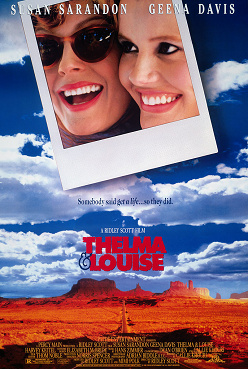
Thelma and Louise leave for a weekend away, but their trip changes after Harlan attempts to rape Thelma outside a bar. Louise intervenes, then shoots him after further taunting. Doubting that they will be believed, they flee towards Mexico. Louise obtains her savings from boyfriend Jimmy, only for the charming drifter J.D. to steal them after spending the night with Thelma. Thelma takes charge and robs a store. Investigator Hal Slocumb tries to persuade the women to surrender as their flight brings further confrontations with a state trooper and an abusive trucker. Police eventually corner them beside the Grand Canyon. They choose to keep going together and drive over the edge. The ending turns the journey's promise of freedom into an image that cannot be separated from its terrible cost.
The friendship has room for different kinds of strength. Louise begins with a practical confidence that Thelma lacks; Thelma's eagerness for adventure can look reckless beside her friend's caution. Callie Khouri's screenplay lets that balance change instead of assigning each woman a permanent function. Neither is simply the sensible one or the irresponsible one. Experience offers protection, but it can also make trust difficult; enthusiasm can expose someone to danger, but it can develop into decisiveness. Their bond becomes convincing through that movement. When one woman's resources fail, the other can act. The journey asks them to respond to each other as people whose abilities are still emerging.
Geena Davis and Susan Sarandon's characters make escape mean more than a geographical change. A weekend away is a modest wish, yet even that requires negotiation with habits of deference, obligation and fear. The film begins with circumstances in which women's decisions are already being judged by other people. Once the road opens up, those judgments do not disappear; they acquire different forms. The distance travelled therefore has an emotional counterpart. Thelma and Louise become less willing to let somebody else's explanation of their behaviour settle the matter. That change supplies the story's exhilaration, while the increasing pursuit makes clear that personal liberation does not automatically bring safety or public understanding.
The violence at the beginning cannot be reduced to a convenient trigger for an adventure. It establishes an imbalance between what happens to a person and how that event might be described afterwards. Suspicion about credibility shapes the choices available long before any courtroom exists. The film puts viewers beside the women, close to the immediate experience that an official account might flatten or dispute. It also allows the consequences of Louise's action to remain serious. Understanding the pressures behind a decision does not require pretending that the decision carries no weight. The road movie grows out of that tension between sympathy, anger and a future which has suddenly become harder to imagine.
The men surrounding the friendship do not all occupy the same moral position. Authority, attraction, commitment and concern appear in different combinations, making the women's world more complicated than a single contest against an interchangeable enemy. The significance of a gesture depends partly on who has the power to follow through. Somebody can be sincerely sympathetic and still belong to a structure that the women cannot trust. Somebody else can offer pleasure while quietly treating confidence as something to exploit. Those differences help explain why the friendship becomes the story's most dependable relationship. It is built through shared risk and attention rather than an assurance that everything will be fine.
Ridley Scott gives the journey the scale of an adventure rather than confining it to a small cautionary drama. Adrian Biddle's photography and Hans Zimmer's music belong to a film that can make movement feel expansive even as the available routes narrow. The open landscape offers a powerful contradiction: there appears to be space everywhere, yet having somewhere to go becomes increasingly difficult. That is central to the road movie's appeal here. The convertible allows a kind of exposure to the world which enclosed domestic rooms cannot, while distance never guarantees an escape from the systems following it. A beautiful horizon can promise possibility without promising a viable destination.
Humour keeps the women from becoming solemn symbols. Their companionship includes irritation, pleasure, embarrassment and the pleasure of surprising themselves. Those changes of mood matter because the film is concerned with people claiming a fuller existence, not simply embodying a position in an argument. A friendship expressed only through suffering would leave much of that existence out. The comedy makes the stakes more concrete: freedom includes the right to be foolish, enjoy company and discover another side of yourself. As the story grows more dangerous, the memory of those possibilities remains alive. The audience can understand what the women want beyond the immediate need to avoid capture.
The final image holds the promise and failure of that freedom together. It can feel defiant without becoming a practical solution to the circumstances the film has created. That unresolved quality is part of its emotional force. Thelma and Louise have become capable of choosing together, but the world around them has not become capable of accommodating that choice. Their story raises questions about whose movement gets celebrated as adventure, whose anger gets understood and whose account of an event is allowed to carry authority. Its lasting subject is the friendship itself: two women learning to rely on each other while discovering how much their supposedly ordinary lives had required them to surrender.