
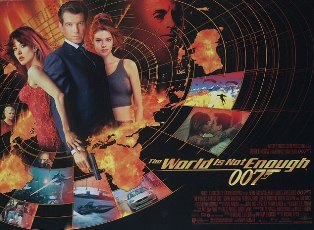
Behind the film
- Year
- 1999
- Director
- Michael Apted
- Writers
- Neal Purvis, Robert Wade, Bruce Feirstein
- Genres
- Spy, Action
- Production
- Eon Productions
- Country
- United Kingdom, United States
- Cast
- Pierce Brosnan, Sophie Marceau, Robert Carlyle, Denise Richards, Judi Dench, Robbie Coltrane, Desmond Llewelyn, John Cleese
About the film
Contains story spoilers.
The story starts with Bond retrieving money from a Swiss banker in Bilbao, but the handoff is already compromised. The banker is killed before he can identify an assassin, and Bond escapes with the cash. At MI6 in London, the money explodes and kills oil magnate Sir Robert King, a friend of M. The opening boat chase pursues the woman responsible along the Thames toward the Millennium Dome; she dies after Bond offers protection and she rejects it. The incident brings together the film’s two engines: a personal loss that puts M close to the case and a trail of violence leading toward a much larger attack. Bond’s failure to bring the assassin in alive makes the assignment more urgent, while the explosive money establishes how easily business can conceal danger.
Bond is sent to Azerbaijan to guard King’s daughter Elektra, who is overseeing a new oil pipeline across the region. Renard, the terrorist who once kidnapped her, has a bullet lodged in his brain; it dulls his ability to feel pain but is slowly killing him. The injury is more than a villain’s gimmick: Renard can withstand wounds that would stop another man, but his apparent strength comes with an approaching limit. Bond’s assignment is complicated because Elektra has been through a real ordeal and may be in danger, yet her confidence and command of the project make her difficult to read as simply a protected victim. Her father’s death also gives her an independent reason to resent MI6’s role in the earlier crisis.
A snowmobile attack on Bond and Elektra during a mountain tour reinforces the threat, while Bond’s visit to Valentin Zukovsky’s casino supplies a clue. Elektra loses a million dollars at a high-card game in a way that looks deliberate, and Bond suspects her security chief Sasha Davidov is working with Renard. He kills Davidov and travels to a dismantling site in Kazakhstan disguised as a Russian scientist. There he meets nuclear physicist Christmas Jones, who is supervising removal of weapons material. Renard steals a plutonium core and locator card from a warhead, leaving Bond and Jones to escape an exploding silo with the tracking device. Jones contributes more than technical exposition: her expertise helps Bond understand what was taken and what the material could make possible.
Back at the pipeline, Bond warns M that Elektra may have aligned herself with Renard, but before the suspicion can be resolved, the stolen bomb appears attached to a scraper heading toward the oil terminal. Bond and Jones enter the pipe to disarm it and discover half the plutonium is missing. They escape as a section is destroyed, and the outside world assumes they have died. That apparent loss gives Elektra room to reveal her true position: she arranged her father’s murder because she resented being used as bait during her kidnapping, and she takes M hostage because M had advised against paying the ransom. The change reframes the protection job, but it does not erase Elektra’s grievance; her plans grow from an understandable wound into willingness to endanger thousands.
Bond turns to Zukovsky, whose casino losses and business ties are part of Elektra’s scheme. Zukovsky admits he was promised casino bets in exchange for arranging access to an old Soviet submarine under the command of his nephew. The remaining plutonium is meant for its reactor. Christmas recognizes that a meltdown in the Bosporus would destroy Istanbul and damage competing oil routes, leaving Elektra’s pipeline more valuable. The plan combines revenge against her father, control of regional energy trade, and Renard’s willingness to die as part of the attack. Oil geography supplies the villains’ motive, while the submarine gives the scheme a mechanical deadline that Bond and Jones can actually try to stop.
The final stages split the rescue across the Maiden’s Tower and the submarine. Bond tracks M using the locator card, but an explosion at the command centre leaves him and Jones in enemy hands. Elektra tortures Bond and reveals that her victimhood concealed a partnership with Renard; she had injured her own ear to make her story convincing. Zukovsky is shot while helping Bond escape, and uses his cane gun to free him. Bond releases M and kills Elektra, then dives to the captured submarine and frees Jones. As the damaged sub sinks, he fights Renard and drives the plutonium rod into him, stopping the reactor plan. The last movement resolves each strand: M is safe, the threat is contained, and Bond and Jones reunite in Istanbul.
Apted’s film gives its international chase a chain of distinct spaces: river pursuit, Caucasus pipeline, Kazakhstan dismantling site, Caspian factory, tower, and submarine. Each location changes the practical problem rather than serving as a generic backdrop. Early set pieces make Bond’s protection assignment look conventional, while Elektra’s place in the business and history gradually alter how the viewer reads it. The finale’s underwater machinery brings the nuclear threat into a cramped physical space, where Bond’s fight with a man who feels no pain turns abstract danger into immediate action. Christmas works as a practical partner in that sequence. The story’s stakes remain a contest over territory and energy, but the characters’ choices make that large conspiracy personal.