
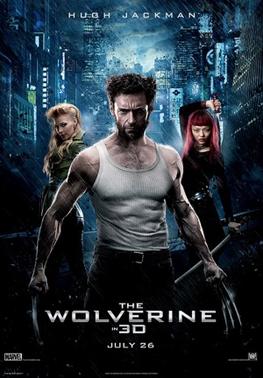
Behind the film
- Year
- 2013
- Director
- James Mangold
- Writers
- Mark Bomback, Scott Frank
- Runtime
- 2h 6m
- Genres
- Action, Superhero, Science fiction, Fantasy
- Production
- 20th Century Studios, Marvel Entertainment, The Donners' Company
- Country
- United Kingdom, United States
- Cast
- Hugh Jackman, Tao Okamoto, Rila Fukushima, Hiroyuki Sanada, Will Yun Lee, Svetlana Khodchenkova, Famke Janssen, Haruhiko Yamanouchi
About the film
Contains story spoilers.
The Wolverine places Logan’s healing ability at the center of two opposing desires. He experiences continued life as an accumulation of losses, while another man sees that same ability as an escape from death. James Mangold’s film uses the disagreement to change the usual meaning of the character’s endurance. Surviving a wound is not identical to recovering from what happened, and a body that repairs itself cannot restore the people it has lost. Hugh Jackman carries that distinction into Logan’s withdrawal from ordinary relationships. The trip to Japan brings him back into contact with obligations that do not disappear simply because he would prefer to remain alone.
The Yashida family gives the story a structure of inheritance that contrasts with Logan’s long, unsettled life. Authority is attached to a company, a household and the expectation that one generation will determine what the next receives. Mariko’s position makes that expectation unstable. A family can claim to protect her while arranging her future around somebody else’s control, giving personal attention a coercive purpose. Logan arrives as a guest who does not know the full arrangement, which makes protection a matter of learning whose explanation to trust. The family’s influence is visible through its resources, but the threat emerges from the disagreement about who should command those resources and whose wishes count when they are passed on.
Logan saved Ichirō Yashida during the Nagasaki bombing in 1945. Decades later, Yukio brings him to Japan, where the dying Yashida offers to take his healing ability. Logan refuses. After Yashida’s reported death, attackers target granddaughter Mariko, and Logan discovers that his wounds no longer heal normally. He escapes with her and uncovers a family plot over the company’s succession. With Yukio’s help, he removes a parasite from his heart and recovers his powers. Captured later, he faces the Silver Samurai armor, containing Yashida, who faked his death and is trying to extract Logan’s healing factor. The armor cuts away his metal claws, but Mariko intervenes; Logan’s bone claws return, and he kills Yashida. Yukio defeats the physician Viper. Mariko takes control of the company, and Logan leaves with Yukio after letting go of his visions of Jean, choosing continued involvement rather than his earlier isolation.
The interruption of healing changes the timing of action. Logan has to carry pain and impairment from one encounter into another, rather than allowing each fight to reset his physical condition. Movement now requires attention to what his body can endure. Mangold gives that vulnerability a spatial form in the train sequence, where speed, exposure and the need to hold on matter alongside the ability to strike. The danger is distributed across the environment, making a familiar fighting body negotiate an unfamiliar set of limits. The premise does not erase Logan’s experience. It asks what that experience can accomplish when the physical advantage on which it has often relied stops behaving as expected.
Tao Okamoto’s Mariko and Rila Fukushima’s Yukio occupy different relationships to the household’s authority. Mariko is embedded in the succession conflict, while Yukio can move between the family’s demands and Logan’s world with a more independent manner. The film gives both women consequential actions rather than making protection entirely Logan’s achievement. Their presence also offers different forms of connection: intimacy does not have the same terms as companionship, and neither needs to become permanent to matter. Yukio’s continued place beside Logan gives departure a social meaning. He can leave one household without returning to the solitary condition in which the film found him, making movement toward another place a change in how he intends to live.
Jean’s recurring presence makes memory feel more immediate than the journey’s practical complications. Famke Janssen’s character belongs to Logan’s grief rather than to a new adventure occurring alongside it. The images can offer the comfort of continued contact while keeping him attached to a loss he cannot repair. That creates a difference between the invitation to stop suffering and the obligations still available among living people. Yashida’s pursuit of longevity reflects the other side of the problem: the desire to keep living becomes detached from the people whose bodies or futures must be used to sustain it. The film sets those extremes around Logan, who has to find a reason to continue without treating continued existence as either an absolute reward or an absolute punishment.
The Silver Samurai gives the final conflict a deliberately enlarged image of possession. Technology surrounds an aging body and tries to make another person’s capacity into an extractable resource. Its armor converts family power into a machine, revealing a wish to control life that the earlier offer framed as mutual benefit. Logan’s exposed bone claws bring the confrontation back to the body beneath his familiar metal surfaces. The ending does not grant him a painless future or erase the past. It gives him a direction and someone with whom to travel, while Mariko’s new authority settles the immediate succession story. Those separate departures make survival something each character must use, rather than a single prize awarded to the strongest fighter.