
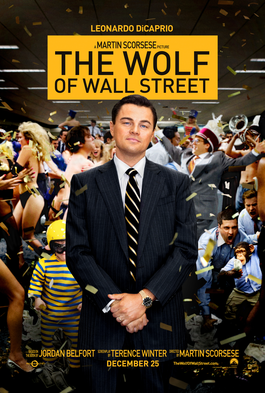
Behind the film
- Year
- 2013
- Director
- Martin Scorsese
- Writers
- Terence Winter
- Runtime
- 2h 59m
- Genres
- Black comedy, Biographical, Crime, Drama
- Production
- Paramount Pictures
- Country
- United States
- Cast
- Leonardo DiCaprio, Jonah Hill, Margot Robbie, Matthew McConaughey, Kyle Chandler, Rob Reiner, Jon Favreau, Jean Dujardin
About the film
Contains story spoilers.
Martin Scorsese’s The Wolf of Wall Street presents Jordan Belfort’s financial ascent as a performance that keeps trying to outdo itself. Jordan begins in a legitimate brokerage office, where veteran broker Mark Hanna teaches him that the business rewards appetite and persuasion. The 1987 market crash wipes out the firm, leaving Jordan looking for another route into finance. At a small operation selling penny stocks, he discovers commissions are far larger and customers easier to pressure. He recruits Donnie Azoff, and together they create Stratton Oakmont.
The firm grows through boiler-room tactics: brokers call investors, amplify promises and push shares that enrich sellers more reliably than buyers. Jordan turns the sales floor into a stage, delivering motivational speeches that blur leadership with intoxication. Donnie becomes his closest partner, and the office recruits friends willing to adopt the same swagger. The film’s energy comes from how quickly the culture becomes self-reinforcing: lavish parties and visible money convince workers that the scheme is success, while the people buying the stocks remain distant voices on the telephone.
Jordan’s personal life follows the same pattern of escalation. He marries Naomi, whose glamour and bluntness appeal to him, and moves into a home that displays wealth as proof of achievement. Their relationship becomes increasingly volatile as Jordan’s drug use, infidelity and business lies compound. He and Donnie expand the company through stock manipulation, including the public offering connected to shoe designer Steve Madden. Jordan’s salesmanship can move money and attention, but the film shows him confusing influence with invulnerability. Naomi’s decisions eventually shift from indulgence to protecting herself and their children.
Denham’s investigation gives Jordan an adversary who cannot be impressed with the sales-floor performance. Jordan’s attempted bribe fails, and he opens a Swiss account through banker Jean-Jacques Saurel using Naomi’s aunt Emma’s name. Brad’s family helps move the cash, but an argument between Brad and Donnie during a handoff draws police attention. Meanwhile, Jordan and Donnie take powerful Quaaludes whose delayed effect leaves them dangerously incapacitated. Warned that his phones are tapped, Jordan struggles home from a payphone and tries to stop Donnie discussing business on the telephone. Donnie chokes while eating, forcing Jordan to revive him. Jordan’s memory of driving home is also unreliable: the wrecked car reveals how different the journey was from the effortless escape he imagined.
Emma’s death threatens the arrangement holding Jordan’s hidden money. He tries to travel toward Switzerland, but the yacht journey from Italy encounters a storm and the passengers have to be rescued; another planned route fails when his aircraft is destroyed. These escapes delay his return to the problem rather than solving it. Saurel’s later arrest exposes information the money’s movement was meant to conceal, and Jordan is arrested. At home, Naomi tells him she wants a divorce and custody of their children. He assaults her, relapses on cocaine and tries to leave with their daughter, crashing in the driveway. The danger has reached the household directly, beyond the office performances and the transactions he tells himself he can control.
Offered a reduced sentence for cooperating, Jordan agrees to wear a wire and help expose people in his operation. During a conversation at the office, he secretly passes a note to Donnie warning him about the wire. The warning note reaches the FBI, revealing Jordan’s attempt to protect his partner despite the cooperation agreement. The exchange breaks the loyalty Jordan has spent years demanding from his employees. He is ultimately sent to prison, while the epilogue shows him later teaching sales techniques to a room of aspiring brokers. The final image leaves the audience facing the same persuasive performance that built his empire.
The narration makes Jordan a salesman of his own story. He interrupts events to explain a financial scheme, then sometimes abandons the explanation because he assumes the audience would rather hear how much money he made. Office speeches and parties provide an audience that rewards his performance, while quieter exchanges with Naomi and Denham expose the limits of his authority. The film’s rapid shifts of scale move from expensive houses and crowds of brokers to a note passed between two men. It adapts Belfort’s memoir through that character’s perspective, so the screen account remains distinct from the real criminal case. The seminar ending returns him to an audience eager to learn, leaving the appeal of the sales pitch intact after punishment.
Jordan’s narration gives him unusual control over how events are introduced, but the screen reveals the gap between his story and other people’s experience. The sales pitch promises opportunity to customers; the camera stays with sellers who know the stock is dubious. His performances inspire loyalty and mimic the rhythms of a show, yet the investigation follows evidence that cannot be talked away. Ending with a sales seminar circles back to performance and leaves the consequences of Jordan’s example uncomfortably present.