
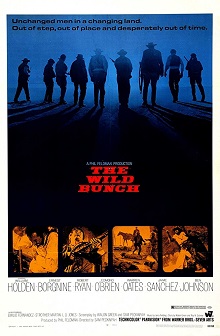
Behind the film
- Year
- 1969
- Director
- Sam Peckinpah
- Writers
- Walon Green, Sam Peckinpah, Roy N. Sickner
- Genres
- Heist, Western, Vigilante
- Production
- Warner Bros.-Seven Arts
- Country
- United States
- Cast
- William Holden, Ernest Borgnine, Robert Ryan, Edmond O'Brien, Warren Oates, Ben Johnson, Jaime Sánchez, Emilio Fernández
About the film
Contains story spoilers.
The Wild Bunch places Pike Bishop’s aging gang in 1913, as the old outlaw life is being crowded out by railroads, armies, and organized pursuit. Disguised as cavalrymen, Pike and his partners try to rob a Texas railway office, but Deke Thornton, Pike’s former associate, has been forced to lead a posse against them. A temperance parade becomes a confused massacre, and the surviving gang discovers that the stolen bags contain washers rather than money. In Mexico, Mapache offers a weapons-train robbery; Angel gives part of his share to his village, and the general seizes him when the theft is uncovered. After Mapache cuts Angel’s throat, Pike, Dutch, and the others answer with a direct attack, killing Mapache and fighting the army until the gang is wiped out. Thornton arrives afterward and chooses to remain in Mexico; Sykes later returns with villagers and revolutionaries.
Pike is neither a romantic hero nor a simple villain. He has enough authority to keep the group moving, but the film gives him moments of calculation and fatigue that make his leadership feel costly. He knows how to make decisions quickly, yet each one narrows the future available to the men around him. His connection to Thornton is especially revealing: the posse is not only a law-enforcement instrument but a reunion of former partners who have ended up on opposite sides of a changing world. Thornton’s assignment is coerced, but that does not erase the harm he helps inflict. The tension between these men rests on shared history that no longer produces shared loyalties.
The gang’s inner code is not presented as clean or noble. Its members betray, abandon, or kill people when survival demands it, and the early robbery leaves civilians caught in the violence. Yet they have a specific obligation to one another that proves stronger than the bargain with Mapache. Angel’s decision to divert rifles toward his community makes the story’s idea of loyalty concrete: he is not merely stealing from one side for personal gain, but trying to protect people whose lives are threatened by the conflict around them. Pike’s eventual return to Agua Verde comes after he has already accepted the practical cost of refusing that appeal.
Mexico is more than a backdrop for the outlaw plot. The film presents Mapache’s army as a modernized force, with uniforms, trucks, alcohol, and newly acquired weapons, while local villages live with the consequences of military power. Angel’s village has its own elders and collective memory; Agua Verde displays the general’s rule as a spectacle of excess. This contrast gives the train robbery a second meaning: the rifles move through several competing claims, from a US military shipment to Mapache’s troops, and finally to the villagers Angel hopes to defend. The movie’s fictional historical setting evokes the Mexican Revolution, but its characters and events are dramatized rather than a documentary account. The surrounding revolution remains larger than the gang, a force that neither Pike nor Mapache can fully control.
Peckinpah’s action style refuses the clean geometry of a conventional shootout. The opening ambush is difficult to parse because armed men and civilians occupy the same crowded street; the temperance marchers make violence spill into ordinary public life. Later, the climactic attack is shaped by anticipation and delay before detonating into sustained gunfire. The editing combines different angles and speeds, so one movement can be fragmented into a series of impacts rather than shown as a single, reassuring action. That approach gives gun violence a physical weight. It also changes how the viewer reads skill: precision may win a moment, but it cannot restore the world after the shooting stops.
Lucien Ballard’s wide compositions let the landscape hold the riders and their pursuers in the same frame. The land is open, but it does not provide freedom; tracks, bridges, and military routes channel movement and make escape temporary. In Agua Verde, the town’s architecture becomes part of Mapache’s display of authority, while the gang’s slow walk toward him briefly alters the balance through sheer composure. The film’s attention to faces, clothes, dust, and machinery gives its world a material specificity. The outlaws look increasingly out of place beside a system capable of replacing them with organized force.
The conclusion offers no clean way to turn the gang's code into a moral victory. Loyalty can motivate a meaningful stand without undoing earlier cruelty or protecting innocent people from its consequences. That makes the film's ageing outlaws more difficult to dismiss and more difficult to celebrate. They can recognise an obligation while remaining men whose habits have helped create the surrounding brutality. The question left behind is who might put their abilities to a different purpose, and at what cost. A changing world does not automatically become a better one. The film leaves its survivors with possibilities rather than absolution, and leaves the audience to distinguish admiration for courage from approval of the life that made it necessary.