
Behind the film
- Year
- 1973
- Director
- Sydney Pollack
- Writers
- Arthur Laurents, Dalton Trumbo
- Genres
- Romance, Drama
- Production
- Columbia Pictures
- Country
- United States
- Cast
- Barbra Streisand, Robert Redford, Bradford Dillman, Lois Chiles, Patrick O'Neal, Viveca Lindfors, Herb Edelman, Sally Kirkland
About the film
Contains story spoilers.
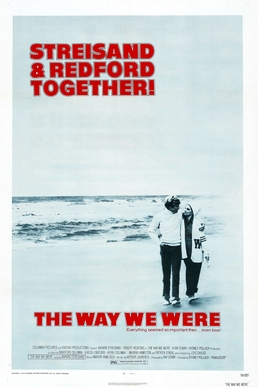
The Way We Were follows Katie Morosky, played by Barbra Streisand, and Hubbell Gardiner, played by Robert Redford. She is a Jewish political activist; he is a gifted writer. They meet at college, become lovers during the war and marry. In Hollywood, Hubbell compromises his novel and has an affair with Carol Ann. He eventually tells Katie that writing another novel was her ambition for him. Pregnant, she asks him to stay until their baby is born. Sydney Pollack's direction moves between periods of their lives. Asked about the film's jumps in time in a Directors Guild interview, he resisted the idea that flashbacks should be governed by fixed rules. He valued the freedom to move away from a strictly realistic progression and choose particular moments. His explanation concerns which parts of a relationship reach the screen: a filmmaker can select the moments that matter without having to follow every intervening step in order.
Streisand's memoir recalls producer Ray Stark asking Arthur Laurents to devise a project for her. A conversation about politics suggested Katie, whose convictions and attraction to Hubbell Streisand immediately understood. She also recalls inventing the gesture of brushing his hair aside when Katie finds him asleep at a bar, then repeating it elsewhere. Her recollection differs from Pollack's account of rehearsals: she says she disliked excessive repetition and valued the first take's spontaneity. For Streisand, listening to Redford and reacting without knowing precisely what he would do mattered more than preparing a fixed response. Pollack remembered a different practical problem. Streisand wanted extended discussion and rehearsal, while Redford felt that too much preparation made his performance stale. He described trying to time the camera so their performances reached the right point together. That account makes directing the couple a matter of judging when each actor was ready, rather than simply giving both performers the same amount of rehearsal.
Katie's origins have also been reconsidered. Interviewed by Trudy Ring about his book The Way They Were, Robert Hofler contrasted Laurents's account of a female college acquaintance with the writer's later admission that Katie was largely himself. Hofler's research included interviews with Laurents, Pollack and the stars, as well as a chapter of an unfinished Laurents novel. He reads the romance partly through Laurents's relationships with Gentile men and his feelings about being Jewish. He does not identify Hubbell as a direct portrait of one lover. In that reading, the character draws on several relationships, allowing Katie's attachment to carry experiences beyond the female classmate usually named as her inspiration. Hofler considered Jewish men loving Gentile men an underexplored subject.
Laurents's own experience of Hollywood's anti-Communist witch-hunt informed the story, as his Guardian interview explains. He remained angry about the reduction of its politics. In his Backstory 2 interview, Laurents recalled being dismissed from the production and summoned back after shooting had begun. He said he agreed to return on condition that he could leave if his work was rejected. His sharpest objection concerned the connection between politics and the marriage. He described a filmed exchange in which Hubbell explains that the studio regards Katie as subversive and threatens his job unless she informs. In Laurents's account, Katie then proposes divorce as the practical way to remove that threat. He complained that the political explanation had been cut, leaving the suggestion of divorce without its intended setup. These are his recollections of removed material, rather than dialogue to expect in the released film. He remembered being told that the filmmakers wanted a romance rather than a political picture. His concern was that the marriage's collapse had lost a specific pressure from the world around the couple. He also recalled writing a sequel script and discussing it with Redford, but regarded its prospects as doubtful. The continuation existed for him as an unrealised screenplay; it did not supply a different ending to the film audiences had seen.
Years later, Katie sees Hubbell in Manhattan with his new wife. Katie has remarried too. He now writes television. She invites him to meet her husband and their daughter Rachel, but a reunion is impossible. They embrace sadly and part. Marvin Hamlisch's music returns the relationship to that last meeting. He had known Streisand as the rehearsal pianist on Funny Girl; Stark asked him to write a theme on spec, with the scoring job dependent on approval. Alan and Marilyn Bergman supplied the lyrics, which Hamlisch welcomed without reservations. Streisand suggested a melodic adjustment and a change in the opening thought. A second, more complicated song was recorded, but comparing both versions against the film led back to the original. Hamlisch initially avoided using the theme at the final encounter, fearing excess. Arranger Leo Shuken argued that dialogue absorbed attention differently from music. Hamlisch paid for another orchestral session himself to add the theme to the scene.