
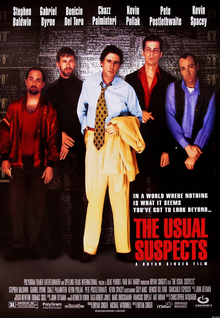
Behind the film
- Year
- 1995
- Director
- Bryan Singer
- Writers
- Christopher McQuarrie
- Runtime
- 1h 46m
- Genres
- Heist, Neo-noir, Mystery, Flashback
- Production
- PolyGram Filmed Entertainment
- Country
- United States
- Cast
- Stephen Baldwin, Gabriel Byrne, Benicio Del Toro, Kevin Pollak, Kevin Spacey, Chazz Palminteri, Pete Postlethwaite, Peter Greene
About the film
Contains story spoilers.
The Usual Suspects opens after the violence: a ship burns at a California dock, and the injured Hungarian survivor Arkosh Kovash is taken to hospital while police question the limping Verbal Kint. Verbal’s account moves back six weeks to a New York police lineup, where he met Dean Keaton, Michael McManus, Fred Fenster and Todd Hockney. None had been involved in the truck hijacking for which they were detained, but the indignity and anger of being used as convenient suspects create a shared grievance. The story is filtered from the beginning through a man who is both witness and participant, and the framing interview invites us to judge his control of detail.
The five men later rob an emerald smuggler connected to corrupt police, an operation that gives them money and a sense of retaliation. They take the jewels to California and sell them to Redfoot, who offers them another job. That robbery goes badly, and the group discovers that lawyer Kobayashi has arranged the chain of events. He says he works for Keyser Söze, an elusive Turkish crime lord whom each man has unknowingly crossed. The film lets the idea of Söze grow through stories rather than direct appearances: each new account makes him seem less like an ordinary criminal and more like a force that can make others act through fear.
Kobayashi’s demand is precise and terrifying. The group must raid a ship carrying Argentinian smugglers and destroy a cargo of cocaine worth millions; in exchange, Söze will settle their individual debts. Fenster tries to escape and is killed before the raid. The others are kept in line by threats against their families and loved ones, and their distrust does not help them find a safe alternative. Keaton, once a police officer himself, tries to read the plan like a professional operation, while McManus and Hockney are more openly impatient. Verbal appears to be the weakest member, but his position gives him time to observe how the men react.
At the ship, the supposed cocaine is missing. The crew instead finds a collection of armed men, and the raid turns into a massacre whose cause is not fully clear from Verbal’s point of view. Hockney, McManus and Keaton are killed during the attack. Verbal hides on the dock, while another figure moves through the ship and sets it ablaze. The opening scenes now acquire a context, but not certainty: the viewer has heard what Verbal says happened, not received an independent account of every death. In parallel, Kovash describes a figure he believes was Söze, and a sketch artist is trying to turn a fleeting sight into evidence.
Detective David Kujan is especially interested in Keaton, whose past as a corrupt officer and alleged attempt at reform make him a plausible mastermind. He believes Verbal’s story points to Keaton as Söze and presses Verbal until he agrees. That conclusion satisfies Kujan’s theory but also changes what the audience is watching: the interrogation has become a collaborative construction, with the detective supplying interpretations and the witness shaping his account around them. Verbal gives a vivid story of Söze’s brutality, but the film withholds the neutral narrator who could confirm which parts are remembered, invented or assembled to keep Kujan focused on Keaton.
After Verbal is released, Kujan notices that names and details from the story match objects on the office bulletin board and the bottom of his coffee mug. He runs after Verbal, whose limp disappears as he walks away. Kovash’s sketch arrives at the station and resembles Verbal, who escapes in a car with the man he called Kobayashi. The revelation does not neatly answer every question about the ship; instead it forces a re-reading of the testimony. Verbal may be Söze, and much of what Kujan accepted may have been improvised from the room, but the film preserves uncertainty about which events occurred as narrated.
Bryan Singer’s direction and John Ottman’s editing make the story’s two time frames distinct but connected. The interrogation room is plain and controlled, while the flashbacks give Verbal’s recollections more movement and atmosphere. The editing makes transitions feel like evidence being laid out, though the final discovery reveals how easily those apparent clues can be rearranged. Christopher McQuarrie’s screenplay builds the mystery through competing stories, not through a puzzle with one objective viewpoint. The ensemble cast gives each criminal a recognizable temperament—Keaton’s guarded authority, McManus’s aggression, Fenster’s nervousness, Hockney’s cynicism and Verbal’s mildness—so the group feels like a temporary alliance rather than a stable crew.
The film’s central contest is not only to identify a mastermind, but to notice who has power to tell the story. Kujan thinks his interrogation method is exposing truth; Verbal appears to be a cooperative, physically vulnerable source; and the viewer is encouraged to use the same details as Kujan. The final image of Verbal slipping away turns that confidence into an open question. The burning ship has a firm place in the frame story, while the chain of motives and identities remains colored by a narrator who may be the person everyone is hunting. Its ending leaves the story’s account itself as the last piece of evidence.