
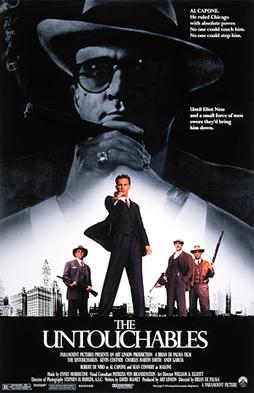
Behind the film
- Year
- 1987
- Director
- Brian De Palma
- Writers
- David Mamet
- Runtime
- 1h 59m
- Genres
- Gangster, Historical, Action, Biographical
- Production
- Paramount Pictures
- Country
- United States
- Cast
- Kevin Costner, Sean Connery, Charles Martin Smith, Andy Garcia, Robert De Niro, Richard Bradford, Jack Kehoe, Patricia Clarkson
About the film
Contains story spoilers.
Brian De Palma’s The Untouchables places Eliot Ness in a Chicago where Prohibition has made illegal alcohol a public business and gang violence an instrument of control. Ness begins with a failed raid, learning that information reaches Capone before his team can act. Veteran officer Jim Malone offers a harder lesson: trust must be earned one person at a time. Ness recruits police trainee George Stone for his marksmanship and integrity, and accountant Oscar Wallace for a less glamorous but more promising angle on Capone’s power.
The small team’s first successful liquor raid wins them a name in the press, but its progress carries personal risk. Wallace recognizes that Capone’s failure to file income-tax returns may be more useful than a direct attempt to prosecute every crime, while Capone’s enforcer Frank Nitti threatens Ness’s family. A border operation captures a bookkeeper who can testify; Nitti then kills Wallace and the witness in a police-station elevator. Malone, who has helped Ness build the team, is attacked and mortally wounded. His last information leads Ness and Stone to the Union Station confrontation with another accountant, Walter Payne.
The station sequence is the film’s most famous piece of visual construction. Ness pauses to help a mother struggling up the stairs with a baby carriage, while armed men arrive to protect Payne. The action unfolds across the height of the concourse: the carriage tips and rolls down the steps as Ness and Stone exchange fire with the guards. The scene makes a public architectural space into a maze of exposure, with the endangered child and the case’s key witness sharing the same dangerous frame. It is not presented as a real event in Ness’s career, but as an emphatic set piece in the film’s invented pursuit.
At Capone’s trial, Ness notices the gangster’s calm and spots Nitti carrying a gun. Searching him reveals a matchbook bearing Malone’s address, and Ness connects Nitti to the murder. On the courthouse roof, Nitti taunts him about escaping punishment; Ness throws him to his death. Stone then finds a list showing the jurors have been bought, and Ness persuades the judge to switch Capone’s jury with one from another case. Capone’s lawyer enters a guilty plea to tax evasion, and the film closes with Ness packing up his office, giving Stone Malone’s keepsakes and anticipating the repeal of Prohibition.
The film's small team is a practical answer to a problem of scale. Capone's authority reaches across the city, while Ness can make progress only after identifying a few people whose conduct he can rely on. Accounting gives that trust a different purpose from marksmanship: one skill can protect a witness, while another makes the witness's knowledge usable in court. The deaths unsettle that balance and leave Ness tempted to make anger do the work of procedure. De Palma's heroic crime drama gives the confrontation clear sides, but the protagonist's decisions still reveal a tension between taking a criminal's power away and reproducing his disregard for the law.
De Palma’s craft makes that moral clarity feel physically immediate. The Union Station set piece stretches time through slow motion, carefully spaced movements and repeated changes in point of view. Elsewhere, strong diagonals and deep, composed spaces make law offices, warehouses and hotel interiors feel like arenas where someone is likely to be watched. The direction favors overtly shaped moments rather than procedural naturalism; details are arranged for an audience as conspicuously as they are for the characters. Morricone’s theme gives the story a ceremonial quality, especially against De Palma’s sharp transitions between private conversations and public danger. The sound often lets the audience register a scene’s scale before the frame settles on who is at risk. That music and the city’s imposing architecture support the film’s deliberately mythic shape, even as the historical boundary remains important: the film is telling a designed story about how courage and procedure might work together.
Ennio Morricone’s score supplies a broad, memorable emotional register, while the period costumes and Chicago locations make the world feel grander than the small team’s resources. Malone’s apartment and the Untouchables’ office give Ness two contrasting kinds of instruction: private, conversational judgment and formal public duty. Sean Connery’s Malone is not merely an older mentor but the person who insists that Ness learn how corruption actually operates before making another raid. His death gives that advice a cost without making Ness’s anger a reliable guide. Its work therefore lasts to the very end.
Kevin Costner plays Ness as a family man learning to turn idealism into tactics, while Charles Martin Smith lets Wallace’s accounting work feel like a distinct kind of courage. Andy Garcia’s Stone is introduced through precision rather than speech, and Robert De Niro makes Capone’s command visible in the reactions of everyone around him. The ensemble gives the film several competing forms of authority—street violence, institutional access, expertise and trust. Its final victory is deliberately limited: Capone is convicted, but Ness’s farewell suggests that the team’s temporary alliance has reached its end.