
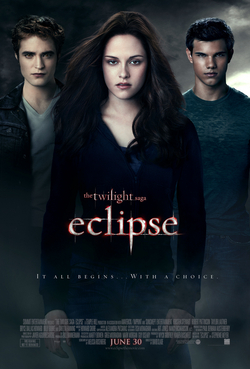
Behind the film
- Year
- 2010
- Director
- David Slade
- Writers
- Melissa Rosenberg
- Runtime
- 2h 4m
- Genres
- Romance, Fantasy, Teen, Vampire
- Production
- Summit Entertainment, Maverick Films
- Country
- United States
- Cast
- Kristen Stewart, Robert Pattinson, Taylor Lautner, Bryce Dallas Howard, Billy Burke, Peter Facinelli, Ashley Greene, Jackson Rathbone
About the film
Contains story spoilers.
David Slade’s Eclipse begins with Victoria building a newborn vampire force to take revenge on Edward. In Forks, Bella is weighing her future with Edward and her friendship with Jacob, while the Cullens discover the threat approaching town. Edward’s family and the werewolf pack agree to fight together; the battle leaves Jacob injured, Victoria dead and newborn Bree in the Volturi’s custody, where she is killed. Bella chooses Edward and accepts his marriage proposal, but remains human as the film ends. This conflict gives the third Twilight film a sharper external frame than a romance alone: the characters’ private decisions take place beside a threat that can only be met through cooperation among groups that distrust one another.
The love triangle is less a contest over which young man is more attractive than a clash between possible lives. Bella’s bond with Jacob carries the familiarity of a friendship tied to family and community, while Edward offers access to a world whose dangers and rules she already knows. Her choice is not made at the story’s end by a supernatural transformation; she is still human, and the commitment she makes points toward a future rather than resolving every consequence in advance.
Edward and Jacob’s rivalry is often staged through physical closeness and protective gestures. Their attempts to guard Bella can resemble care while also restricting her freedom to decide. Bella objects when information is withheld from her and when the men treat her as a problem to be managed. The film’s conflict between protection and agency is therefore built into the romance itself. She can love people who disagree with her choices and still insist that those choices belong to her.
The newborn threat gives the vampires and werewolves a reason to cooperate without making their history disappear. Their preparation scenes emphasize that trust is practical and provisional: they need to learn how to fight together, even though their loyalties and bodies are different. Jasper’s experience with an earlier newborn army gives him a special role as trainer, and his account introduces a perspective beyond Bella’s immediate relationships. The alliance is not an abstract symbol of harmony; it is a short-term agreement that has to be made useful before Victoria’s force reaches them. Jasper’s authority is useful because it comes from experience with newborns of the kind they face, but the film also marks the cost of that past. His advice is tactical rather than triumphant, giving the training a wary tone: survival depends on preparation, not on the romance of being a warrior.
Charlie Swan’s part in the story keeps Forks connected to ordinary family life. He worries about Bella’s isolation and her closeness to Edward, while she tries to maintain both romantic and childhood connections under the pressure of danger. The school, home and forest create different degrees of exposure: public routines make her visible to friends and family, whereas the secluded settings hold the supernatural conflict. This small-town geography helps the film move between teen drama and fantasy action without making either world feel entirely separate.
Slade gives the film a cooler, more suspenseful visual tone than a straightforward romance. Seattle’s attacks and the training in the forest make the approaching threat feel like a pattern gradually moving toward Forks. In contrast, scenes between Bella and Edward or Jacob often linger on faces and pauses, allowing attraction and disagreement to share a moment. The contrast gives the approaching violence a different pace from Bella’s conversations, which can pause around an unanswered question or an uncertain commitment. The balance between these visual registers helps the viewer read the story’s changing scale. Close framing preserves the awkward privacy of an argument between teenagers, while wider forest scenes turn the same characters into a coordinated group. Neither scale removes the consequences of choosing a future before knowing how it will feel.
Bella’s final choice is treated as both emotional commitment and a decision about identity. She is drawn to the vampire world, but the story stops before that change occurs, leaving her with a human life and a promise that will require negotiation with her father and her friends. This makes the ending a threshold rather than a transformation scene. The series’ supernatural premise remains important, but the film’s immediate resolution is a conversation about what Bella values and what she is willing to choose.
The film lets its different modes speak to one another: the quiet scenes ask who Bella wants to become, while the action plot asks what happens when those private relationships are tested by a shared danger. The characters’ alliances do not erase competition or grief; they make cooperation necessary for a limited purpose. That tension gives Eclipse its shape. It is a romance set against a coming battle, but the battle’s clearest consequence is not a new supernatural status for Bella. It is a stronger declaration of the life she intends to pursue.