
Behind the film
- Year
- 2010
- Director
- Florian Henckel von Donnersmarck
- Writers
- Florian Henckel von Donnersmarck, Christopher McQuarrie, Julian Fellowes
- Runtime
- 103 minutes
- Genres
- Crime, Drama, Action, Melodrama
- Production
- StudioCanal, Spyglass Media Group, GK Films
- Country
- United States, Italy, France
- Cast
- Angelina Jolie, Johnny Depp, Paul Bettany, Timothy Dalton, Steven Berkoff, Rufus Sewell, Christian De Sica, Igor Jijikine
About the film
Contains story spoilers.
The Tourist makes the problem of reading another person inseparable from the possibility of falling for them. A meeting can appear spontaneous while somebody else has arranged its circumstances, and an attractive invitation can create a role the recipient does not understand. The film places that uncertainty inside a polished European holiday. Its promise of leisure depends on movement through beautiful public spaces, while its suspense depends on those same spaces being watched. Romance and investigation therefore share a question: how much can a gesture tell somebody when the person making it has reasons to conceal what the gesture is meant to accomplish?
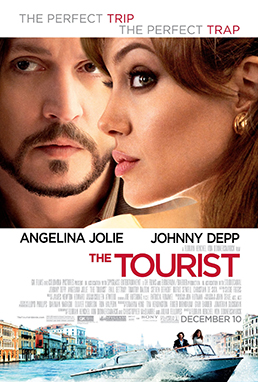
Florian Henckel von Donnersmarck directs the 2010 film, starring Angelina Jolie as Elise and Johnny Depp as Frank. Von Donnersmarck, Christopher McQuarrie and Julian Fellowes receive the screenplay credits. Paul Bettany plays Acheson, Timothy Dalton plays Jones and Steven Berkoff plays Shaw. The story moves from Paris to Venice, combining romantic intrigue with a pursuit built around a missing man's identity. Its apparently ordinary traveller is drawn into a world in which police and criminals can interpret the same meeting differently. The setting supports that confusion by making public visibility and private intention difficult to separate, even when the surroundings suggest an uncomplicated escape from everyday responsibilities.
Elise follows instructions from her missing lover Pearce to select a decoy on the train to Venice. Frank becomes that apparent substitute, drawing pursuit from authorities and gangster Shaw. Elise rescues him but remains entangled with Acheson's investigation. Shaw eventually holds her hostage while demanding access to Pearce's money. Frank returns to protect her; Jones orders intervention that kills Shaw and his men. An arrested supposed Pearce proves to be another decoy. Frank then opens the safe, revealing that he is Pearce after altered appearance. The authorities find payment for the outstanding tax debt, and Frank and Elise leave together.
The decoy premise makes appearance a practical problem rather than simply a theme announced through dialogue. An observer needs to decide who somebody is, but the information available can be selected specifically to encourage the wrong answer. Confidence does not guarantee that an inference is sound. The police and the criminal pursuit can each become vulnerable to the expectation that they already understand what they are seeing. This gives the romance another dimension: attraction also involves building an explanation from incomplete evidence. Wanting to believe a person can make a plausible account feel more certain than the available knowledge really permits.
Elise's role asks her to manage other people's attention while remaining involved in the feelings that management produces. Being able to direct a meeting does not mean remaining unaffected by it. That tension gives her composure a purpose beyond presenting an elegant figure within the setting. Control can become difficult when an apparently useful performance creates genuine attachment, or when the same act exposes somebody to danger. The story's uncertainty keeps intention and consequence close together without making them identical. Somebody can understand what they meant to do and still have to reckon with a result that makes continuing along the intended path harder to justify.
Venice gives the pursuit a world in which movement and exposure belong to the same routes. A visitor may experience a city as a series of attractive destinations, while someone following that visitor reads it through access, visibility and possible escape. The film lets those perspectives occupy the same surroundings. That contrast suits a traveller's limited understanding: places can remain beautiful while becoming difficult to navigate safely. It also connects the holiday fantasy to the thriller's pressure. The freedom associated with being away from home comes with reduced familiarity, making the person offering guidance more important and potentially harder to assess independently.
The romantic intrigue concerns trust without pretending trust is simply the absence of uncertainty. A relationship can develop through moments whose meaning changes when later information becomes available. That does not automatically make every earlier feeling false, but it requires the people involved to reconsider what they thought they understood. The story's identity puzzle places that reconsideration at its centre. Affection and explanation are intertwined, while neither can entirely replace the other. A person might feel sincere attachment to somebody whose past remains concealed, yet the attachment alone cannot establish whether the danger around them is understood or whether consent to it was meaningfully given.
The ending brings practical knowledge into the romantic revelation. A person's ability to do something specific can answer a question that appearance, manner and official pursuit have left unresolved. The crime story and the relationship consequently meet in the same disclosure rather than requiring entirely separate conclusions. That resolution also gives the holiday setting a new significance: departure becomes possible once the immediate pressures change. The Tourist is a romantic suspense story organised around the instability of an apparently chance encounter, with its central pleasures coming from how a place associated with leisure becomes a stage for identities other people are struggling to recognise.