
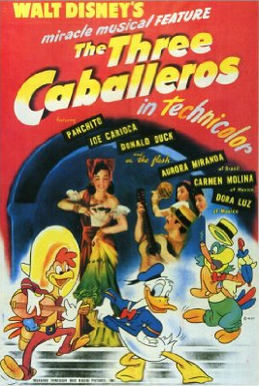
Behind the film
- Year
- 1944
- Director
- Norman Ferguson, Clyde Geronimi, Jack Kinney, Bill Roberts, Harold Young
- Writers
- Homer Brightman, Ernest Terrazas, Ted Sears, Bill Peet, Ralph Wright, Elmer Plummer
- Genres
- Musical, Children's, Fantasy, Family
- Production
- The Walt Disney Company
- Country
- United States
- Cast
- Clarence Nash, José Oliveira, Joaquin Garay, Aurora Miranda, Dora Luz, Carmen Molina
About the film
Contains story spoilers.
The Three Caballeros gives Donald Duck a birthday celebration that keeps expanding beyond the room in which he opens his presents. Gifts from friends in Latin America become films to watch, a book to enter and a journey in which music can change the size and shape of the world. José Carioca, the Brazilian parrot introduced in Saludos Amigos, returns as a guide, while Panchito joins them as an exuberant Mexican rooster. Their friendship supplies the frame for a collection of stories, performances and visual experiments rather than a single quest with a villain to defeat. Donald’s curiosity, impatience and romantic enthusiasm provide continuity when the film shifts between places and forms. He is both a spectator learning about unfamiliar experiences and a disruptive visitor whose reactions keep pulling the presentation into comedy.
The first gift is a projector, making the early part of the film a show that Donald watches alongside the audience. One story follows Pablo, a penguin who longs to leave the cold South Pole. His efforts to reach a warm island reverse the usual expectation that a penguin belongs happily among ice and snow, and arrival does not entirely free him from nostalgia for what he left. The bird material also introduces the Aracuan, whose odd cry and unpredictable appearances undermine attempts to keep the presentation orderly. Another story follows a young gaucho and a donkey with wings, turning a racing opportunity into a problem of concealment. These episodes give the birthday gift variety: it can contain a travel account, an animal joke or a small fable before Donald’s companions physically draw him into the journey.
José’s pop-up book changes the relationship between image and traveler. Instead of remaining outside a projected story, Donald shrinks and enters an illustrated route toward Bahia. The sequence mixes drawn characters with live performers, including Aurora Miranda as a seller of quindim, and lets Donald’s attraction interrupt the business of looking around. Music organizes the encounter, while buildings, dancers and cartoon reactions occupy the same apparent space. Donald can follow a performer without belonging to the world in quite the same way she does, so his movement continually tests the boundary between the animated visitor and the photographed setting. The book is therefore more than another present: its pages give the film permission to move from observing a place into inventing an encounter inside it.
Panchito’s arrival supplies the third member of the group and a new burst of ceremony. The trio’s musical identity is playful and expansive, with instruments, hats and the characters’ changing positions becoming part of the performance. Panchito introduces Mexican customs, including Las Posadas and the breaking of a piñata. Donald’s attempt to take part turns explanation into action, letting a shared celebration become another source of comic frustration. A flying serape then carries the friends through further sights, songs and dances. The film’s travel rules no longer depend on ordinary transport: a woven object can become a vehicle, and a musical number can move the characters between places before any realistic itinerary needs to catch up. José and Panchito retain their roles as companions even when Donald’s attention wanders elsewhere.
The later material becomes increasingly dreamlike as Donald pursues singers and dancers through a world of shifting colors and shapes. Dora Luz’s performance and Carmen Molina’s dancing are incorporated into sequences where animation no longer merely fills a corner of a live-action image. It responds to movement, multiplies figures and turns attraction into a visual reverie. Patterns can replace geography, and a cut can move Donald from an identifiable setting into a space governed by rhythm rather than gravity. The climax brings that looseness back to a physical gag, with a firecracker bull chasing him. The birthday celebration ends in commotion rather than a final lesson or a completed expedition. Its movement has been from manageable presents toward an experience Donald cannot keep under control.
The film’s anthology structure means that its world is best understood through transitions. The projector places a boundary between Donald and a story; the book allows him to cross one; the musical fantasy makes boundaries themselves unstable. The Aracuan repeatedly interferes with those arrangements, including drawing tracks that redirect a train. A supposedly explanatory presentation can therefore be interrupted by a creature who behaves as if the picture is his playground. This is animation using its ability to revise the rules of a scene in front of the viewer. It also explains why the film can feel less like a conventional travel narrative than a collection of experiments connected by three personalities. Donald resists and desires, José guides with relaxed confidence, and Panchito continually enlarges the scale of the occasion.
The Three Caballeros premiered in Mexico City in 1944 before its American release in 1945, and its interest in Latin America belongs to Disney’s wartime cultural exchange projects. That context helps explain the mixture of introductions, songs and broad comic impressions, but the film remains an entertainment assembled from selected images rather than a comprehensive account of the countries it visits. Its most distinctive achievement is the interaction between photographed performers and drawn characters, extending techniques that the studio had used on a smaller scale. Donald can dance alongside a human performer, react to her and then carry the encounter into impossible space. The result preserves traces of real performance while making the surrounding world elastic. Watching how those layers meet gives the musical journey a second story: the film is exploring what a feature-length combination of live action and animation can become.