
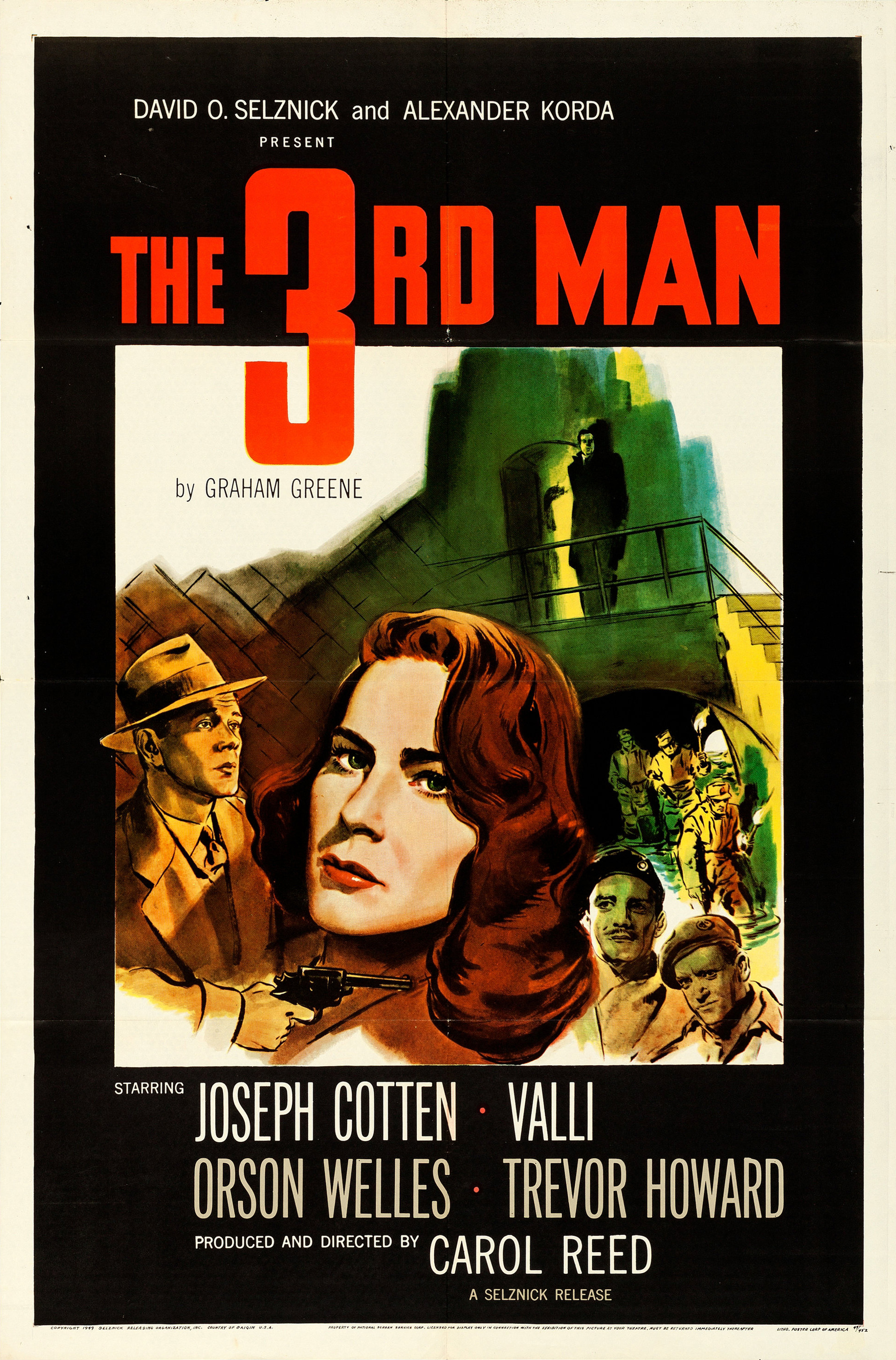
Behind the film
- Year
- 1949
- Director
- Carol Reed
- Writers
- Graham Greene
- Genres
- Film noir, Mystery, Drama, Thriller
- Production
- London Films
- Country
- United Kingdom
- Cast
- Joseph Cotten, Alida Valli, Orson Welles, Trevor Howard, Bernard Lee, Paul Hörbiger, Ernst Deutsch, Erich Ponto
About the film
Contains story spoilers.
The Third Man brings Holly Martins to Vienna with a promise that has already become impossible to collect. His friend Harry Lime has offered him work, but Holly arrives in time for a funeral. The city is divided among occupying powers, and an American visitor cannot assume that he understands either its rules or the people speaking to him. Joseph Cotten plays Holly as a man accustomed to supplying clear plots in his Western novels, now confronted by a place that refuses to arrange itself so simply. His initial faith in Harry gives him a reason to investigate and a reason to resist what the investigation might reveal.
Major Calloway regards Lime as a criminal, a judgement Holly takes as an insult to someone he knows better than the officer does. Sergeant Paine’s familiarity with Holly’s books briefly offers a friendlier connection without changing the official view of Harry. Conversations with people supposedly present at the fatal accident introduce discrepancies, especially a porter’s account of another man helping carry the body. The title’s unanswered identity becomes a way into a larger problem: several witnesses seem to be providing a story they want repeated rather than one they are willing to examine. Holly’s insistence on asking questions makes him increasingly visible to people who would prefer that he leave.
Harry’s girlfriend Anna supplies a different kind of loyalty. Played by Alida Valli, she mourns someone whose importance to her cannot be replaced by Holly’s willingness to help. Her precarious papers also make the boundaries between Vienna’s occupied sectors personally consequential. A document can protect her, expose her or be used in a bargain conducted by officials and men who claim affection. Holly’s growing attachment gives his investigation another motive, but it does not give him authority over her feelings. She can recognise information about Harry while continuing to love him, refusing the tidy emotional conversion Holly hopes his discoveries will produce.
Carol Reed makes the city’s architecture part of that resistance to clarity. Streets tilt in the frame, shadows separate a person from a recognisable face, and damaged spaces offer routes that an outsider may not know exist. Anton Karas’s zither music brings an unexpectedly jaunty sound to those movements, letting menace and charm coexist instead of assigning the city a single sombre mood. The porter’s death makes Holly’s search dangerous, while a literary talk provides a different humiliation when his presumed expertise fails to match the audience’s expectations. He can neither command the mystery nor remain the confident author presented by his professional identity.
Harry’s reappearance in a doorway gives that unstable world a face Holly has been determined to find. Orson Welles allows a small smile to carry the shock of recognising a friend whose funeral has already taken place. Their later meeting on the giant wheel changes the scale of the argument: people below become small enough for Harry to discuss them as figures in a calculation. His charm remains intact while his account of his business reveals how readily he discounts suffering. Holly has to reconcile the familiar friend with the person speaking in front of him. The reunion supplies an answer to the apparent death without supplying the reassurance he had wanted from that answer.
Calloway’s evidence about diluted penicillin gives the criminal activity consequences that cannot remain a rumour about Harry’s associates. Seeing its effects on children makes Holly’s personal loyalty harder to preserve as an innocent position. Agreeing to help catch Harry is still complicated by Anna’s situation and her refusal to accept the bargain as a kindness. The film does not let discovering the truth make Holly’s motives pure or his actions painless. He is changing sides within a set of relationships that matter to him, and the person he hopes to protect may experience that change as another betrayal rather than proof that he cares.
The planned meeting leads into the sewers, where Harry’s knowledge of Vienna becomes a means of escape. The chase strips away much of the social performance that has sustained the deception, leaving sounds, water, light and blocked routes to determine what anyone can do. Paine is killed, Harry is wounded, and Holly follows the man he once wanted to defend. Their final encounter takes place beneath a street grating that offers an image of an exit without allowing Harry to reach it. A shot ends the pursuit. The friendship cannot survive the decision, and the city offers no scene in which Holly can explain it into a more comfortable result.
At the second funeral, he waits for Anna beside the long road from the cemetery. Her approach takes enough time to create the expectation that she will acknowledge him, making her silent passage feel like a choice rather than an incidental missed meeting. She continues past without giving him the reconciliation that a solved mystery might ordinarily promise. Graham Greene’s screenplay lets the investigation reach its conclusion while leaving the emotional account unsettled. Vienna has taught Holly something about the friend he came to see, but that knowledge cannot recover the earlier friendship or compel another person’s forgiveness. The last stretch of road gives the cost of understanding a space as memorable as the chase that preceded it.