
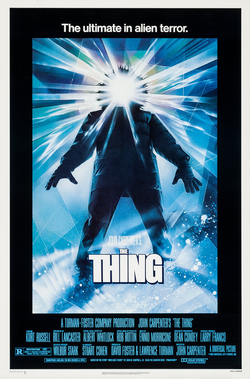
Behind the film
- Year
- 1982
- Director
- John Carpenter
- Writers
- Bill Lancaster
- Runtime
- 1h 49m
- Genres
- Horror, Science fiction, Mystery, Body horror
- Production
- Universal Pictures
- Country
- United States, Canada
- Cast
- Kurt Russell, Wilford Brimley, Keith David, Donald Moffat, Charles Hallahan, T. K. Carter, David Clennon, Richard Masur
About the film
Contains story spoilers.
John Carpenter’s The Thing opens with a dog running over the Antarctic snow while a Norwegian gunman in a helicopter tries to kill it. The chase reaches an American research station, where the gunman wounds George Bennings before commander Garry shoots him. The dog is taken inside, apparently rescued, but the surviving station members have no idea why the Norwegians pursued it so desperately. MacReady and Dr. Copper fly to the abandoned Norwegian base to investigate; they find a damaged outpost, frozen bodies and a strange hollow in the ice. They bring back a corpse and other evidence, hoping to understand what happened. The film begins as a mystery about a violent pursuit, then gradually reveals that the dog is not merely an animal caught between two teams. It is the means by which something dangerous has entered the Americans’ closed community.
Clark places the dog with the station’s other dogs. After he leaves, the animal’s face splits open and tentacles emerge as it begins absorbing the pack. The crew rushes to the kennel and burns the creature, but the damage is already done: any living thing it has absorbed can be copied. The autopsy suggests a shape-shifting organism, and Blair uses a computer simulation to show how quickly an infection could spread if it reached populated areas. The result makes the threat larger than the station while making the station feel smaller. Radio contact cannot reach help beyond the continent, the weather isolates the outpost, and the team begins to suspect that one of its members may already be a copy. The central question changes from how to kill an alien to how to know whether the person beside you is still the person you knew.
The evidence appears in grotesque, sudden transformations. Bennings is absorbed while alone with the remains, and the imitation that emerges outside is caught before it can disappear into the snow. The crew restrains Blair after he sabotages equipment and kills the remaining dogs, but his warning to watch Clark deepens distrust rather than resolving it. Blair’s calculations have convinced him that the organism could spread rapidly through humanity; the crew now has to act without knowing who is already infected. MacReady, who is often away from the main group in his shack, becomes a suspect after his jacket is found and Nauls cuts him loose during a storm. He returns to the station with dynamite and a flare, demanding that nobody come near him. The scene leaves both sides with reason to fear the other, while the alien can exploit the confusion.
MacReady eventually takes control and proposes a blood test. He reasons that the creature’s separate cells should try to survive when threatened, so a heated wire applied to blood will expose an imitation. The test is tense because it depends on a simple procedure and a room full of men who no longer trust one another. Palmer’s blood reacts, revealing him as infected; he transforms and kills Windows before MacReady burns him. The group tests the others and clears them, but the locked shed where Blair was held is empty. Beneath it, the crew finds a tunnel and evidence that Blair has been constructing a small craft. They realize the organism has been working toward escape, not merely hiding in the station. The outpost’s machines and routines—radios, generators, vehicles, laboratory supplies—have become part of the creature’s possible route to the outside world.
After destroying the craft, the survivors realize the Thing has cut the power so it can freeze and await discovery. They resolve to burn the station before it can hide in the ice. Blair kills Garry as the explosives are being prepared, and Childs disappears from his post during the chaos. MacReady confronts the final creature with his remaining explosives, bringing down the camp and leaving himself outside in the snow. Childs later returns, saying he became lost while pursuing Blair. The film ends with the two men sitting among the burning ruins, sharing a bottle and acknowledging that there is little reason to trust either one. They have no way to know whether the creature is still among them, and the audience is given no conclusive visual answer. The ending turns survival into an uneasy pause rather than a victory: the station is destroyed, but certainty has not returned.
Carpenter’s film is the 1982 adaptation of John W. Campbell’s story “Who Goes There?”, not the later 2011 prequel and not simply a remake of the 1951 The Thing from Another World. The shape-shifter in this version can imitate organisms it absorbs, a premise that changes how every reaction is read. Ennio Morricone’s spare score and Dean Cundey’s photography make the compound feel sealed off even before the storm closes in. The practical creature effects give transformations a physical quality: bodies open, separate and reorganize rather than changing through a clean optical effect. That material horror reinforces the plot’s uncertainty, because the infected individual remains hard to identify until violence makes it undeniable. The film’s cold spaces are lit by harsh interiors and snow glare, with the darkness outside acting as an unmarked extension of the station’s danger.
The ensemble’s ordinary habits matter as much as the monster. Men play chess, drink, argue, work on machines and occupy separate corners of the station; no single person has complete authority over the group for long. MacReady’s leadership emerges because he proposes practical tests and accepts that their usefulness is limited, not because he can see the truth in everyone. The dog that first seemed harmless and the colleague who seems compromised are both reminders that appearance has become unreliable. Even after the blood test identifies Palmer, it cannot undo earlier losses or prove that those who remain will survive. Their shared drink does not settle whether either man is human. The film ends in the same conditions it has been tightening throughout: cold, isolation, and a need to decide how much trust is possible when certainty is gone.