
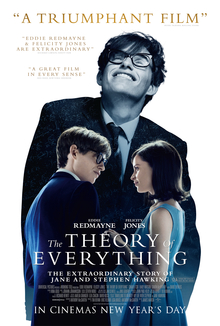
Behind the film
- Year
- 2014
- Director
- James Marsh
- Writers
- Anthony McCarten
- Runtime
- 2h 3m
- Genres
- Romance, Biographical, Drama, Historical
- Production
- Working Title Films, Focus Features, Universal Pictures
- Country
- United Kingdom, Japan, United States
- Cast
- Eddie Redmayne, Felicity Jones, Charlie Cox, Emily Watson, Simon McBurney, David Thewlis, Maxine Peake, Harry Lloyd
About the film
Contains story spoilers.
The Theory of Everything opens in Cambridge in 1963, where astrophysics student Stephen Hawking meets literature student Jane Wilde. Stephen is brilliant but has not yet found a thesis problem. A lecture about black holes and singularities gives him a direction: he begins asking how the universe started and what its ending might mean. Jane’s interests are different, but their relationship grows around lively conversation and attraction. The film lets academic curiosity and young romance develop together before the illness at its center changes the pace of their lives.
Stephen begins losing coordination and suffers a fall. Doctors diagnose progressive motor neurone disease and tell him that his body will continue to fail, estimating that he may have about two years to live. The diagnosis isolates him; he withdraws and struggles with depression, while the intellectual work remains possible. Jane tells him she loves him and intends to stay. They marry and have a son, Robert. As Stephen’s mobility declines, a wheelchair becomes part of daily life, and his thesis work advances toward a theory connecting black-hole singularities with the Big Bang.
The story follows Jane’s work of care alongside Stephen’s scientific career. After the birth of their daughter Lucy, she is responsible for raising children while adapting to Stephen’s changing needs. His reputation grows, and his work on black holes develops toward the prediction of Hawking radiation. Jane’s own academic ambitions recede under the weight of family responsibilities. Stephen recognizes that she may need more help, and the arrival of Jonathan, a widower she meets through a church choir, changes the household’s routines.
Jonathan becomes Robert’s piano teacher and a close friend of the whole family. He plays with the children and supports Jane while she cares for Stephen; the relationship becomes emotionally complicated, particularly after the birth of their third child, Timothy. Stephen’s mother asks Jane whether Jonathan is the baby’s father, prompting conflict, but Stephen tells Jonathan that Jane needs him. The film treats this arrangement as a practical and emotional negotiation rather than a simple rivalry: Stephen’s increasing dependence and Jane’s exhaustion exist alongside their enduring affection and respect.
A holiday in Bordeaux brings a medical crisis. Stephen develops pneumonia, and doctors explain that a tracheotomy will save his life but leave him unable to speak. Jane agrees to the surgery. Stephen first communicates with a spelling board and later uses a computer voice synthesizer, an adaptation that allows him to continue writing and speaking publicly. He uses the device to produce A Brief History of Time, which becomes a bestseller. The new voice changes how he participates in the world, while care continues to require the people around him to interpret his needs.
By the late 1980s, Stephen tells Jane he has been invited to the United States to receive an award and intends to take his nurse Elaine with him. Their marriage has reached a point where both acknowledge it cannot continue as it has. They agree to divorce; Stephen’s relationship with Elaine deepens, and Jane reunites with Jonathan. In a public lecture, Stephen watches a student drop a pen and imagines himself getting up to return it. The moment turns a physical limitation into a private grief, before he speaks about pursuing ambitions while life remains.
The film’s later scenes maintain the connection between the family story and Stephen’s public life. In 1989 he receives the Order of the Companions of Honour and invites Jane and their children to accompany him to meet Queen Elizabeth II. The closing images run backward through selected moments to their first meeting, echoing Stephen’s efforts to think about time in reverse. An epilogue notes Jane’s academic achievement and marriage to Jonathan, Stephen’s continued work, and the former couple’s ongoing friendship. Their shared history has changed form but remains present. Jane’s religious belief also gives the household a perspective different from Stephen’s account of the universe. Their early conversations make that distinction part of the attraction rather than immediately treating it as an obstacle. As their lives change, neither a scientific explanation nor a declaration of faith can perform the practical work the family needs. The choir provides Jane with a place beyond the household, and it is there that her connection with Jonathan begins. The film allows convictions to matter through the relationships and institutions they lead people toward, rather than presenting the marriage as a debate one person has to win.
James Marsh’s drama is adapted from Jane Hawking’s memoir and is best understood as a shaped retelling, not a complete biography or scientific account. Cambridge settings and period changes mark the passage of decades, while Jóhann Jóhannsson’s score gives private scenes a sense of movement without turning them into lectures. Eddie Redmayne’s performance tracks physical change through posture, speech and increasingly limited movement; Felicity Jones gives Jane an independent emotional trajectory, including the costs of putting her own work aside. The film’s most durable perspective is the relationship between scientific ambition and the ordinary labour required to sustain a family.