
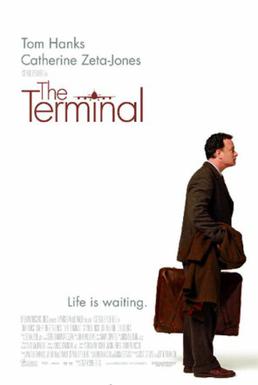
Behind the film
- Year
- 2004
- Director
- Steven Spielberg
- Writers
- Sacha Gervasi, Jeff Nathanson, Andrew Niccol
- Genres
- Tragicomedy, Drama
- Production
- Amblin Entertainment, Parkes/MacDonald Productions
- Country
- United States
- Cast
- Tom Hanks, Catherine Zeta-Jones, Stanley Tucci, Diego Luna, Chi McBride, Kumar Pallana, Zoe Saldaña, Barry Shabaka Henley
About the film
Contains story spoilers.
The Terminal begins with a traveller discovering that arriving somewhere does not necessarily mean being allowed to enter it. Viktor Navorski reaches New York while a coup is changing the status of his home country, Krakozhia. His passport can no longer perform the work he expected from it, and his limited English makes the explanation difficult to grasp. Officials can describe the rules but cannot provide a practical destination. Steven Spielberg places this predicament in a space designed for people to pass through quickly, then asks what life might look like for someone required to remain. Every sign promising an onward journey acquires a different meaning for Viktor.
Tom Hanks gives Viktor’s early confusion physical expression through pauses, gestures and attempts to read the reactions around him. Watching news of the upheaval on television makes the danger at home emotionally immediate even when its bureaucratic consequences remain obscure. Frank Dixon, played by Stanley Tucci, sees a problem that can interfere with his own carefully managed career. His efforts to encourage Viktor to leave the permitted area would make the situation another authority’s responsibility. Viktor’s refusal to take that route frustrates an official who expects either straightforward compliance or a violation he knows how to process. Remaining in place becomes a kind of resistance without Viktor presenting it as a campaign.
The terminal’s ordinary infrastructure supplies the materials for his improvised household. A gate under renovation offers somewhere to sleep, while returning luggage carts provides money for food until Dixon closes that opportunity. Viktor learns by watching, comparing languages and recognising repeated routines. His practical ability becomes more useful when construction workers discover what he can do, providing a way to earn money within the place that has trapped him. The comedy frequently begins with an object or procedure everyone else takes for granted. A cart, a food counter or an unfinished wall can become a resource because he has to understand its possibilities more carefully than the travellers around him.
Relationships give those routines a social life. Enrique brings meals while seeking advice about Dolores, whose immigration desk places her on another side of the terminal’s divisions. Joe and Gupta contribute different kinds of knowledge about the building and the people working in it. Their friendship with Viktor grows through exchanges and misunderstandings rather than an instant declaration of solidarity. Gupta’s suspicion has roots in a history that makes official attention dangerous for him, and helping someone openly is therefore a consequential choice. The airport begins to feel like a neighbourhood whose residents happen to be carrying baggage, cleaning floors or feeding people who usually do not stay long enough to learn their names.
Amelia’s repeated arrivals offer another rhythm within Viktor’s suspended life. As a flight attendant she can leave the terminal easily, yet her relationship with a married man keeps her waiting in a different way. Catherine Zeta-Jones gives their conversations room for attraction, embarrassment and uncertainty, preventing their connection from becoming a simple reward for Viktor’s patience. The place provides opportunities to meet without supplying a stable future together. A carefully prepared meal can matter even when it does not resolve what either person will do afterward. Their romance shares the film’s larger interest in lives that continue while a decisive answer remains beyond reach.
The encounter with a man carrying medicine home makes the difference between procedure and understanding especially clear. Viktor can communicate with him where the officials cannot, and he recognises what the threatened confiscation would cost. His solution uses an exception for medicine intended for animals, embarrassing Dixon by finding room to act within the categories the official has been enforcing. The incident increases Viktor’s standing among the staff, but it also intensifies Dixon’s hostility. The film allows a small act of ingenuity to acquire public significance without making Viktor fluent in every system around him. He can help because he listens to the person whose circumstances are being turned into paperwork.
The peanut tin he carries finally reveals the purpose behind his journey. His father collected signatures from musicians pictured in the famous Harlem jazz photograph, leaving Benny Golson as the missing name when he died. Viktor has come to complete that collection. The modest physical container holds a promise that explains why simply returning home would leave something unfinished. When the crisis in Krakozhia ends and Amelia secures an emergency visa, Dixon can still obstruct its use. Threats against Viktor’s friends make his decision harder, especially because Gupta could face deportation and the consequences of his earlier life in India. The kindness that has sustained Viktor now exposes other people to risk.
Gupta’s intervention delays the departure Viktor has reluctantly accepted and gives him the chance to make his own way out. The staff’s response transforms the terminal from a place of enforced waiting into the community that has helped him endure it. Reaching Golson and obtaining the signature brings the story to a scale far smaller than the international conflict that began it. Viktor can go home with a promise fulfilled, without the film pretending that he has solved the machinery of borders. Its spacious concourses, busy escalators and repeated announcements contain an intimate drama about work, loyalty and recognition. People who appear briefly in a traveller’s day have become the reason this particular traveller can finish his journey.