
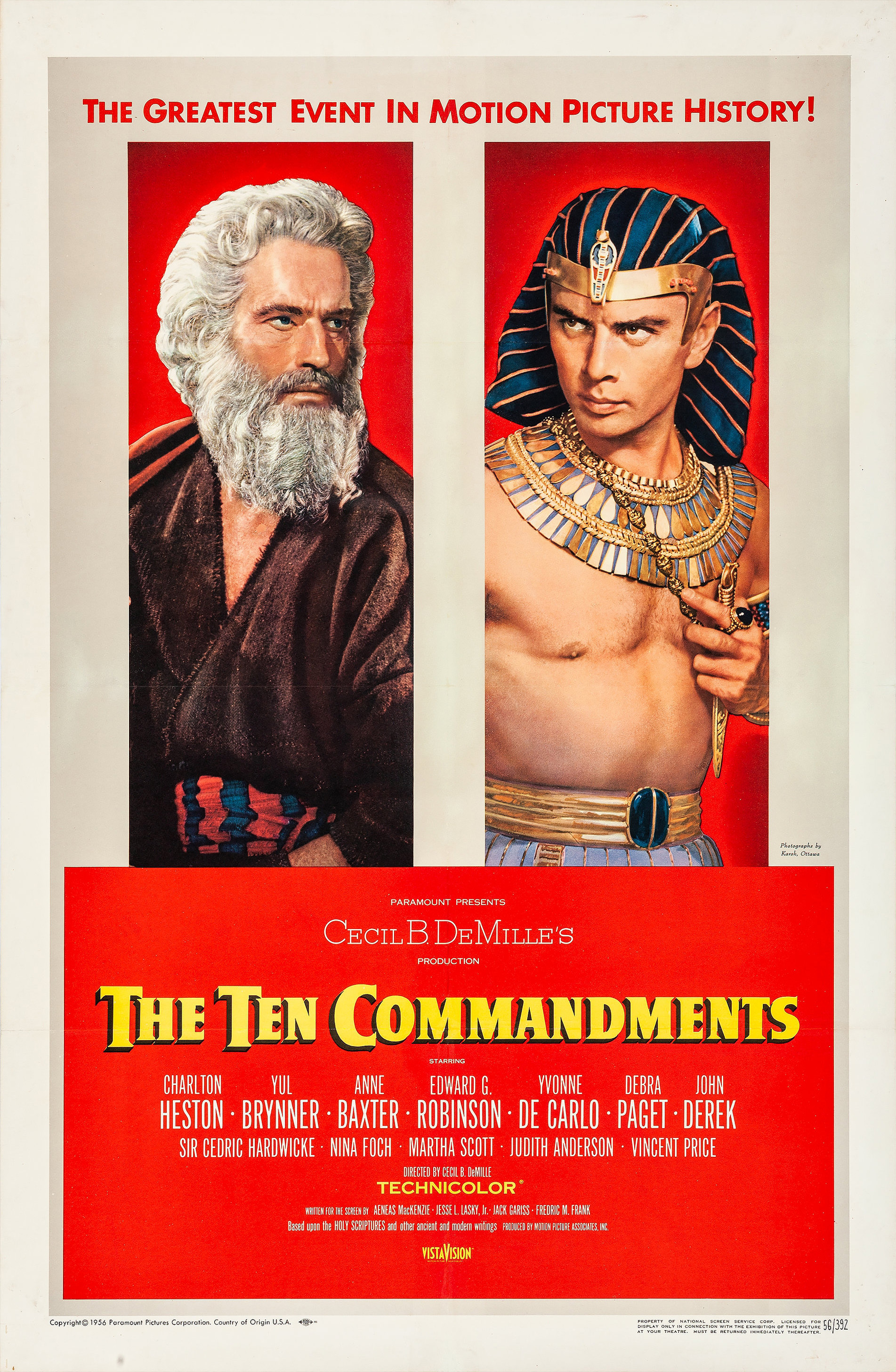
Behind the film
- Year
- 1956
- Director
- Cecil B. DeMille
- Writers
- Æneas MacKenzie, Jesse L. Lasky Jr., Jack Gariss, Fredric M. Frank
- Genres
- Drama, Adventure, Historical, Sword-and-sandal
- Production
- Paramount Pictures
- Country
- United States
- Cast
- Charlton Heston, Yul Brynner, Anne Baxter, Edward G. Robinson, Yvonne De Carlo, Debra Paget, John Derek, Cedric Hardwicke
About the film
Contains story spoilers.
Pharaoh orders Hebrew newborn sons killed, but the infant Moses is found by the Egyptian princess Bithiah and raised at court. As an adult, he becomes a general and is chosen as heir, until his Hebrew origins are exposed and Rameses banishes him. In Midian, Moses marries Sephora and hears God call him to return. He demands the Hebrews’ freedom; after plagues devastate Egypt, Rameses releases them, then pursues them to the Red Sea, where Moses leads the people through and the waters engulf the army. On Mount Sinai, Moses receives the commandments while Dathan leads a rebellion around a golden calf. Moses destroys the idol and leads the people towards Canaan, but cannot enter; he ascends Mount Nebo after charging Joshua to guide them, as the film closes on the tablets and its final written promise.
DeMille shapes the story as a conflict between kinds of authority. The palace has ranks, armies, public ceremony and the ability to command labour; Moses’ later leadership asks the people to recognise a law that is not simply an extension of royal will. That contrast gives the film a clear dramatic architecture. The images are enormous, but the central question remains legible: what makes power legitimate, and what happens when rulers treat other people as instruments? The religious framework is explicit, and the film should be understood as a dramatic interpretation of scripture rather than evidence about ancient events. Its confidence belongs to the epic form and its beliefs, not to archaeology.
Moses’ divided identity gives that political question a personal form. Charlton Heston’s performance carries a formal certainty suited to the film’s elevated style, yet the role is built around a man forced to reconsider the story he has been told about himself. That recognition changes the meaning of belonging. The court has given him status and education, but neither can settle the question of what responsibility follows from knowing the truth. His movement from palace privilege to exile and prophetic leadership is not merely a change of location. It reframes service: the same qualities that once made him effective within the Egyptian order must be directed towards people that order oppresses.
Rameses is a compelling counterweight because Yul Brynner plays authority as public performance. His Pharaoh understands command as something displayed and defended before others; yielding would threaten not only policy but the image of sovereignty itself. This makes the conflict larger than a private disagreement between former brothers. Each man represents a different relationship between power and obligation. Rameses’ stubbornness is not presented as a lack of intelligence so much as a refusal to accept a limit on his will. Brynner’s composed bearing gives that refusal a polished surface, helping the film show how control can look dignified even while it becomes cruel.
The women around the central conflict occupy sharply different positions within the court and the community. Anne Baxter’s Nefretiri is politically perceptive and emotionally entangled with the succession struggle, so her choices carry consequences beyond romance. Yvonne De Carlo’s Sephora belongs to a different stage of Moses’ life and a different social world, one that makes the palace’s scale feel less absolute. The film’s enormous focus on male leaders can leave these characters within a narrower range than the central men, but their presence clarifies what public power costs private relationships. The court turns intimacy into leverage; family bonds are repeatedly asked to survive decisions made in the name of nation, status or faith.
DeMille’s spectacle has a ceremonial quality. Processions, architecture, costumes and massed crowds make political authority visible in every frame, while the wide compositions let the human figures seem small beside institutions and landscapes. This is not naturalistic historical reconstruction. It is studio epic, using scale to give sacred narrative the public weight of legend. The famous effects work belongs to that same visual strategy: physical marvels are presented as events capable of changing a community’s understanding of power. The design asks an audience to experience the story as grand and consequential, which is different from asking viewers to mistake its dramatic choices for a scholarly account of Egypt.
The film’s religious language is also tied to its idea of freedom. Liberation does not mean that people simply exchange one leader for another and become answerable to no shared rule. The narrative insists that a community needs a moral structure that can restrain its own appetites and leaders. That claim shapes the film’s treatment of both Pharaoh’s authority and the people’s conduct. It also explains the severity of its judgment: the story is less interested in presenting freedom as an uncomplicated reward than in asking what kind of discipline can make it meaningful. Whether a viewer shares the film’s faith commitments or not, this framework is central to how its conflicts are organised.
For modern audiences, the movie’s directness can feel very different from contemporary historical drama. Characters speak with theatrical conviction, symbols are large and clear, and the scale rarely seeks modesty. Those qualities are not accidental flaws to be edited out of the experience; they are part of DeMille’s chosen mode. The film wants a story of belief and collective identity to occupy a monumental canvas. Its enduring interest lies in the way personal revelation becomes public consequence, and in how a religious epic can make questions of law, loyalty and freedom accessible through a handful of strongly drawn figures. It is an imaginative retelling with an unmistakable point of view, not a substitute for historical research.