
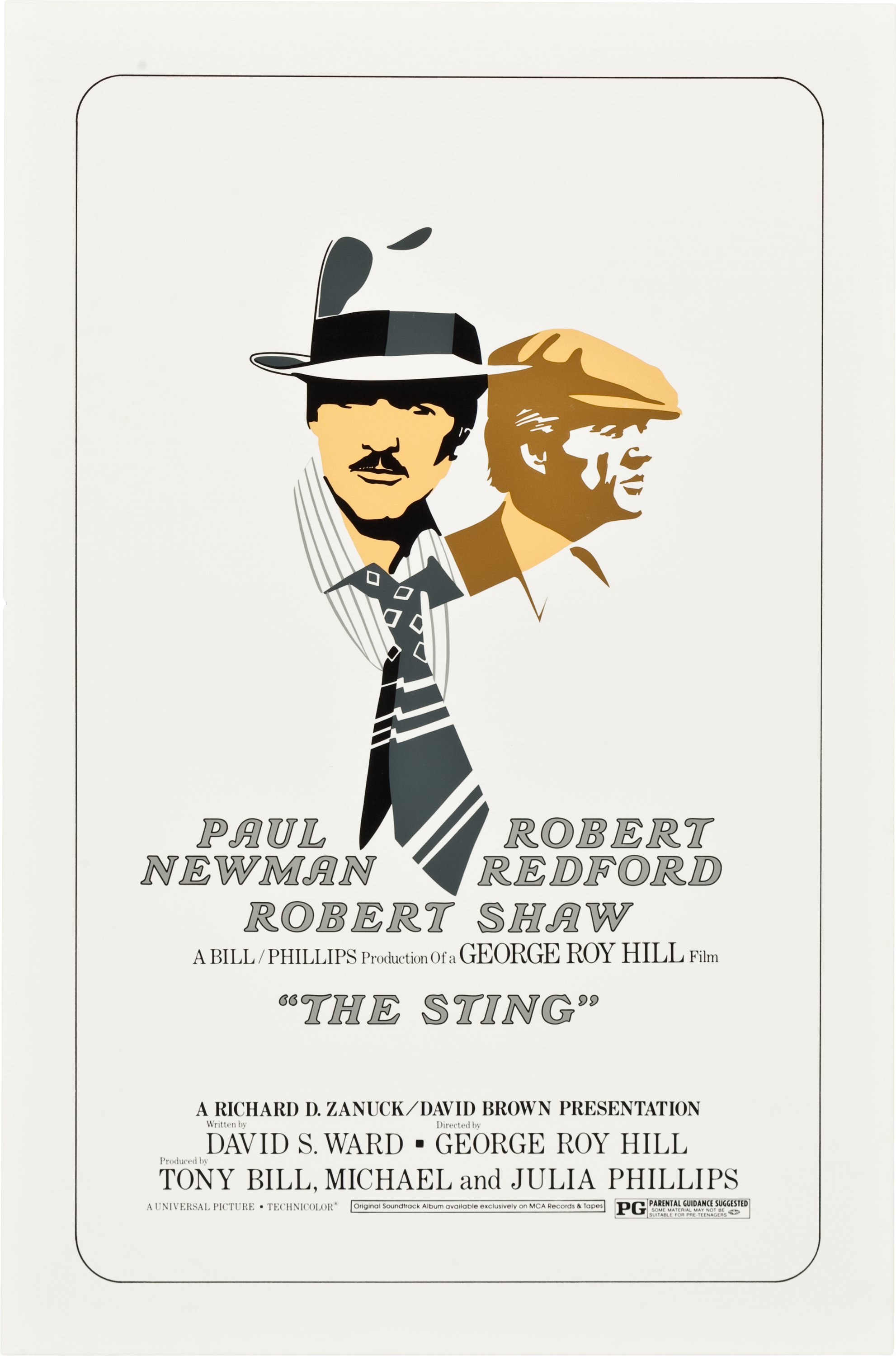
Behind the film
- Year
- 1973
- Director
- George Roy Hill
- Writers
- David S. Ward
- Genres
- Heist, Buddy, Comedy, Drama
- Production
- Universal Pictures
- Country
- United States
- Cast
- Paul Newman, Robert Redford, Robert Shaw, Charles Durning, Ray Walston, Eileen Brennan, Harold Gould, Dana Elcar
About the film
Contains story spoilers.
The Sting begins in 1936 Joliet, where Johnny Hooker and his friend Luther Coleman work the small, quick confidence games that make a living from distracted strangers. Their latest take comes from a courier carrying money for crime boss Doyle Lonnegan, a target far above their usual level. Luther recommends that Hooker learn the big con from Henry Gondorff, but Lonnegan’s retaliation reaches Luther before Hooker can get clear. That loss gives the story its purpose: Hooker wants to answer violence with a fraud large enough to wound the man responsible, and he needs the veteran Henry Gondorff to teach him how to do it.
Hooker finds Gondorff in Chicago, where the older con man lives under an assumed name and has reason to avoid the police. Their partnership is not simply mentor and student. Gondorff has the experience to design a layered deception, while Hooker brings nerve, speed and a talent for improvising when a mark presses too hard. They recruit a crew whose jobs range from creating a fake wire service to operating a covert betting parlor. Each person must inhabit a role convincingly, and each layer gives Lonnegan a reason to believe the next one.
The central trick asks Lonnegan to trust that he can profit from a private channel for betting on horse races. Gondorff’s group makes the imagined operation feel tangible: a cramped office, a stream of staged information, people who seem to know more than they should, and a race result that appears to arrive before the public announcement. Hooker plays the eager intermediary, careful to seem clever enough to be useful but not so capable that Lonnegan suspects a trap. The con works because every clue is arranged to confirm the boss’s own confidence in his judgment.
The film’s pleasures come from watching performance inside performance. Characters rehearse mannerisms, maintain false names and adjust their stories to fit the listener, while the audience is invited to read a scene for both its immediate action and its hidden function. Chapter cards divide the scheme into stages, giving the picture the rhythm of a story being laid out on a table. The structure lets the viewer understand enough to appreciate the planning while withholding enough that a confident explanation can still be wrong. The chapter headings also act as contracts with the audience: they promise an explanation, but the explanation can be incomplete or staged. Because so much of the story concerns people acting for an audience inside the film, the viewer occupies an unstable position between spectator and mark. A casually placed prop or confident reaction may be evidence, misdirection, or both. The film’s clean visual organization keeps the complexity readable without making the work look effortless; the crew’s coordination remains the point.
That design also gives the ensemble room to make the world feel occupied rather than mechanically plotted. The crew members have distinct tasks and temperaments, but the film never pauses to turn each into a separate miniature biography. Instead, their value appears through timing: a door opened when needed, a distraction sustained, a line delivered with just the right degree of impatience. The period streets, offices and railway interiors support the con’s practical texture. Props and locations matter because a false operation must look ordinary to the people inside it. Gondorff’s guardedness also shapes the film’s sense of space. His quieter rooms and unhurried manner contrast with the public bustle of the con, but the apparent retreat is another kind of preparation. When he joins the operation, the ease he projects becomes a tool the younger Hooker cannot yet imitate. Their teamwork is persuasive because it is neither equal nor static: Hooker learns to wait, while Gondorff has to trust a partner who can move faster than he can.
Marvin Hamlisch’s score, built around Scott Joplin ragtime, adds another layer to the film’s tone. The music evokes a popular past without pretending to be a literal report from 1936, and its buoyancy sits beside a story shaped by murder, fear and revenge. Paul Newman and Robert Redford keep the partnership lively through contrast: Gondorff’s relaxed command against Hooker’s alert, restless energy. Robert Shaw makes Lonnegan dangerous without making him omniscient; his pride is the opening the con needs.
The final movement reveals that the plan has been protecting itself from more than one threat. Snyder, the suspicious detective following Hooker, has been manipulated into believing the operation has ended in bloodshed, while Lonnegan leaves the scene believing he has survived an FBI raid, abandoning his $500,000 bet without realizing he has been conned. Gondorff and Hooker are alive, and Hooker declines his share before walking away with his partner. The conclusion turns the apparent collapse into the con’s last piece of theatre: its targets have accepted the ending they were shown, while the people who built it can finally drop their roles.