
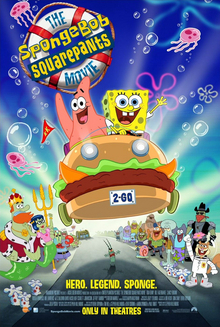
Behind the film
- Year
- 2004
- Director
- Stephen Hillenburg
- Writers
- Stephen Hillenburg, Derek Drymon, Tim Hill, Kent Osborne, Aaron Springer, Paul Tibbitt
- Genres
- Buddy, Family, Comedy, Teen
- Production
- Nickelodeon Movies, United Plankton Pictures, Paramount Pictures
- Country
- United States
- Cast
- Tom Kenny, Bill Fagerbakke, Clancy Brown, Rodger Bumpass, Mr. Lawrence, Scarlett Johansson, Jeffrey Tambor, David Hasselhoff
About the film
Contains story spoilers.
Mr. Krabs opens the Krusty Krab 2 but promotes Squidward instead of SpongeBob, saying his fry cook is too childish to manage it. Plankton steals King Neptune’s crown, sends it to Shell City and frames Krabs. SpongeBob, hung over after drowning his disappointment in ice cream, accepts a six-day deadline to retrieve it or Krabs will be executed. He and Patrick drive the Patty Wagon through a trench, meet Mindy and are captured by the human diver mistaken for the Cyclops. Their tears trigger sprinklers there, saving them and the dried sea creatures. They get the crown back to Bikini Bottom as Plankton controls the town with helmets. SpongeBob’s rock performance breaks the spell, Neptune frees Krabs, and Krabs appoints him manager of the new restaurant.
The movie gives SpongeBob a stretch of life beyond the episodic rhythm of his job. The new restaurant turns a workplace disappointment into a question he cannot laugh away: is he capable of growing up, or does that require becoming somebody else? Krabs’s judgment hurts because SpongeBob has made the restaurant central to his identity. His enthusiasm is genuine labour, not simply childish noise, and the film lets him experience a setback before answering him. The promotion matters because ambition acquires emotional weight rather than remaining a temporary gag. The story does not ask SpongeBob to suppress his personality to prove himself; instead, it questions the narrow idea of maturity that equates responsibility with seriousness.
Patrick is more than a passenger on the journey. His presence makes the adventure a friendship story in which two characters can be ridiculous together and still act with loyalty when the other falters. They begin by fleeing humiliation, but their shared confidence becomes useful. Their exchanges are simple and carefully paced: a pause, a facial expression or an abrupt shift in scale can carry a joke. Patrick’s sincere misunderstandings make danger absurd without cancelling it, and his encouragement helps SpongeBob move when his self-image has narrowed to the word kid. The film’s tenderness comes from letting the friendship remain unpolished. They do not become more articulate or worldly; they learn that they can rely on one another.
Scale is one of the film’s most useful comic tools. A small character can inhabit an apparently ordinary environment until the perspective changes and exposes how overwhelming it is. That makes the journey feel larger without requiring the audience to abandon the familiar personalities at its centre. The humour depends on both recognition and estrangement: an object can be obvious to the viewer while remaining mysterious to the traveller. This uneven understanding allows suspense and silliness to work together. SpongeBob’s world is elastic enough to exaggerate a fear, yet specific enough that the exaggeration still belongs to the way its characters encounter what is unfamiliar.
The animated town has a lively visual density, with signs, commercial spaces and exaggerated inhabitants making everyday activity look persistently comic. Its social world is easy to grasp because personalities are expressed through design as well as dialogue. SpongeBob’s openness, Patrick’s loose confidence and Plankton’s intense smallness suggest different relationships with the same environment. The contrast gives ambition a physical form: one character seems ready to embrace the world, while another wants it compressed around his own importance. Cartoon exaggeration makes that difference immediately legible. The film can establish an attitude through a posture or a change in size before a character has explained what he wants.
Mindy and Neptune bring different kinds of authority into the story. Scarlett Johansson’s voice gives encouragement an accessible warmth, while Jeffrey Tambor’s commanding delivery allows status to become comic through its insistence on being taken seriously. The contrast makes the royal presence feel like another personality problem inside the same absurd world. Power can be intimidating and ridiculous at once, particularly when its confidence exceeds its patience. The film uses that overlap to keep the stakes understandable without making the tone solemn. Its heroes do not need to acquire a grand official manner to matter; their more informal emotional vocabulary can remain sufficient for the adventure.
Stephen Hillenburg mixes hand-drawn animation with live-action interruption, including Hasselhoff’s ride, as if the surface world is simply another extension of the show’s imagination. The pirate framing device prepares the audience for a story that can leap between scales and styles. Underwater backgrounds remain busy with signage, props and moving sea life, while the human world’s sunlit space feels overwhelming from the tiny heroes’ viewpoint. These changes are not a break from the cartoon logic but a way to enlarge it. Animation lets faces stretch and objects transform, while live action makes SpongeBob’s passage into the surface world feel spectacularly literal.
The resolution gives recognition more value than a change in personality. The idea of growing up can easily become a demand that enthusiasm be concealed, but the film finds a different possibility inside SpongeBob’s openness. Responsibility and excitement need not be mutually exclusive. That is a fitting emotional direction for a story whose visual form delights in excess: the pleasure of animation supports a character who cannot be reduced to sensible proportions. The ending allows ambition to coexist with friendship and play, leaving the audience with the sense that a larger role might be inhabited without abandoning the qualities that made the person distinctive in the first place.