
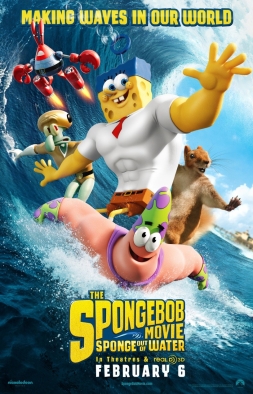
Behind the film
- Year
- 2015
- Director
- Paul Tibbitt, Mike Mitchell
- Writers
- Jonathan Aibel, Glenn Berger
- Runtime
- 1h 33m
- Genres
- Family, Pirate, Animated film with lgbt character(s), Time-travel
- Production
- Nickelodeon Movies, United Plankton Pictures, Paramount Pictures
- Country
- United States
- Cast
- Antonio Banderas, Tom Kenny, Clancy Brown, Rodger Bumpass, Bill Fagerbakke, Carolyn Lawrence, Mr. Lawrence, Matt Berry
About the film
Contains story spoilers.
Sponge Out of Water finds an entire cartoon community's sense of order inside a fast-food recipe. That deliberately ridiculous scale is useful: the loss can be enormous to Bikini Bottom without requiring the audience to mistake the story for a solemn disaster. The adventure expands from a familiar workplace rivalry into a journey between kinds of storytelling. Animated characters meet a live-action pirate, written words alter events, and superhero forms become another way to play with personalities the audience already knows. The changes in style are part of the comedy. Underneath them sits a straightforward practical question: can SpongeBob cooperate with someone whose usual goal is to undermine the thing he loves? Pirate Burger Beard acquires a magical book whose writing can become real, then reads a tale about SpongeBob and the Krusty Krab. When the secret Krabby Patty formula disappears during a struggle between SpongeBob and Plankton, Bikini Bottom loses its central comfort and descends into disorder. The rivals cooperate, chasing clues through time and eventually surfacing in Burger Beard’s world. With the formula still at stake, SpongeBob and his friends gain superhero identities and confront the pirate before restoring the underwater town’s familiar routine.
The film’s most consequential formal decision is saved for the move from animation to live action. Until then, Bikini Bottom operates under its own elastic laws: food, machinery and bodies can stretch into gags without needing realistic scale. On the surface, the characters become small animated visitors inside a photographed landscape. The difference makes the transition itself a comic event. Rather than conceal the change in medium, the movie turns it into a new arena with new physical rules, letting the audience feel the world widen as the characters leave their familiar frame.
The formula works as both a plot object and a measure of routine. It represents the Krusty Krab’s business, but also the dependable ritual that organizes SpongeBob’s workday and his place in town. When it vanishes, the crisis is not framed as abstract economic collapse; customers, friendships and the landscape itself seem to lose their rhythm. SpongeBob’s confidence that Plankton can be innocent becomes the first step toward cooperation. The story uses that choice to show how trust can begin before complete evidence, especially when the characters recognize the possibility that an old rivalry is shaping their assumptions.
Plankton’s shifting role gives the adventure a useful internal counterpoint. He has spent years trying to steal the recipe, so an alliance with SpongeBob carries comic suspicion in every scene. Their partnership does not erase the history between them; the jokes depend on the fact that each knows how the other thinks. SpongeBob’s optimism is not portrayed as an argument that Plankton has never done harm. Instead, it is a willingness to test whether the familiar pattern can change when circumstances demand it. The film makes cooperation funny because neither character becomes suddenly unrecognizable.
Burger Beard links the pirate framing device to the power of authorship. His book can turn text into matter, giving the story a playful excuse to let words redirect events. The conceit also makes storytelling visible: a page can describe danger, and the characters must live inside what has been written. Antonio Banderas plays the pirate as a broad live-action presence, a performer whose scale and gestures contrast with the compact animation. He is both an antagonist and a reminder that the movie can change narrative levels whenever the gag needs another turn.
The superhero transformation gives the ensemble a temporary visual language for teamwork. The familiar characters receive powers and costumes that exaggerate traits already present in the series, so the genre parody remains character-based rather than a set of random references. SpongeBob’s enthusiasm, Patrick’s unpredictability and the others’ distinct comic rhythms remain recognizable inside the new forms. The film borrows the pose-and-reveal grammar of superhero cinema, then bends it toward absurdity. Its action is designed to culminate in group invention rather than in one exceptional hero solving the problem alone.
The vocal cast helps the two visual worlds feel continuous. Tom Kenny’s SpongeBob stays buoyant in both environments, while the supporting voices preserve the undersea ensemble’s established timing when the image changes around them. The jokes depend on fast contrast: a grand heroic pose may be followed by a simple misunderstanding, and a sudden change of scale becomes its own punchline. John Debney’s score can support adventure without losing the cartoon’s playful elasticity. Sound and voice hold the character world together while the animation and live action trade places.
As a sequel, the film expands outward while returning to the series’ simplest value: SpongeBob’s loyalty is a force that can bridge a rivalry. The resolution restores the Krusty Krab’s routine, but the journey has required the characters to leave that routine and imagine themselves differently. This gives the title’s “out of water” idea more than a literal meaning. The surface world changes what the characters can do and how they appear, yet the core of their comic identity survives the shift. The final effect is an adventure built from formal transformation and familiar friendship.