
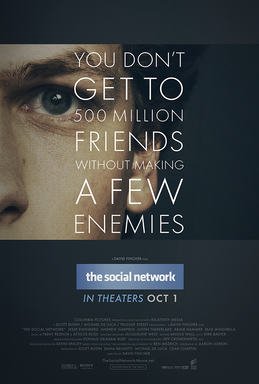
Behind the film
- Year
- 2010
- Director
- David Fincher
- Writers
- Aaron Sorkin
- Runtime
- 2h 0m
- Genres
- Biographical, Trial, Drama
- Production
- Relativity Media, Trigger Street Productions, Columbia Pictures
- Country
- United States
- Cast
- Jesse Eisenberg, Andrew Garfield, Justin Timberlake, Armie Hammer, Max Minghella, Rooney Mara, Brenda Song, Rashida Jones
About the film
Contains story spoilers.
The film opens with Harvard student Mark Zuckerberg leaving a conversation with his girlfriend Erica Albright and returning to his dorm to write an insulting blog post about her. He then builds Facemash, a site that lets students compare photographs of women taken from campus directories. The site becomes popular quickly and overloads parts of Harvard’s network, bringing Mark academic probation. The incident also draws the attention of Cameron and Tyler Winklevoss and their partner Divya Narendra, who invite him to help build a Harvard-only social network they call Harvard Connection. This is the film’s dramatized account of those events.
Mark accepts the invitation but spends his time working on his own idea with his friend Eduardo Saverin. They create TheFacebook, initially restricted to Harvard students before expanding to other colleges, and Eduardo provides early funding. The Winklevoss brothers and Divya believe Mark has used their concept while delaying their project; they take their complaint to Harvard president Larry Summers, who dismisses the matter. The film presents the conflict through the parties’ competing accounts in depositions, so the same early decisions are repeatedly seen against later claims about credit, trust and ownership.
As TheFacebook spreads to other campuses, Mark and Eduardo meet Christy Lee, who begins dating Eduardo. They later meet Sean Parker, the co-founder of Napster, who has discovered the growing site. Parker is impressed by the site and urges a larger ambition, including shortening its name to Facebook. Eduardo distrusts Parker but accepts the name change. When Mark relocates the operation to Palo Alto with Parker, Eduardo remains in New York for business development. The distance creates a new imbalance: Parker is physically close to Mark and increasingly influential, while Eduardo still sees himself as the company’s essential partner.
The narrative keeps cutting between these events and two deposition proceedings: Eduardo is suing Mark, and the Winklevoss twins are suing over the origins of the site. This structure makes the creation story feel like testimony, with every act of friendship eventually examined as evidence. The film also follows the company’s rapid expansion, including its move to Stanford and then further across campuses. The college setting remains present even as the scale grows, because dorm rooms, parties and informal conversations become the places where people make decisions with lasting business consequences.
The Winklevosses see Facebook expanding into Europe and decide to sue for intellectual-property theft. Meanwhile, Eduardo objects to Parker’s authority and freezes the company’s bank account during their dispute. Mark tells him that they have secured investment from Peter Thiel, and Eduardo relents. He is later invited to the new California headquarters for what he believes is a business meeting and celebration of the millionth user. There he learns that a new investment deal has reduced his ownership stake and removed his name from the company masthead. He confronts Mark and Parker before security escorts him out.
Parker’s own standing falls when he is arrested for cocaine possession with a minor at a party celebrating Facebook’s millionth user. He tries to blame Eduardo, and Mark cuts ties with him. The depositions continue to frame the damage left by the company’s rise. Marilyn Delpy, a junior associate on Mark’s legal team, tells him they will settle with Eduardo because the details of Facebook’s beginnings and Mark’s behavior could alienate a jury. The film ends with Mark alone, sending Erica a friend request and repeatedly refreshing the page to see whether she responds.
The closing text says the lawsuits were settled out of court and that Mark became a billionaire. The film’s story is a dramatization built around lawsuits and competing accounts, not a neutral record of every event or conversation. That boundary matters because it gives characters sharp motives and memorable confrontations that should not be mistaken for verified historical dialogue. The movie’s portrait of Mark is shaped by the depositions and by the dramatic choices of its script; it follows how its version of a friendship breaks as the business becomes valuable.
The structure keeps the technical product itself mostly simple: TheFacebook grows from a campus project into a company, while the human story concerns who contributed, who trusted whom and who controls the result. The deposition scenes interrupt the forward rush with formal challenges to memory and motive. Meanwhile, conversations and parties carry the momentum of the early expansion. The rowing races add a visual measure of the Winklevoss brothers’ world, where discipline and inherited access contrast with Mark’s online project. The move from Harvard rooms to a company headquarters tracks the widening stakes, but the legal testimony keeps returning the story to personal grievance. Mark’s final refresh returns the film to a small, private gesture after a story full of corporate growth and legal disputes. The site has connected millions in the film’s closing account, but its founder is still waiting for one person to answer. The unanswered request measures the distance between them.