
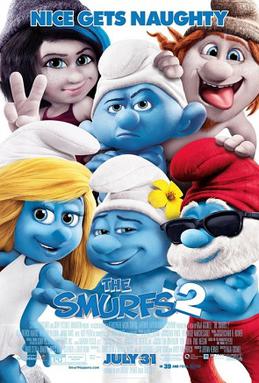
Behind the film
- Year
- 2013
- Director
- Raja Gosnell
- Writers
- J. David Stem, David N. Weiss, Jay Scherick, David Ronn, Karey Kirkpatrick
- Genres
- Fantasy, Comedy, Children's, Family
- Production
- Columbia Pictures, Sony Pictures Animation, Kerner Entertainment Company
- Country
- United States
- Cast
- Neil Patrick Harris, Jayma Mays, Hank Azaria, Brendan Gleeson, Katy Perry, Christina Ricci, JB Smoove, Jonathan Winters
About the film
Contains story spoilers.
The Smurfs 2 turns a rescue adventure into a question about where identity comes from. Smurfette's place among the Smurfs seems established to the people around her, yet her origins remain a source of doubt for her. That gap gives the kidnapping more than a practical objective. The danger includes someone trying to persuade her that belonging elsewhere has always been a mistake. The family-film premise is therefore built around the distinction between having been made for a purpose and having to remain faithful to that purpose. A person can acquire relationships and values their creator never intended them to have.
Raja Gosnell directs the 2013 sequel, which combines animated characters with live-action performers. Neil Patrick Harris and Jayma Mays return as Patrick and Grace Winslow, Hank Azaria plays Gargamel and Katy Perry voices Smurfette. The screenplay credits include J. David Stem, David N. Weiss, Jay Scherick, David Ronn and Karey Kirkpatrick. Paris becomes the new setting for a collision between a tiny magical community and a much larger human environment. The size difference supports the comedy, but the emotional concern is familiar in either world: somebody unsure of being wanted is especially vulnerable to an invitation that appears to explain who they really are.
Gargamel's creations Vexy and Hackus help bring Smurfette to Paris so he can obtain the formula that makes them real Smurfs. Papa and a rescue party seek the Winslows' help. Smurfette befriends the new creatures and gives up the formula to save them, after which Gargamel tries to exploit all three. The rescuers destroy his machine and free the captives. Vexy and Hackus join the village's birthday celebration. The ending expands the family instead of merely returning it to its previous membership, making the new arrivals' future part of the rescue's meaning.
Gargamel's approach makes affection look like something that can be offered strategically. If a vulnerable character wants recognition, the villain can supply a flattering account of why she belongs with him. The story invites younger viewers to distinguish that account from what the supposed welcome demands in practice. An invitation may sound personal while treating the invited person as useful equipment. The contrast is particularly clear in a fantasy whose antagonist wants to extract magical power. Recognition becomes a means of obtaining a resource, and kindness becomes unreliable when it disappears as soon as the recipient refuses to be useful.
Smurfette's concern for Vexy and Hackus complicates a simple division between rescuers and enemies. Their original role does not prevent a different relationship from forming. That matters because the same principle applies to her own origins. If she believes that her beginnings do not completely define her, she must allow the possibility that someone else's beginnings need not define them either. Compassion becomes more substantial than a reassuring statement about herself. It creates an obligation to see potential beyond the role another character was assigned, even when that recognition makes her immediate situation harder to manage.
Papa's place in the story offers an alternative account of parenthood. The relevant relationship is not only about who created a being, but who helps that being become part of a community. Care is measured through continuing action, including the willingness to search when somebody has been taken. That gives the magical premise a domestic meaning. Families can be built through responsibility and acceptance rather than restricted to a claim of original ownership. The film's invented rules make those alternatives visible, but the emotional difference does not require magic to understand: belonging depends on being treated as a person rather than possessed as a product.
The human characters extend that concern into another form of family friction. A group can be united by an urgent rescue while carrying unresolved feelings about how its members fit together. The comedy's larger-scale disruption makes cooperation necessary before everyone has achieved perfect understanding. That is useful to the film's theme because it keeps acceptance from becoming something delayed until a relative has become exactly the person expected. People can work alongside one another, recognise a contribution and revise a judgement through shared effort. The adventure provides the circumstances in which that revision has a practical consequence.
The final celebration gives the rescue an inclusive shape. Saving Smurfette does not require rejecting every relationship she formed while separated from home. Some of those relationships reveal new members worth welcoming. The Smurfs 2 thus uses its fantasy conflict to ask whether a community can protect its own without assuming that the unfamiliar must remain outside. Its answer is carried through an enlarged family rather than a speech about origins. The colourful setting and exaggerated villain keep the stakes within a children's adventure, while the emotional centre remains the possibility of being accepted for the choices one makes after the story of one's creation.