
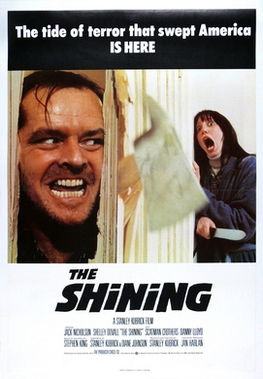
Behind the film
- Year
- 1980
- Director
- Stanley Kubrick
- Writers
- Stanley Kubrick, Diane Johnson
- Runtime
- 2h 24m (US version)
- Genres
- Horror, Psychological horror, Drama, Mystery
- Production
- Hawk Films
- Country
- United Kingdom, United States
- Cast
- Jack Nicholson, Shelley Duvall, Danny Lloyd, Scatman Crothers, Barry Nelson, Philip Stone, Joe Turkel, Tony Burton
About the film
Contains story spoilers.
Stanley Kubrick’s The Shining begins with Jack Torrance interviewing for the winter caretaker position at the Overlook Hotel, an immense resort closed during the cold season. The manager explains that a previous caretaker, Charles Grady, killed his wife and daughters before taking his own life. Jack treats the story as an occupational warning he can rationalize away. He brings his wife Wendy and their young son Danny to the hotel, hoping the seclusion will give him time to write. The place is beautiful in scale and unnerving in emptiness: long corridors, polished floors and large public rooms that seem to have been designed for crowds but now hold almost no one. The film’s opening travel shots follow the family’s car through mountain roads, establishing distance from ordinary help before the snow traps them inside.
Danny has a private way of sensing the hotel. His imaginary friend Tony shows him visions, including the murdered Grady girls, and Dick Hallorann recognizes that the boy shares a psychic gift he calls “the shining.” Hallorann warns Danny to avoid Room 237 and explains that the hotel itself can retain traces of past events. The warning does not give Danny a map of what will happen; it makes him more aware that the Overlook’s history can intrude on the present. Wendy is caring and attentive, but Jack’s relationship with her is already strained by his history of drinking and anger. The film lets viewers see Danny’s fear and curiosity before Wendy understands how serious it is. The hotel’s supernatural presence and the family’s emotional history begin to overlap, leaving open whether Jack is being changed by the building, revealing a side he already carried, or both.
As the weeks pass, Jack spends long periods at his typewriter but makes no progress on a novel. Wendy explores the hotel with Danny, while he rides his tricycle through hallways whose repeated patterns make the camera’s low tracking shots feel hypnotic. He sees the Grady sisters standing together at the end of a corridor, then finds himself drawn toward Room 237 after a ball rolls near its door. When Wendy discovers Danny bruised, Jack investigates the room and encounters a woman whose apparent beauty changes into decay. He tells Wendy that he found nothing and suggests Danny injured himself. She wants to leave; he insists that she is undermining him and his job. Their conflict makes the hotel more dangerous because Wendy cannot easily separate the family’s existing injuries from the new, inexplicable ones.
Jack’s encounters with the hotel’s past take the form of conversations. In the Gold Room he sees a party that should not be there, meets bartender Lloyd, and later encounters a waiter named Grady in the men’s room. Grady tells Jack that Danny is trying to interfere with his father’s work and encourages him to discipline the family. The scenes are unnerving because the hotel’s ghosts speak in the language of Jack’s resentment, treating his wife and child as obstacles to his authority. Wendy eventually enters Jack’s workspace and finds pages filled with the same sentence repeated over and over rather than the manuscript he claimed to be writing. The discovery collapses the last ordinary explanation she had for his behaviour. Jack’s declared ambition to write has become a ritual of control, and she must decide how to protect Danny rather than continue trying to preserve the family’s routine.
Danny’s word “REDRUM” appears on a door and becomes legible in a mirror as “MURDER.” The image links his visions to Wendy’s growing fear, while Hallorann receives a psychic call from the boy and tries to return to the hotel. Jack attacks with an axe, forcing Wendy and Danny to shelter in the bathroom. She gets Danny out through the window but cannot fit through it herself. As Jack breaks through the door, she slashes his hand with a knife. Hallorann’s arrival draws Jack away, but Jack kills him in the hotel before pursuing Danny. The boy runs into the snowbound hedge maze and uses his own footprints to mislead Jack, stepping backward along his trail before hiding elsewhere. Jack loses him and remains trapped outside. Wendy and Danny escape in Hallorann’s snowcat; the next morning Jack is shown frozen in the maze. The rescue vehicle becomes their route out even though its driver has not survived to lead them.
The closing image shifts away from that escape to a photograph on the hotel wall: Jack appears among guests at a 1921 party. The film does not explain the image in a final line or establish a single literal account of Jack’s relationship to the hotel’s past. It offers an uncanny image after the physical chase has ended, keeping the Overlook’s hold on the story alive even as Wendy and Danny get away. That unresolved quality belongs to Kubrick’s film, whose ending differs from Stephen King’s novel. In the book, the hotel’s boiler becomes central and the building explodes; that plot is not part of the movie’s conclusion. The film instead leaves the hotel intact and ends with a picture that makes time, identity and possession feel uncertain.
Kubrick’s craft makes the building feel like a system the characters cannot fully understand. Steadicam movement follows Danny’s tricycle at floor level, changing from carpet to hard flooring and back, so sound marks each surface before the image reveals what lies ahead. Symmetry and wide compositions place a small family within halls and rooms that seem to stretch beyond them. The soundtrack shifts between silence, mechanical hum and abrasive music, making quiet moments feel active rather than restful. The film adapts King’s novel but reshapes its emphasis: Jack is more immediately volatile, Wendy’s point of view becomes crucial, and the supernatural events remain unresolved rather than culminating in the novel’s boiler explosion. The Overlook is not merely a haunted setting; it is a place that gives Jack language for his anger and turns the family’s isolation into a trap.