
Behind the film
- Year
- 2017
- Director
- Guillermo del Toro
- Writers
- Guillermo del Toro, Vanessa Taylor
- Genres
- Thriller, Fantasy, Drama, Romance
- Production
- Searchlight Pictures, TSG Entertainment
- Country
- United States, Mexico
- Cast
- Sally Hawkins, Michael Shannon, Richard Jenkins, Octavia Spencer, Michael Stuhlbarg, Doug Jones, Nick Searcy, Nigel Bennett
About the film
Contains story spoilers.
The Shape of Water is set in 1962 Baltimore, where Elisa Esposito works the night shift cleaning a high-security government laboratory. She is mute and communicates through sign language, while her routines with coworker Zelda and neighbour Giles give her a small, carefully structured life. The movie introduces that routine through clocks, meals, bathing and the old cinema beneath Elisa’s apartment. Into this enclosed world comes a large metal tank carrying an amphibious creature captured in South America. Colonel Richard Strickland oversees the facility and treats the being as a specimen whose usefulness matters more than its pain. The rigid laboratory hierarchy contrasts with Elisa’s patient curiosity.
Elisa learns to visit the creature in secret, bringing eggs and music and watching how he responds. Their communication develops without spoken language: she signs, he answers through gesture, sound and movement in the water. Strickland’s research is tied to Cold War competition, and he argues that the creature’s respiratory system should be studied through vivisection. Scientist Robert Hoffstetler urges him to keep the captive alive, though Hoffstetler himself is a Soviet agent ordered to kill the specimen before the Americans can exploit him. The conflicting motives turn a laboratory procedure into a race against time, with Elisa the only person who treats the creature as a thinking individual.
Elisa decides that the creature must be removed before Strickland’s plan can be carried out. Giles initially hesitates, worried about the practical danger and his own precarious position, but he agrees to help. Zelda becomes part of the plan, and Hoffstetler provides advice and chemicals Elisa needs to keep the creature alive in her bathtub. The theft works, and Elisa hides him in her apartment until a canal can connect with the sea during heavy rain. Their domestic arrangement is makeshift: a tub, a bathroom door and the rhythms of the building now have to contain a being who belongs to water. His arrival unsettles the apartment but gives Elisa a relationship built on mutual attention.
The creature’s presence changes Elisa’s household. Giles tries to stop him from attacking one of his cats and is injured when the creature slashes his arm. The being later touches Giles’s head and wound; the next day Giles notices that his hair has returned and his arm has healed. Elisa and the creature grow closer, while his strength and unfamiliar instincts remain difficult to manage. The film lets wonder and danger coexist in the apartment rather than treating him as a harmless pet. Elisa’s choices are acts of intimacy, but they also bring a hunted captive into a shared home and make the people around her complicit in a risky escape.
Strickland is under pressure from General Hoyt to retrieve the creature, and he follows Hoffstetler to a meeting with his handlers. Hoffstetler is shot, while Strickland forces information about Elisa’s plan from him. He confronts Zelda at home, and Zelda’s husband reveals the creature’s whereabouts. Strickland finds evidence in Elisa’s apartment and discovers the calendar note indicating the canal release. At the same time, the creature’s condition is deteriorating, making delay dangerous even if Elisa’s group can evade the authorities. The effort to rescue him now places each helper at risk from Strickland’s authority and willingness to use violence.
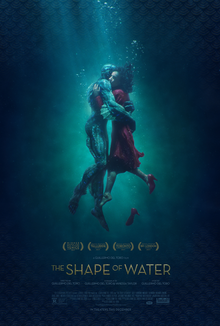
At the canal, Elisa and Giles are preparing to say goodbye when Strickland arrives. He shoots Elisa and the creature, then fights with Giles. The creature heals, kills Strickland and carries Elisa into the water. His touch opens the scars on Elisa’s neck into gills, and she revives underwater. Giles’s narration imagines them living happily together, while the visual ending shows the pair floating beneath the surface. The transformation is presented as fairy-tale fact rather than a medical explanation, keeping its final emphasis on the life Elisa chooses beyond the laboratory’s categories. The canal, once a route to release, becomes the place where the two can remain together.
Guillermo del Toro builds the film’s world through colour and movement: the laboratory’s hard institutional surfaces sit beside Elisa’s apartment, whose bath, windows and old movie house seem to hold a different kind of possibility. Water is both the creature’s environment and the film’s visual connective tissue, appearing in the opening dream and in repeated scenes of Elisa’s private routines. The creature suit, designed around Doug Jones’s physical performance, gives communication a tactile presence even without dialogue. Its wet skin and gill movement make the creature expressive before he can speak or share Elisa’s language.
The story’s relationships cross lines the 1960s setting tries to enforce, including disability, race, sexuality and Cold War suspicion, without reducing its characters to symbols alone. Zelda’s translation at work often makes her voice audible where Elisa is ignored, while Giles’s friendship offers a quieter refuge from the city’s discrimination. Their small alliances matter because the laboratory treats the creature as property and the wider world has little patience for difference. The film combines monster-movie suspense with a romance that finds its intimacy in gesture, shared routine and touch; the result makes freedom depend on a group learning to recognize one another’s needs.