
Behind the film
- Year
- 1957
- Director
- Ingmar Bergman
- Writers
- Ingmar Bergman
- Genres
- Fantasy, Drama, Historical
- Country
- Sweden
- Cast
- Max von Sydow, Gunnar Björnstrand, Bengt Ekerot, Nils Poppe, Bibi Andersson, Inga Landgré, Gunnel Lindblom, Åke Fridell
About the film
Contains story spoilers.
The Seventh Seal begins on a shore where a returning knight can no longer keep death at the distance expected of an ordinary danger. Antonius Block has survived the Crusades, but survival has not supplied the answers he wanted from faith. When Death appears, Block proposes a chess game and uses the contest to postpone what seems inevitable. The bargain gives the journey its unusual structure: the knight can continue moving through the world while knowing that his opponent will meet him again. It is a concrete game with pieces and moves, yet the time it creates is spent on questions no clever strategy can conclusively settle.
Block’s squire Jöns provides a different response to their surroundings. He is sharp, sceptical and attentive to what people do to one another, particularly when religious language conceals cruelty or opportunism. The plague has turned fear into a public atmosphere. Churches, roads and villages offer reminders that illness may arrive without a moral explanation, while sermons and images promise to interpret it. At a church, Block confesses his uncertainty and reveals how he hopes to win at chess, only to discover that Death has been listening in the confessional. The setting seems to offer access to reassurance but instead allows his opponent to learn more about him.
Travelling performers bring another kind of life into this landscape. Jof, Mia and their baby Mikael move with a small company whose work depends on entertaining people still willing to gather. Jof sees things others do not, including a vision he describes to Mia, who responds affectionately without sharing his certainty. Their companionship contrasts with Block’s troubled isolation. They have meals to prepare, a child to care for and work that must continue, even when the larger world offers little security. Their ordinary attachments are not proof that the danger is imaginary. They show a form of meaning that can exist without first solving the knight’s demand for knowledge.
The performers’ public show is interrupted by a procession of people punishing themselves, accompanied by a preacher who turns fear into spectacle. Elsewhere, intimidation at an inn exposes a more personal use of the same atmosphere. Jof is bullied by men encouraged to treat him as an easy target, and Jöns intervenes. The squire has already encountered Raval, a man connected to the decision to join the Crusades who is now exploiting the suffering around him. These episodes make the film’s world more than a backdrop for philosophical conversation. Hunger, humiliation, violence and dishonest authority continue to matter even when everyone is aware that a greater catastrophe may be approaching.
A young woman condemned as a witch becomes the focus of Block’s attempt to reach beyond uncertainty. If she has encountered the Devil, he hopes she can tell him something about God. The question initially makes her useful to his search, but what he can actually see is a frightened person being taken to her death. That encounter forces abstract curiosity against suffering that cannot wait for an answer. The film does not supply an authoritative explanation through the execution. It leaves the cruelty visible and exposes the insufficiency of treating another person’s pain as a possible shortcut to revelation. The knight must decide how to respond when the knowledge he seeks remains unavailable.
The journey also accommodates earthy comedy and petty evasions. The actor Skat becomes involved with the blacksmith Plog’s wife and tries to escape the consequences through theatrical deception. Performance can briefly redirect human anger, but it does not grant an exemption from Death. Against those episodes, Block’s meal with Mia and Jof takes on a different weight. Milk, strawberries and the company of the family offer a moment he wants to preserve. Its value comes from attention rather than possession or triumph. The knight has been looking for something large enough to justify his life; here, a small shared experience becomes something he can recognise as worth having lived.
Jof eventually sees the knight’s opponent and realises that his family should leave. Block disrupts the chessboard, buying enough distraction for them to escape even though Death restores the game and wins. The knight cannot secure his own survival, but the delay has finally allowed him to do something for someone else. At the castle, he reunites with his wife and shares a last meal with his companions before Death arrives. Jof and Mia survive the storm elsewhere, and the next morning he sees the distant figures led across the hillside. The famous dance does not erase the family’s continuing life; both departure and survival remain within the ending.
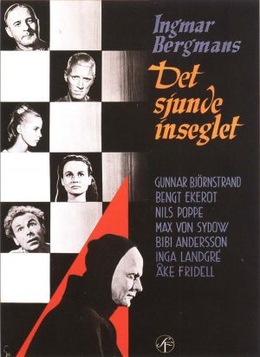
Ingmar Bergman gives Death an unhurried physical presence rather than keeping him entirely inside metaphor. Bengt Ekerot’s pale face and dark clothing turn him into a figure the knight can sit opposite, while Max von Sydow’s restraint lets uncertainty remain visible without requiring constant declarations. Gunnar Fischer’s black-and-white photography places bodies against sea, sky, walls and open country, making the spaces between people expressive. Gunnar Björnstrand’s Jöns keeps pulling the discussion toward conduct in the present. The setting is a medieval allegory, not an exact historical reconstruction. Its force comes from allowing doubt, tenderness, cruelty and laughter to occupy the same threatened world without pretending that any one of them cancels the others.