
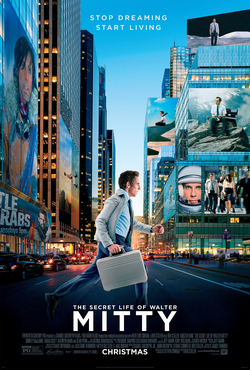
Behind the film
- Year
- 2013
- Director
- Ben Stiller
- Writers
- Steven Conrad
- Genres
- Fantasy, Drama, Comedy
- Production
- 20th Century Studios
- Country
- United States, United Kingdom
- Cast
- Kristen Wiig, Sean Penn, Adam Scott, Adrian Martinez, Amy Stiller, Andy Richter, Ben Stiller, Conan O'Brien
About the film
Contains story spoilers, including the ending.
Ben Stiller directs and stars in the 2013 The Secret Life of Walter Mitty, written by Steve Conrad. Its daydreaming protagonist faces a threat to his job and to the work of a colleague played by Kristen Wiig. The danger pushes him into an adventure outside the routine he has been imagining his way through. Stiller's fellow cast members include Shirley MacLaine, Adam Scott, Kathryn Hahn and Sean Penn. The film joins an ordinary man's working life to the larger exploits that have occupied his thoughts.
Walter handles Life's photographic negatives and likes coworker Cheryl. Photographer Sean O'Connell sends a roll with negative 25 designated for the final print cover, but Walter cannot find it. Clues send him to Greenland, where he jumps from a helicopter and reaches a ship, then to Iceland. He misses Sean during a volcanic eruption and returns to New York to be fired by transition manager Ted Hendricks. His mother's connection with Sean supplies another clue. Walter follows the trail into the Afghan Himalayas and finds the photographer waiting for a snow leopard. Sean reveals that the negative was tucked inside the wallet he gave Walter.
Walter had thrown that wallet away, but his mother retrieved it. Back in America, he takes out the negative, delivers it without looking at the image and challenges Hendricks's treatment of the staff. He also reconnects with Cheryl. Together they see the last issue on sale: its cover shows Walter outside the Life building examining a contact sheet, and the issue honours the magazine's employees. The sought-after image was of the man doing the searching. Walter and Cheryl continue walking hand in hand. The discovery returns attention to the quiet work that preceded his travels.
Conrad wanted Walter's existing life to have value before any journey began. He explained that daydreaming need not mean a person is weak or worthless; someone can be occupied with useful work, caring for other people and maintaining a home while wishing for a different future. That is a generous basis for Walter's change. The screenplay adds family circumstances around the dreamer, including his relationship with his mother and the death of his father. Conrad resisted treating the character's dissatisfaction as proof that everything he already did was wasted. He also said Stiller chose Life carefully to give the world a texture that seemed slightly outside a particular moment. The magazine connects Walter's daily tasks with images of distant places. His job puts adventure within reach as a photograph even while it remains far away as an experience. Conrad's modern version builds a longer life around Thurber's brief character, giving the fantasies somewhere specific to begin.
Stiller credited Conrad's draft with making the project feel new to him. Although he had encountered an earlier screenplay years before, this version seemed like a different film. He was drawn to a man discovering why he daydreamed, rather than merely performing an assortment of fantasies. He described Conrad's interest in ordinary people who go unnoticed, and in humour that can sit alongside emotional openness. That mixture helps explain the scale of Walter's adventure without turning him into a conventional action hero. Stiller also distinguished the screenplay from Danny Kaye's musical comedy: the earlier movie had its own identity, and duplicating it would not suit him as a performer. His aim as director was to communicate the feeling he had found on the page. The romantic hopes, professional uncertainty and improbable exploits belong to the same character, whose imagination is already active before his confidence catches up with it.
Visual-effects supervisor Guillaume Rocheron described the film's look as a heightened version of reality, tied to Walter seeing the world through great photographers' images. Everyday scenes used spherical lenses and fantasies used anamorphic lenses, with subtle changes in distortion, background blur and saturation helping the transitions. The journey's apparently natural landscapes could be heavily constructed. Walter's Himalayan trekking was photographed in Iceland, then given Nepalese backgrounds and steeper pieces of foreground. The ocean sequence began with practical photography, including Stiller jumping into the sea. Digital water and skies made the conditions more dangerous while keeping the actors and boats in the image. A mechanical shark fin helped establish eyelines and positions, while shots of a shark trying to bite Walter used a digital animal. These choices let the real journey retain some of the heightened appearance of his fantasies. The danger outside his head can occupy the same rich visual world that first seemed available only when he stopped paying attention to his surroundings.
Walter's imagined fight with Ted turns New York streets into a surface that behaves like water. MPC built a wake behind the combatants and used destruction effects for breaking pieces, sparks and dust. Its digital doubles came from scans of the actors; whole doubles handled difficult stunts, while replacement limbs helped feet and legs interact with boards and carved street surfaces. A rubber Stretch Armstrong toy needed digital facial movement and exaggerated stretching beyond what the practical prop could do. The company also extended streets and skyscrapers. This fantasy gives Walter a physical answer to a workplace humiliation: he can pursue and strike the man who controls his professional future. The flexible roadway makes that anger obey an impossible set of rules. The sequence's digital city is therefore closely attached to the particular rival Walter wants to overcome, before his real travels give him a different way to stand up for himself.