
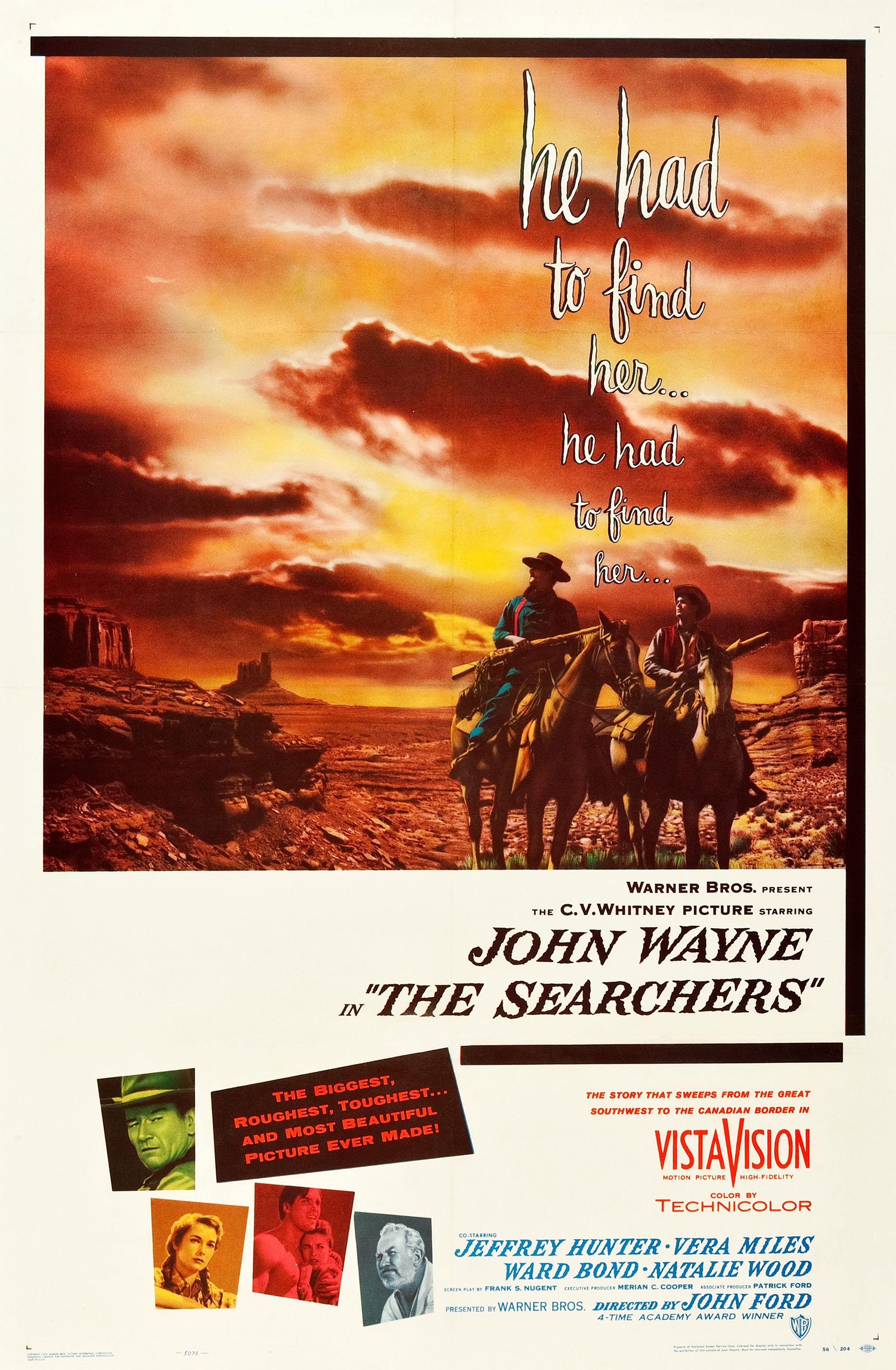
Behind the film
- Year
- 1956
- Director
- John Ford
- Writers
- Frank S. Nugent
- Runtime
- 1h 59m
- Genres
- Western, Drama, War
- Production
- Warner Bros. Entertainment
- Country
- United States
- Cast
- John Wayne, Jeffrey Hunter, Vera Miles, Ward Bond, Natalie Wood, Henry Brandon, Ken Curtis, Harry Carey Jr.
About the film
Contains story spoilers.
Ethan Edwards returns to his brother's Texas home, then joins a pursuit that leaves the family exposed to a Comanche raid. His brother, sister-in-law and nephew are killed; nieces Lucy and Debbie are taken. Ethan, Martin Pawley and Lucy's fiancé Brad search for them. Finding Lucy dead sends Brad into a fatal attack, while Ethan and Martin continue for years. They locate Debbie with Scar's band, but Ethan attempts to kill her because she has become part of the Comanche community. Martin protects her. Later, a new lead brings them to Scar's camp. Martin kills Scar and rescues Debbie; Ethan scalps Scar, then pursues the fleeing girl. Instead of killing her, he carries her home. The others enter the house while Ethan remains outside and walks away.
The search gives the Western an apparently straightforward purpose, then makes that purpose increasingly difficult to trust. Bringing a missing family member home sounds like an action whose goodness can be assumed. Ethan's character unsettles the assumption by allowing his idea of family to conflict with the life of the person he is seeking. John Wayne's commanding presence is central to that discomfort. The qualities that make him effective in a hostile environment do not necessarily make his judgment humane. The audience has to distinguish the force of a performance from the moral authority of the character performing the search. A man may be capable of surviving a difficult world while interpreting that world through convictions that endanger the people he claims to protect.
Jeffrey Hunter's character has a different relationship with belonging, one that cannot be reduced to Ethan's preferred racial categories. His presence keeps the journey from becoming a single person's account of justified vengeance. The men can share a destination without sharing a definition of success. Staying beside Ethan is not simply an expression of admiration or dependence; it can also mean keeping watch over what Ethan might do. Martin gives care a more specific shape by insisting that the person being sought remains a person, rather than a symbol of what has been taken from somebody else. The difference becomes the central measure of the search.
The years on the trail make persistence ambiguous. Continuing when others stop can appear admirable, but duration alone does not establish that an undertaking is worthwhile in the way its pursuer imagines. A long commitment can preserve loyalty or harden an obsession, and the film keeps those possibilities close together. Time also changes the life to which someone hopes to return. The world does not wait in a fixed arrangement for the searchers to complete their task. Vera Miles's Laurie gives the domestic side of that problem a voice and a set of desires beyond the men's immediate objective. Her place in the story helps make absence consequential. Endurance on the frontier is accompanied by uncertainty for people whose lives continue elsewhere, without the same freedom to organise everything around pursuit.
The landscape gives that pursuit both grandeur and isolation. Ford's framing places human intention inside spaces that do not become manageable simply because someone is determined to cross them. Monument Valley's forms supply an imposing visual world, but the expansiveness can also make the travellers seem exposed. A horizon offers possibility while refusing reassurance about what lies beyond it. That visual tension suits a story in which the clarity of the stated destination does not produce clarity of judgment. The physical world can be surveyed more easily than another person's intentions. The film's images invite attention to where a figure stands, what surrounds him and which boundaries he can cross. Those relationships make belonging visible as a question of position as well as attachment.
The racial representation requires a similarly careful distinction between the film's scrutiny of Ethan and the limits of its own perspective. His hatred is a central dramatic problem, but that does not make every other element of the portrayal of Native people free from stereotype. The fictional story gives unequal space to different lives and should not be treated as a comprehensive account of Comanche history. Scar has a place in the film's logic of retaliation, yet the searchers still occupy most of its emotional and narrative attention. A useful reading holds both things in view: the Western questions an assumption built into its hero's identity while remaining shaped by conventions that restrict how fully others can appear. Recognising that tension makes the film more understandable without simplifying its contradictions.
Debbie is the point at which those contradictions become impossible to keep abstract. Natalie Wood's character cannot be understood solely as the object that will complete an undertaking. A person's experience may change what home means, while those looking for her continue to imagine an earlier version of her life. That gives rescue a difficult relationship with possession. Caring about someone involves more than deciding where she belongs according to another person's values. The searcher's wish to restore an old arrangement can become hostile to the person who has survived its destruction. The film uses that danger to expose how easily a language of protection can carry a demand for control, particularly when difference is treated as a stain that attachment cannot accommodate.
The final doorway leaves the relationship between action and belonging unresolved in a particularly clear image. Completing the journey does not automatically make Ethan part of the life it has made possible. The distinction gives the ending its force without requiring a single explanation of what changes inside him. A humane decision can matter while leaving the history of earlier decisions intact. The Searchers asks the viewer to follow someone whose strength, damage and prejudice cannot be separated into convenient roles. Its world contains genuine care, but care must repeatedly contend with a more destructive certainty. Understanding the film involves seeing how that struggle alters the meaning of the journey, until arriving home becomes a question of who is allowed to live there and on whose terms.