
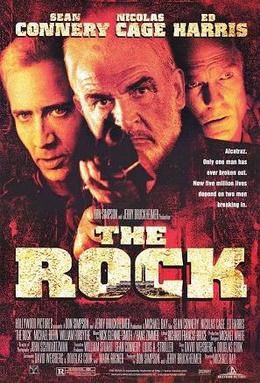
Behind the film
- Year
- 1996
- Director
- Michael Bay
- Writers
- David Weisberg, Douglas S. Cook, Mark Rosner
- Genres
- Action, Thriller, Buddy, Buddy cop
- Production
- Jerry Bruckheimer Films, Hollywood Pictures
- Country
- United States
- Cast
- Sean Connery, Nicolas Cage, Ed Harris, Michael Biehn, William Forsythe, David Morse, John Spencer, Vanessa Marcil
About the film
Contains story spoilers.
The Rock turns a prison's old purpose into a new threat. Alcatraz was designed to keep people inside; the crisis makes getting inside its decisive problem. That reversal gives the setting a useful identity beyond its recognisable outline in the bay. Walls, enclosed routes and separation from the city make movement consequential, while the people outside have to make decisions about a place they cannot freely enter. The film's action comes from that uneven access. An island can be close enough to remain visible and still be distant enough that knowledge of its interior becomes more valuable than the resources assembled around it.
Michael Bay directs the 1996 thriller, starring Nicolas Cage as Stanley Goodspeed, Sean Connery as John Mason and Ed Harris as General Hummel. The credited screenplay is by David Weisberg, Douglas S. Cook and Mark Rosner. Goodspeed's expertise and Mason's past make an unusual partnership: one understands the immediate danger, while the other understands how to move through the place containing it. Their usefulness does not depend on sharing a background or an attitude towards authority. The premise makes cooperation necessary before trust is comfortable, allowing competence to become something each has to recognise in a person he would not otherwise have chosen.
Hummel occupies Alcatraz and threatens the city, seeking compensation for neglected military families. Goodspeed joins an assault with Mason, whose previous escape makes him essential. The team is killed, leaving the pair to stop the weapons. Hummel reveals his threat was a bluff, but mutineers turn it into a genuine danger. They kill him, and Goodspeed and Mason prevent catastrophe despite an impending government strike. Goodspeed reports Mason dead so he can escape; Mason directs him to hidden evidence of state secrets. The crisis ends with survival accompanied by another decision about who should possess dangerous knowledge.
Goodspeed's position makes specialist knowledge different from the confidence expected of an action hero. Knowing what a threat can do does not immediately supply ease under gunfire or familiarity with a hostile environment. That distinction gives his participation a specific pressure. He cannot simply leave the practical work to somebody more accustomed to danger, because the practical work also needs what he knows. The film builds its partnership around this dependence rather than treating unfamiliarity as permanent uselessness. Capability can arrive through a particular discipline and still require the person carrying it to learn how that discipline operates under circumstances it was not designed to make comfortable.
Mason's relationship with the authorities makes freedom an unstable promise. Help is requested from someone whose captivity has already made official reassurance suspect. That gives negotiation an edge beyond ordinary disagreement between strong personalities. An institution can recognise a person's usefulness without accepting a responsibility towards that person, and Mason has reason to keep those possibilities separate. His cooperation therefore contains an ongoing calculation about what happens after the immediate need disappears. The crisis temporarily changes who has bargaining power, but temporary usefulness is not the same as a dependable future. Goodspeed's later decision gives their developing trust a practical consequence beyond completing the mission together.
Hummel brings a different fracture to the military confrontation. His grievance concerns people who were used and then neglected, making his demand intelligible without making his hostage-taking acceptable. The action turns on the distinction between a motive and the means employed to pursue it. A leader can believe he is enforcing recognition while building a situation that gives other participants permission to do something much worse. His loss of control exposes that gap. Command does not guarantee agreement about the purpose of force, especially when a group has been assembled through promises whose meaning changes as danger and payment become more immediate than the original grievance.
The threatened government strike adds a second source of danger to the island. A response designed to protect people outside can become fatal to people still trying to solve the problem inside. That creates suspense through competing understandings of the same situation, rather than through a single enemy's determination. Information has to travel faster than an action already being prepared, and survival depends on whether success becomes visible in time. The film gives scale a human limit here. A decision can look necessary from a distant command position while becoming disastrous at ground level because the people making it cannot see what has changed.
The ending makes loyalty an action rather than a sentiment. Goodspeed has to choose what to report once the mission no longer requires Mason's presence, and that choice tests whether their partnership has changed anything beyond their immediate chances of survival. The hidden evidence also leaves the state's claim to control information unsettled. The Rock uses its enclosed battlefield to bring several kinds of authority under pressure: scientific, military, institutional and personal. Its central partnership becomes clearest when knowledge and experience cease to be competing displays of confidence and become things two people can place at each other's disposal, with the consequences continuing after the island emergency ends.