
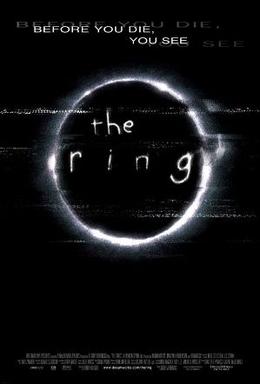
Behind the film
- Year
- 2002
- Director
- Gore Verbinski
- Writers
- Ehren Kruger
- Genres
- Horror, Psychological horror fiction, Mystery, Thriller
- Production
- DreamWorks
- Country
- United States
- Cast
- Naomi Watts, Martin Henderson, David Dorfman, Daveigh Chase, Brian Cox, Jane Alexander, Lindsay Frost, Amber Tamblyn
About the film
Contains story spoilers.
Rachel Keller investigates the death of her niece Katie and finds a videotape whose viewers die seven days after watching it. Rachel watches, receives the warning and seeks help from Noah, who also views it. Their son Aidan sees it as well. Clues lead to horse breeders Anna and Richard Morgan and their adopted daughter Samara, whose abilities tormented the household. Richard kills himself. Rachel and Noah discover Samara's confinement and trace a tree image to a well beneath their starting point. Rachel finds Samara's body and witnesses Anna throwing her into the well. Burial seems to resolve the curse, but Samara emerges from Noah's television and kills him. Rachel realises she survived by copying and sharing the tape, then helps Aidan do the same.
The investigation makes watching itself dangerous. Rachel's professional habit is to seek information, inspect evidence and connect apparently separate events. Here those useful habits involve exposure to the very thing she needs to understand. That creates a problem more specific than encountering an inexplicable threat. Knowledge can be necessary without being safe, and refusing to look would not necessarily protect the people already involved. Naomi Watts's central character gives the conflict a practical urgency. She cannot remain a distant observer once her work has entered her family life. The story therefore turns a journalistic pursuit into a struggle over what responsibility means when discovering something also changes the conditions under which discovery takes place.
The tape's images make that responsibility difficult to organise. They appear to offer clues without providing the ordinary context that would make a clue intelligible. An image can be precise and still fail to explain itself. That gap suits Gore Verbinski's world, where everyday surroundings seem to contain traces of something that has not been properly acknowledged. The visual atmosphere gives the investigation a persistent discomfort rather than relying entirely on the arrival of a monster. Rooms, screens and landscapes can feel implicated before their relationship to the story is clear. The audience is asked to look closely, but close attention does not reliably produce reassurance. It can instead make familiar things seem less complete, as if the apparent surface of the world has left out an essential fact.
Aidan changes the scale of Rachel's obligation. David Dorfman's character brings vulnerability into a situation that might otherwise remain a professional challenge, but he also has a relationship with the threat that does not fit a simple picture of an uninformed child. That prevents parenthood from becoming merely a motivation attached to the investigator. Rachel has to respond to someone whose experience she cannot wholly control or interpret for him. The distance between protecting a child and understanding what the child knows becomes part of the tension. A parent's urgency can produce action without guaranteeing that the action rests on the right explanation. The film repeatedly puts care under that pressure, requiring it to operate in circumstances where confidence is much easier to announce than to justify.
Noah provides a different way of reading the evidence. Martin Henderson's role lets technical attention share the investigation with Rachel's pursuit of people and history. A recorded image is a physical object that can be examined and reproduced, even when the force attached to it refuses a technical explanation. That combination matters to the film's treatment of media. The screen does not remain a passive surface on which something frightening is displayed. It becomes part of a relationship between looking, copying and transmitting. The familiar convenience of a recording acquires a moral difficulty because making information available can also make danger available. The film's supernatural rules are fictional, but the distinction between understanding an image and taking responsibility for its circulation gives the fantasy a recognisable shape.
Samara's story unsettles the expectation that revealing a hidden injury will automatically make its effects disappear. Daveigh Chase's figure carries both the vulnerability associated with a child and a destructive presence that resists being contained by that association. The film uses the audience's desire for a coherent explanation as part of its suspense. A tragedy may seem to offer a reason for the threat and therefore a route towards ending it. Yet explaining suffering is not identical to explaining every later action connected to it. That distinction keeps the mystery from resolving into a comforting account in which compassion supplies a complete practical answer. The story can acknowledge harm without requiring the harmful presence to respond in the way the investigator hopes.
The ending makes survival a question of consequence rather than simply a successful escape. Passing something onward changes who carries the danger, which complicates the apparent achievement of protecting one's own family. The film does not need to deliver a speech about that complication because its rule makes the problem concrete. Rachel's urgency remains understandable, while the possible cost of satisfying it extends beyond the people she knows. The Ring is strongest as a world in which private safety and wider responsibility cannot be made to coincide comfortably. Its mystery offers increasingly specific information, but specificity does not remove the ethical unease. The viewer leaves knowing more about the threat while having less confidence that knowing the truth has produced a clean way to live with it.